
Khajuraho’s Javari Temple:
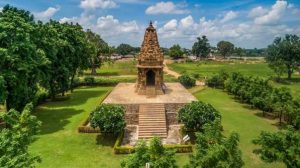
The Archaeological Survey of India (ASI) announced that the missing head of the 11th-century Vishnu idol at Khajuraho’s Javari Temple has been traced in an ASI store, ending a long-standing legal controversy that reached the Supreme Court.
- It is a compact, exquisitely sculpted Hindu temple dedicated to Lord Vishnu, forming an integral part of the Khajuraho Group of Monuments (inscribed as a UNESCO World Heritage Site in 1986).
- Located in: Situated in the Eastern Group of Temples in Khajuraho, Chhatarpur district, Madhya Pradesh.
- Built during the zenith of the Chandela dynasty between 1075 and 1100 CE.
- Local traditions trace its name either to a devout local landowner who commissioned the shrine or to a regional linguistic derivation of javara, reflecting deep agrarian connections.
Key Features of the Temple:
- Nirandhara Architectural Layout: Designed as a compact nirandhara temple (lacking an internal ambulatory circumambulatory path/pradakshinapatha), comprising four well-proportioned longitudinal units: an entrance portico (ardhamandapa), assembly hall (mandapa), vestibule (antarala), and sanctum sanctorum (garbhagriha).
- Ornate Makara-Torana: Famous for its resplendent, delicately carved makara-torana (mythical crocodilian archway) adorning the entrance portico, considered one of the finest entrance arches in Chandela temple art.
- SoaringCurvilinear Shikhara: Features a slender, soaring shikhara decorated with minor miniature spires that create a distinct silhouette above a raised stone plinth (jagati).
- Intricate Sculptural Bands: The exterior walls are carved with two to three continuous horizontal bands of sculptures depicting celestial nymphs (apsaras), divinities, composite mythological beasts (vyalas), and erotic motifs (mithunas) that reflect Chandela aesthetic traditions.
- Sanctum Lintels &Nava-Graha Reliefs: The doorway to the sanctum showcases carvings of the Trinity (Brahma, Vishnu, and Shiva) accompanied by the Nava-grahas (nine celestial planetary deities) on the upper lintel.