
Rogan Art Painting:
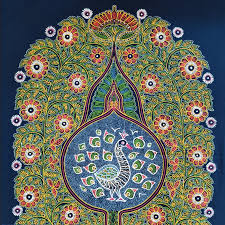
Thai Prime Minister was given a Rogan Art Painting by the Prime Minister of India.
- Rogan Art Painting has been practiced for nearly three centuries in the Nirona village of Kutch, Gujarat traditionally practised by the Khatri community.
- The word Rogan comes from Persian, meaning oil-based.
- This craft uses a thick, colourful paste prepared from castor oil and pigments to create intricate designs on fabric.
- Artists heat castor seed oil for hours, until it thickens into a rich residue, then mix it with pigments to create the vivid paint used on cloth.
- In this, artists use a metal stylus to create intricate designs by carefully guiding thread-like strands of paint onto the fabric without touching its surface.
- Traditionally, artists create one half of a motif first, and then fold the cloth so the wet paint transfers onto the other side. This creates the mirror like patterns Rogan art is famous for.
- It is traditionally practiced on silk, tussar silk, jute, wool, and cotton.
- The general features are curvilinear patterns repeated geometrically.
- The linear forms and symmetry is created by the double impression done by folding and peeling cloth, which leaves a mirror image.
- Phool (flower), Trikhani (three dots), Vesur (wavy border motif) and Jhad (trees) are the oldest found motifs.
- The contemporary motifs include circular/ concentric patterns, motifs forming architectural elements like the Jalis/screens and the tree-of-life motifs.