
Sarnath’s Path to the World Heritage List:
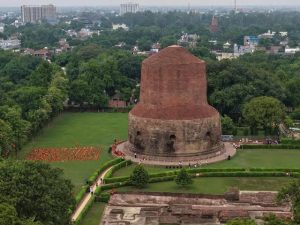
The Ancient Buddhist Site of Sarnath has been inscribed on the UNESCO World Heritage List during the 48th Session of the World Heritage Committee held in Busan, South Korea.With this recognition, India’s UNESCO World Heritage properties have increased to 45, making India the 6th largest country globally in terms of World Heritage properties and 2nd in the Asia-Pacific region.
- Sarnath, located in Varanasi, Uttar Pradesh, is one of the four major Buddhist pilgrimage sites. It is associated with Gautama Buddha’s first sermon after attaining enlightenment.
- The UNESCO World Heritage inscription includes two components — Chaukhandi Stupa and the Archaeological Remains of Sarnath. The archaeological complex contains important structures such as the Dhamek Stupa, Dharmarajika Stupa, Mulagandhakuti Vihara, and Ashokan Pillar.
- Known as Rishipatana, Ishipatana, and Mrigadava in Buddhist texts, Sarnath is the place where Buddha delivered the Dharmachakra Pravartana (Turning of the Wheel of the Law) sermon in the 6th century BCE, leading to the establishment of the Buddhist Sangha and teachings of the Noble Eightfold Path.
- The site reflects nearly 16 centuries of continuous development, with monuments ranging from the Pre-Mauryan period (4th–3rd century BCE) to the 12th century CE.
- It developed through the patronage of rulers, monasteries, and devotees before declining and later being rediscovered in the 18th century.
- Sarnath was included in India’s Tentative List of UNESCO World Heritage Sites in 1998. The nomination proposal was submitted to UNESCO in January 2025, followed by technical evaluation and review by UNESCO advisory bodies.
- UNESCO Criteria for Inscription: Sarnath was inscribed under Criteria (iii) and (vi) of the UNESCO World Heritage List:
- Criterion (iii): Recognises its enduring spiritual importance as one of the four principal Buddhist pilgrimage sites.
- Criterion (vi): Recognises its direct association with significant events in Buddha’s life, including his first sermon and meeting with his first five disciples.
- Sarnath remains a major global pilgrimage destination for Buddhists from countries such as Japan, Thailand, Sri Lanka, Myanmar, Vietnam, South Korea, Cambodia, and Mongolia, strengthening India’s cultural diplomacy.
- With Sarnath’s inclusion, three of the four major Buddhist pilgrimage sites associated with Buddha are now on the UNESCO World Heritage List:
- Lumbini (Nepal) – Birthplace of Buddha
- Mahabodhi Temple, Bodh Gaya (Bihar) – Place of Enlightenment
- Sarnath (Uttar Pradesh) – Place of First Sermon