
Solar Radio Burst:
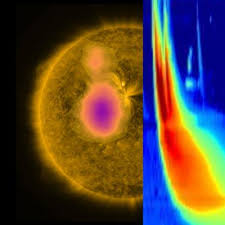
Researchers from the Indian Institute of Astrophysics (IIA) have made a significant breakthrough in understanding a long-standing solar mystery regarding solar radio burst.
- Solar Radio Burst is defined as an intense solar radio emission associated with solar flares.
- These are observed in radio wavelengths most frequently during solar transients, such as coronal mass ejections (CMEs) and flares.
- SRBs are direct signatures of accelerated electrons in the solar atmosphere.
- These are observed across a wide range of wavelengths, from millimetres to kilometres, corresponding to frequencies from the GHz to the kHz range.
- Observations at short wavelengths correspond to distances close to the solar surface, while those at long wavelengths correspond to the large distances from the Sun.
- Types: Considering the morphological characteristics, five main categories of solar radio bursts can be distinguished: Type I, Type II, Type III, Type IV, and Type V.
- These solar transients have a direct impact on the near-Earth atmosphere.
- It can interfere with Global Navigation Satellite System (GNSS) signals by reducing signal-to-noise ratio and causing loss of lock.



