
Solar Storm : In News
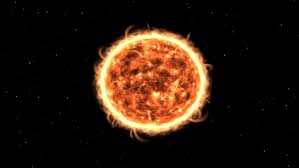
India’s first solar observatory Aditya-L1 played a key role in helping scientists decode why the strongest solar storm in more than two decades that struck Earth in May 2024 behaved so unusually, ISRO said recently.
- A solar storm is a sudden explosion of particles, energy, magnetic fields, and material blasted into the solar system by the Sun.
- The Sun creates a tangled mess of magnetic fields.
- These magnetic fields get twisted up as the Sun rotates — with its equator rotating faster than its poles.
- Solar storms typically begin when these twisted magnetic fields on the Sun get contorted and stretched so much that they snap and reconnect (in a process called magnetic reconnection), releasing large amounts of energy.
- These powerful eruptions can generate any or all of the following:
- a bright flash of light called a solar flare.
- a radiation storm, or flurry of solar particles propelled into space at high speeds.
- an enormous cloud of solar material, called a coronal mass ejection, that billows away from the Sun.
- When directed toward Earth, a solar storm can create a major disturbance in Earth’s magnetic field, called a geomagnetic storm, that can produce effects such as radio blackouts, power outages, and beautiful auroras.
- They do not cause direct harm to anyone on Earth, however, as our planet’s magnetic field and atmosphere protect us from the worst of these storms.
Solar Flares:
- A solar flare is an intense burst of radiation, or light, on the Sun.
- These flashes span the electromagnetic spectrum — including X-rays, gamma rays, radio waves, and ultraviolet and visible light.
- Solar flares are the most powerful explosions in the solar system — the biggest ones can have as much energy as a billion hydrogen bombs.
- Solar eruptions can accelerate charged particles electrons and protons into space at incredibly high speeds, initiating a radiation storm.



