
The ‘Enemy State’ Clauses in the UN Charter:
Japan’s Prime Minister at the United Nations General Assembly (UNGA) urged the UN to eliminate the “enemy state” clauses from the UN Charter.
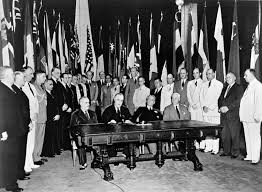
- The UN Charter was drafted towards the end of World War II (WWII) and came into force in October 1945.
- The victorious Allied Powers (including the US, UK, Soviet Union, and China) inserted mechanisms to prevent the resurgence of militarism or fascism in the defeated Axis Powers (mainly Japan, Germany, Italy, and their allies).
- The enemy state clauses are an exception to the post-1945 principle under Article 2(4) of the UN Charter, which generally prohibits the threat or use of force against states.
- The term “enemy state” is explicitly mentioned in three articles of the UN Charter: Articles 53, 77, and 107.
- Article 53: Allows regional arrangements or agencies to take enforcement action against an “enemy state” without the prior authorization of the UN Security Council (UNSC).
- Article 53(2) defines an enemy state as any nation that was an enemy of a signatory of the UN Charter during WWII.
- Article 77: Pertains to the UN “trusteeship system” and mentions territories detached from “enemy states” as a result of WWII.
- Article 107: Validates and protects actions taken by Allied governments against the Axis powers during and immediately after the war.
- Japan joined the United Nations in 1956, after post-war reconstruction and reconciliation with the international community.
- Japan argues these clauses no longer reflect modern geopolitical realities. The UNGA previously recognized these clauses as “obsolete” in 1995 and adopted a resolution supporting their deletion in 2005.
- The outdated clauses are currently being invoked by China and Russia as diplomatic leverage to criticize Japan’s increased defense spending and to invalidate Japan’s territorial claims over the southern Kuril Islands.
- Amendment requires adoption by a two-thirds majority of the UN General Assembly, and ratification by two-thirds of UN member states, including all permanent members of the Security Council who hold veto power.
- They hesitate to open the Charter for revision, fearing it could trigger broader demands for UNSC structural reforms and membership expansion, which Japan strongly advocates.
- Japan’s concerns over outdated UN Charter provisions reinforce India’s long-standing call for UN reform that reflects 21st-century geopolitical realities.
- As a G4 member with Japan, Germany and Brazil, India supports a more representative, legitimate and effective multilateral system.



