
The Sample Registration System (SRS) Statistical Report 2024:
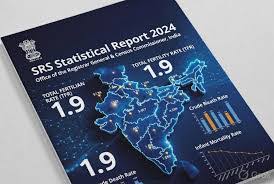
The Office of the Registrar General & Census Commissioner under the Ministry of Home Affairs released the Sample Registration System (SRS) Statistical Report 2024.
The Sample Registration System (SRS) Statistical Report 2024:
- The Sample Registration System (SRS) is a large-scale, continuous, panel household demographic survey.
- It serves as India’s primary macro-source for reliable annual estimates of fertility, birth, and mortality indicators at both sub-national and national levels.
- Published By Office of the Registrar General & Census Commissioner, India, Ministry of Home Affairs, Government of India.
- The 2024 report is drawn from the Census 2011 sampling frame, utilizing a massive representative sample covering approximately 8.9 million individuals across 8,839 sample units.
Key Findings of the 2024 Report:
- Total Fertility Rate (TFR) Collapse: India’s national TFR has officially dropped to 1.9, falling firmly below the traditional societal replacement level of 2.1.
- Crude Birth Rate (CBR) Slide: The national CBR exhibited a steady contraction, sliding down from 21.0 in 2014 to 18.3 in 2024.
- Crude Death Rate (CDR) Stabilization: The national death rate experienced a marginal drop, settling at 6.4 in 2024.
- Infant Mortality Rate (IMR) Improvement: The IMR dropped to 24 deaths per 1,000 live births at the national level, down from 30 in 2019.
- Under-Five Mortality Rate (U5MR) De-escalation: The U5MR declined to 28 deaths per 1,000 live births, down from 29 in the preceding year.
- Shifting Age Demographics: The share of young population aged 0–14 years fell to 24.0%, while the economically active working-age bracket (15–59 years) expanded significantly to 66.4%. Concurrently, the elderly bracket (60+ years) reached 9.7%.
- Delayed Effective Age at Marriage: The mean age at effective marriage for Indian females rose to 23.1 years (22.6 in rural sectors versus 24.4 in urban blocks).
- Sex Ratio at Birth (SRB) Recovery: The national SRB registered a marginal tick upward, reaching 918 females per 1,000 males for the 2022–24 three-year average.
- Widespread Institutional Delivery Access: In 2024, approximately 95.4% of live births were institutional, with mothers receiving care at government or private hospitals.



