
Today’s Current Affairs: 10th Aug 2026 for UPSC IAS exams, State PSC exams, SSC CGL, State SSC, RRB, Railways, Banking Exam & IBPS, etc
Table of Contents
Explosive Ordnance Disposal Exercise:

The Indian Navy–US Navy Explosive Ordnance Disposal (EOD) Exercise 2026 is scheduled to be conducted at Southern Naval Command, Kochi till the 14th of this month.
- It is a bilateral exercise conducted between the Indian Navy and US Navy.
- It aims to enhance interoperability and strengthen professional cooperation between the specialist diving and EOD teams of the two navies.
- It has been conducted by both the countries since 2005.
- The forthcoming engagement marks the eighth edition of this specialised bilateral training exercise.
- It will comprise Subject Matter Expert Exchanges (SMEEs), cross-training, equipment demonstrations and scenario-based practical exercises.
- The programme will facilitate the exchange of contemporary EOD methodologies, emerging technologies and Best Practices.
- It is designed to promote collaborative learning and operational synergy, enabling personnel from both navies to refine procedures, enhance mutual understanding and strengthen their ability to respond effectively to complex and evolving EOD challenges.
- It underscores the enduring commitment of the two navies towards enhancing interoperability, sharing operational expertise and strengthening cooperation in specialised maritime operations.
Eco-Educational Hub:
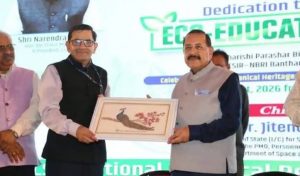
The Union Minister of State for Science and Technology dedicated first-of-its-kind eco-educational hub ‘Prakriti Gyan Dham’.
- It is developed by the CSIR-National Botanical Research Institute (CSIR-NBRI).
- It provides a direct interface between scientific knowledge and public engagement, by making it accessible through experiential and interactive learning.
- Features of the Eco-Educational Hub:
- PAaVan Path (Plants and Associated Vegetations for Appreciating Nature): It is an interpretive heritage trail. The trail takes visitors through curated plant collections representing diverse ecological regions and associated vegetation.
- Vibhav Enclave: It is a Threatened Plants of India Garden provides a dedicated space for rare, endangered and threatened plant species. It promotes awareness about biodiversity loss, habitat degradation, climate change and the need to conserve plant genetic resources.
- Bhairav Enclave: State Plants of India Garden brings together officially designated State Plants of States and Union Territories, presenting their ecological, cultural and symbolic significance.
Dirac Medal:

Deepak Dhar, a theoretical physicist from Uttar Pradesh has been named the co-recipient of Dirac Medal.
- Dirac Medal was first awarded in 1985.
- It is given in honor of P.A.M. Dirac, one of the greatest physicists of the 20th century.
- It is awarded annually on Dirac’s birthday, August 8, to scientists who have made significant contributions to theoretical physics.
- It is awarded by the International Centre for Theoretical Physics (ICTP).
- An international committee of distinguished scientists selects the winners from a list of nominated candidates.
- The Dirac Medal is not awarded to Nobel Laureates, Fields Medallists, or Wolf Foundation Prize winners, although several past Dirac medallists later went on to receive those honours.
- Cash Prize: The Medalist also receives a prize of US $5,000.
- Deepak Dhar is also the second Indian winner of the Dirac Medal; the first was string theorist Ashoke Sen.
- Dhar is known for his work on a concept called Abelian sandpiles.
International Centre for Theoretical Physics:
- It is an international research institute for physical and mathematical sciences.
- The centre was founded in 1964.
- It operates under a tripartite agreement between the Italian Government, United Nations Educational, Scientific and Cultural Organization (UNESCO), and International Atomic Energy Agency (IAEA).
- ICTP is a UNESCO Category 1 Institute.
- It is located in Trieste, Italy.
Export Promotion Capital Goods Scheme:

The Directorate General of Foreign Trade (DGFT) has removed the requirement of submitting physical duty payment challans while applying for Export Obligation Discharge Certificates (EODC) under the Advance Authorisation and Export Promotion Capital Goods (EPCG) Schemes.
- It is a trade promotion scheme implemented by the government of India.
- It allows the duty-free import of capital goods for the purpose of export production in India.
- Objective is to facilitate import of capital goods for producing quality goods and services and enhance India’s manufacturing competitiveness.
- The EPCG scheme is administered by the Directorate General of Foreign Trade (DGFT) and is governed by the Foreign Trade Policy of India.
- EPCG Scheme allows import of capital goods for pre-production, production and post-production at zero customs duty.
- It covers manufacturer exporters with or without supporting manufacturer(s), merchant exporters tied to supporting manufacturer(s) and service providers.
- Second-hand goods of any nature will not be permitted under the EPCG scheme.
What is Phulkari?
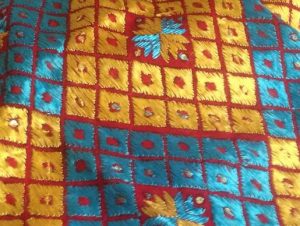
Several years after Punjab’s traditional embroidery, Phulkari, secured the coveted Geographical Indication (GI) tag, the craftspersons who keep the centuries-old practice alive continue to struggle for recognition and a sustainable livelihood.
- Phulkari, meaning “flower work,” is a traditional embroidery art of Punjab.
- There are various theories about the origin of phulkari.
- Some believe this embroidery dates back to the 7th century CE, while others suggest it originated from Iran, where it was known as Gulkari.
- However, distinct styles of phulkari have been identified, making it uniquely Punjabi.
- References to phulkari can be found in ancient texts, folk legends, and literature, with the earliest mention in the 18th-century Punjabi literature.
- It received a Geographical Indication (GI) tag in 2010.
- It’s an amalgam of cotton and silk.
- The cloth used is usually hand-woven thick cotton, called ‘ khadder’. While the threads are thin, lustrous, and breakable silk, called ‘pat’.
- The cloth is usually dyed red, but can be white, grey, or black
- And the treads are a myriad of colors, ranging from the rich dark pink to soothing off-whites.
- The stitch is intricate, small, and completely fills the cloth. The stitch can be vertical, horizontal, or diagonal to create the shadow effect.
- Phulkari embroidery makes use of the least complicated patterns to create extremely intriguing designs.
- The designs and patterns can vary from geometrical figures to flowers to local fauna. Peacocks, elephants, birds, and camels appear frequently.
- Phulkari’s product range includes embroidered chaddars, dupattas, and stoles, traditionally worn by brides or for ceremonies.
Lake Mead:

Lake Mead, the largest reservoir in the United States, has plummeted to its lowest water level since it was filled some 90 years ago, another sign of the crisis plaguing the Colorado River system.
- Lake Mead is one of the largest man-made lakes in the world, located on the border between Southern Nevada and northwestern Arizona in the United States.
- It was formed in the mid-1930s by the damming of the Colorado River through the construction of the Hoover Dam.
- It is the largest reservoir in the U.S. when it’s full of water.
- When Lake Mead is completely full, it stretches 180 km long. It can be 162 m deep at its deepest point.
- Most of the water is drawn from Rocky Mountain snowmelt and runoff.
- It supplies drinking water for about 25 million people.
- It is home to many species of mammals, including desert bighorn sheep, mountain lions, beavers, coyotes, and bats.
- Since 1999, periods of extended drought paired with increased water demands driven by population growth have caused a drastic drop in lake levels.
- Colorado River is a major river of North America.
- It rises in the Rocky Mountains of Colorado, United States.
- The river drains a vast arid and semiarid sector of the North American continent.
- It is often referred to as the “Lifeline of the Southwest.
- It forms several major reservoirs, including Lake Mead and Lake Powell.
- Colorado forms an international boundary between Arizona (US) and Mexico.
- The Colorado River has several tributaries, including Green, Gunnison, San Juan, Dolores, Little Colorado, Gila, and Virgin Rivers.
- One of the Colorado River’s most famous features is the Grand Canyon, which it carved over millions of years.
- Grand Canyon landscape is a UNESCO World Heritage Site and a major tourist attraction.
- The river also flows through Canyonlands National Park and Horseshoe Bend in Arizona.
Over 200 mithuns have died in a foot-and-mouth disease:
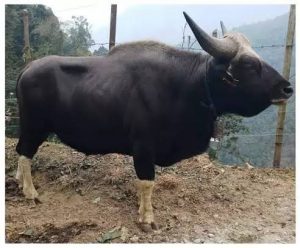
Over 200 mithuns have died in a foot-and-mouth disease (FMD) outbreak in Dibang Valley district of Arunachal Pradesh in the last one month.
- The Mithun, or gayal, is a heavily built, semi-domesticated bovine species.
- Scientific Name: Bos frontalis
- Mithun is believed to have originated more than 8000 years ago and is considered to be a descendent of wild Indian gaur, or bison.
- It is also known as the ‘cattle of the mountain’.
- The highest concentration of mithuns in the world is spread over the North Eastern (NE) region of India, with Arunachal Pradesh having the highest population.
- It is also found in China and parts of Southeast Asia,, Bangladesh, Myanmar, and Bhutan.
- The geographic zone is covered with tropical evergreen rain forests.
- It is the state animal of Arunachal Pradesh and Nagaland.
- The ‘Soulung’ festival is observed annually by the Adi tribes of Arunachal Pradesh to commemorate the birth and arrival of Mithun on this earth.
- It appears somewhat similar to that of Gaur but are distinctly smaller in size.
- The characteristic feature lies in the head, which has a well-developed, broad frontal bone with a flat-shaped face.
- From the front view, it appears like an inverted triangle from where two horns emerge from the lateral sides.
- Horn colour varies from whitish yellow to salty black in most animals.
- The skin color of the head and body is blackish-brown in both sexes, and the forehead is creamy white or yellowish in color.
- The other distinguishing features are a small and double dewlap and white stockings.
- They move in small groups with one or two males and several females and calves.
- Conservation Status:
- IUCN Red List: Vulnerable
- Foot and Mouth Disease (FMD):
- It is a severe, highly contagious viral disease that affects all cloven-hoofed animals, including cattle, sheep, goats, camelids, deer, and pigs.
- Cloven-hoofed animals are those with divided hooves. It does not affect horses or zebras.
- Cause: It is caused by an Aphthovirus of the family Picornaviridae.
- It is a transboundary animal disease (TAD) that deeply affects the production of livestock and disrupts regional and international trade in animals and animal products.
- Intensively reared animals are more susceptible to the disease than traditional breeds.
- FMD is a disease of animals, not humans, and is a different disease than hand, foot, and mouth disease which is common in young children.
- FMD is not transmitted to humans by eating affected meat.
- The virus is transmitted through direct contact between healthy and infected animals.
- Indirect contact with contaminated objects (fomites) such as vehicles, clothing, footwear, and bedding can also spread FMDV.
- Additionally, consuming contaminated feed or milk can transmit the virus as well as through respiratory aerosols.
- Vaccination is the only effective preventive measure against FMD.
Cessna C172:

A Cessna C172 trainer aircraft with two people onboard suffered damage after veering off the runway at the Baramati airfield, Maharashtra, recently.
- The Cessna C172, commonly known as the Cessna 172 Skyhawk, is a four-seat, single-engine aircraft.
- It is manufactured by Cessna, an American manufacturer of general aviation aircraft (now part of Textron Aviation).
- It is used primarily for training and/or private aviation and is still in production today.
- More than 50% of the world’s pilots started their training in the Cessna 172, and it remains a popular aircraft for flight training and personal use.
- This fixed-wing aircraft features a high-wing design, offering great visibility to beginner pilots.
- It also has a reputation for stability, forgiving handling, and simple controls.
- The design prioritizes stability over speed (with a maximum cruise speed of 124 knots), allowing students to focus more on maneuvers, takeoffs, landings, safety, and control before speed.
- Maximum Range: 640 nm.
Russula griseopurpurata:

A mushroom collected beneath a sal tree in Meghalaya’s Ri-Bhoi district in 2022 has been identified as a new species to science, named Russula griseopurpurata.
- Russula griseopurpurata is a new species of mushroom.
- The species has so far been recorded from Meghalaya and West Bengal.
- They were found singly or in scattered groups beneath sal trees.
- It has a greyish-purple cap that develops cracks as it matures.
- Its gills show characteristic forkings near the stalk.
- It belongs to the large and diverse Russula genus.
- Although some Russula species are edible, the researchers have not established R. griseopurpurata as edible.
- Its reported mild taste and odour do not constitute a food-safety assessment.



