
Today’s Current Affairs: 13th Nov 2026 for UPSC IAS exams, State PSC exams, SSC CGL, State SSC, RRB, Railways, Banking Exam & IBPS, etc
Table of Contents
Indian National Science Academy:

The Indian National Science Academy (INSA) participated in the S20 2026 process and endorsed the Joint S20 Statement released by the science academies of the G20 countries.
- Indian National Science Academy was established in January 1935 to promote science in India and harness scientific knowledge for the cause of humanity and national welfare.
- It was earlier known as the National Institute of Sciences of India (NISI)
- It was inaugurated on 7 January 1935 at Calcutta and functioned with its headquarters at the Asiatic Society of Bengal till 1951 and thereafter shifted to Delhi.
- Objectives:
- Promotion of scientific knowledge in India, including its practical application to problems of national welfare.
- Coordination among Scientific Academies, Societies, Institutions, Government Scientific Departments, and Services.
- To publish such proceedings, journals, memoirs, and other publications as may be found desirable.
- To promote and maintain liaison between Science and Humanities.
- To secure and manage funds and endowments for the promotion of science.
- The academy also serves as a forum for interactions among scientists within and outside the country and recognizes outstanding young scientists, engineers, and technologists through the award of medals/prizes and by providing modest financial support for pursuing research.
- Senior scientists are honoured through election to its Fellowship.
- The Academy has established exchange programmes with different overseas academies to facilitate visits of Indian scientists to research institutions abroad and of foreign scientists to India for lectures/scientific discussions.
- It was designated as the adhering organization in India to the International Council for Science (ICSU) on behalf of the Government of India in January 1968.
Mawmluh Cave:
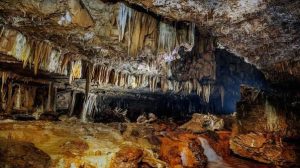
Climate change and mining are threatening Mawmluh Cave’s fragile cave systems, altering rainfall and groundwater patterns while destroying geological formations and underground ecosystems.
- Mawmluh Cave is located at Sohra in the East Khasi Hills district of Meghalaya.
- It is locally known as Krem Mawmluh.
- It was the first cave that was explored by a British official Lieutenant Yule in 1844.
- It is one of the longest and deepest caves in India and holds evidence of the events in the geological history of Earth.
- At 7.2 km in length, it is the fourth longest cave in the Indian subcontinent.
- The cave is part of the Meghalayan Age, the latest age in Earth’s official geological timeline, which began around 4,200 years ago and continues today.
- It is known for its stalagmite structures and other rock formations.
- It contains numerous stalactites, stalagmites, columns and drapes, collectively termed speleothems.
- In 2022, it was recognised among the First 100 Geological Heritage Sites by the International Union of Geological Sciences (IUGS).
Swachh Shehar Jodi initiative:
President of India honoured India’s cleanest cities at the Swachh Survekshan Awards 2025–26 and appreciated the Swachh Shehar Jodi initiative.
- Swachh Shehar Jodi initiative aims to institutionalise structured mentorship, peer learning, and collaborative action between mentor cities and mentee cities from within the same State.
- It is implemented under the Swachh Bharat Mission – Urban (SBM-U).
- Nodal Ministry: Ministry of Housing and Urban Affairs (MoHUA)
- The objective is to support comparitively low performing cities in improving their swachhata performance by drawing on the experience of mentor cities to:
- Replicate tested best practices in sanitation and waste management
- Strengthen processes in mentee cities
- Support the waste processing set-up to improve visible cleanliness
- Improve citizen engagement for responsible behaviour change for swachhata
- Key features
- Under this, each mentor city and mentee city pair will jointly develop an Action Plan.
- Eight thematic Focus Areas:
- Visible cleanliness; waste segregation and transportation; scientific processing of waste; access to sanitation; used water management; mechanised desludging and worker welfare; Swachhata advocacy and citizen engagement; and citizen feedback and grievance redressal.
- Funding: Both mentor and mentee cities may utilize the Capacity Building (CB) Funds allocated to each State/UT as part of SBM-U 2.0. State/UT Governments are encouraged to top up this fund, if required.
- Under this initiative, 70 mentor cities have been paired with 191 mentee cities to facilitate knowledge-sharing and improve sanitation outcomes.
- Recognition in Swachh Survekshan 2025–26: The top three city pairs were Ahmedabad-Sanand, Indore-Depalpur and Tirupati-Kuppam.
Impact Assessment of PLI Schemes:
NITI Aayog, with IIM Ahmedabad as its knowledge partner, has published a mid-course report titled “Impact Assessment of PLI Schemes”. It evaluates all 14 Production Linked Incentive (PLI) schemes on four outcomes: investment, production, employment and exports.
- PLI schemes have strengthened India’s manufacturing ecosystem, mobilising ₹2.40 lakh crore in investments, generating ₹22.66 lakh crore in production and creating 8.49 lakh jobs across 14 sectors as of March 2026.
- Key challenges include low employment generation, limited domestic value addition and uneven sectoral performance. Strengthening demand, local supply chains and Centre-State coordination is essential for achieving Viksit Bharat @2047.
Key Highlights of the “Impact Assessment of PLI Schemes”:
- The report utilizes a 50% threshold of full-tenure targets as a mid-course benchmark to evaluate the schemes.
- Cumulative investment reached Rs 2.40 lakh crore, achieving 76% of the full-tenure target of Rs 3.15 lakh crore.
- Cumulative production/sales stood at Rs 22.66 lakh crore, achieving 64% of the full-tenure target of Rs 35.37 lakh crore.
- Cumulative employment reached 8.49 lakh jobs, representing 28% of the full-tenure target of 30.19 lakh jobs.
- The 14 PLI schemes have completed 58% of their aggregate implementation period, with 42% of the implementation period still remaining.
- Cumulative disbursement stood at Rs 35,354 crore as of March 2026, accounting for 18.51% of the total financial outlay of Rs 1.91 lakh crore.
- Incentives are released based on the fulfilment of prescribed investment and production conditions, rather than upfront.
- Employment generation may take longer because manufacturing investments are followed by capacity commissioning, production ramp-up and expansion of commercial operations.
- Sector-Wise Performance of PLI Scheme
- Nearly 70% of targeted PLI segments are broadly on track, with particularly strong outcomes in electronics, telecom and pharmaceuticals, although performance varies across sectors.
- Large Scale Electronics Manufacturing (LSEM) PLI scheme has emerged as one of the most efficient schemes in terms of resource utilisation and output generation, with mobile exports rising nearly nine-fold to Rs 2 lakh crore in FY2025 and imports declining by 77%.
- It has strengthened domestic manufacturing and paved the way for the Electronics Component Manufacturing Scheme and the Mobile Phone Manufacturing Scheme to deepen domestic value addition.
Pharmaceutical:- Bulk Drugs: The PLI Scheme for Bulk Drugs has strengthened domestic API manufacturing and reduced import dependence, helping India transition from a Rs 1,930 crore trade deficit (FY2021–22) to a Rs 2,280 crore surplus (FY2024–25).
- It has created 55,000 MT manufacturing capacity across 26 critical APIs.
- Chemical synthesis-based products remain the strongest performers. The scheme has also boosted investment, exports, employment and pharmaceutical self-reliance.
- Manufacturing of Medical Devices: The PLI Scheme for Medical Devices has boosted domestic manufacturing of high-value medical equipment, including MRI machines, CT scanners, LINACs, cardiac implants and dialysers, reducing import dependence.
- Pharmaceutical PLI Scheme: The PLI Scheme for Pharmaceuticals (Rs 15,000 crore outlay) has attracted over Rs 45,000 crore in investments through 55 approved applicants and enabled domestic manufacturing of 191 pharmaceutical products for the first time. Pharmaceutical exports increased 32.7%, from USD 19.46 billion (2021) to USD 25.82 billion (2025).
- Large firms contributed 61% of total production, while MSMEs and mid-sized firms recorded moderate growth.
- PLI Scheme for IT Hardware 2.0: It aims to expand India’s electronics manufacturing beyond mobile phones.
- The earlier IT Hardware 1.0 underperformed due to low incentives (1–4%, averaging 2%) and stringent localisation requirements. The revised scheme offers approximately 5% average incentives.
- Telecom & Networking Products: The Telecom PLI Scheme has strengthened domestic 4G/5G equipment manufacturing, with telecom exports growing at 1.5% AAGR and imports declining by 18.5% average annual growth rate (AAGR) (FY21–FY25).
- It provides an additional 1% incentive for design-led manufacturing.
- Automobile and Auto Components: The PLI Scheme for Automobiles and Auto Components is accelerating India’s transition towards electric mobility and advanced automotive technologies.
- Vehicle exports increased 33.2%, from USD 18.9 billion (2021) to USD 25.16 billion (2025).
- The scheme mandates 50% Domestic Value Addition (DVA) and follows an open-to-all approach.
- Advanced Chemistry Cell (ACC) Battery: The PLI Scheme for ACC Batteries aims to build domestic battery manufacturing capacity for electric mobility and energy storage.
- However, progress is severely delayed due to stringent localisation norms, long gestation period, technology gaps and dependence on critical minerals.
- Drones & Drone Components: The Drone PLI Scheme has boosted domestic drone manufacturing, with sector turnover increasing seven-fold. It has disbursed 77.5% of its outlay, strengthening India’s indigenous drone manufacturing and component ecosystem.
- Textile Products:
- The PLI Scheme for Technical Textiles has boosted high-value manufacturing, with imports declining by 49.4% and exports increasing by 59% (2021–2025).
However, fund utilisation remains low at 3.61%, partly due to high eligibility thresholds and rigid HSN codes. - White Goods: The PLI Scheme for White Goods has boosted domestic manufacturing and localisation of AC and LED components.
Compressor manufacturing capacity increased ten-fold, from 1 million units (2021) to 10 million units (2025–26), while investments across 18 states strengthened the domestic supplier ecosystem. However, low incentive disbursement remains a concern.
- The PLI Scheme for Technical Textiles has boosted high-value manufacturing, with imports declining by 49.4% and exports increasing by 59% (2021–2025).
- High Efficiency Solar PV Modules: The PLI Scheme for High-Efficiency Solar PV Modules has accelerated India’s solar manufacturing, with 21% of domestic capacity creation directly attributable to the scheme and declining module imports.
- It has promoted integrated manufacturing across polysilicon, wafers, cells and modules.
However, technology gaps, volatile global prices and dependence on concentrated international supply chains remain key challenges.
- It has promoted integrated manufacturing across polysilicon, wafers, cells and modules.
- Food Products: The PLI Scheme for Food Processing has boosted sectoral growth, with sales rising to Rs 1.09 lakh crore in FY2025–26, generating 3.29 lakh jobs and creating 35 lakh MT annual processing capacity.
- It has strengthened agricultural value chains and supply chains. However, weak global branding support and limited evidence of creating globally competitive firms remain concerns.
- Speciality Steel: The PLI Scheme for Specialty Steel aims to boost domestic production of high-value steel for automobiles, defence, energy and infrastructure.
- It covers 67 applicants across 21 sub-categories, with production showing an upward trend. However, frequent policy revisions, implementation delays and production below expectations remain key concerns.
Three beaches in Maharashtra Received Blue Flag Certification:

Three beaches in Maharashtra—Ladghar and Guhagar in Ratnagiri district and Shrivardhan in Raigad district—have received international Blue Flag certification for 2026–27, marking the state’s first entry into the globally recognised eco-label programme.
- India has 22 Blue Flag-certified beaches for 2026–27, including 13 renewed certifications and nine newly certified beaches, of which three are in Maharashtra.
- The beaches met prescribed international standards for water quality, environmental management, biodiversity conservation, cleanliness, tourist safety and sustainable tourism.
- Blue Flag Certification is an internationally recognised voluntary eco-label awarded to beaches, marinas and sustainable tourism boats that meet prescribed environmental, educational, safety and management standards.
- Administered by the Foundation for Environmental Education (FEE), an international non-profit organisation headquartered in Copenhagen, Denmark.
- Certification is awarded following evaluation through the Blue Flag programme’s assessment process, including review by the International Blue Flag Jury.
- Blue Flag beach certification traditionally covers four major categories:
- Environmental Education and Information: Public awareness, environmental information and educational activities.
- Water Quality: Compliance with prescribed bathing-water quality standards.
- Environmental Management: Waste management, sanitation and protection of coastal ecosystems.
- Safety and Services: Lifeguards, emergency preparedness, accessibility and visitor facilities.
- Certification applies to a specified season, and participating sites must maintain compliance with applicable standards throughout the award period.
- The Beach Environment & Aesthetics Management Services (BEAMS) programme, under the Integrated Coastal Zone Management (ICZM) framework of the Ministry of Environment, Forest and Climate Change (MoEFCC), promotes beach cleanliness, coastal conservation, visitor safety and sustainable beach management, supporting Blue Flag certification.
5 New Marine Nematode Species in Kerala:

Researchers from the University of Kerala have discovered five new species of free-living marine nematodes from the mangrove sediments along the Kerala coast.
- This discovery represents the first confirmed record of the nematode genus Pseudochromadora from the Arabian Sea.
- The five species new to science (Pseudochromadora coronate, P. cryptica, P. kairali, P. kandeli, and P. longicaudata) were collected from the mangrove forests of Kollam and Kannur.
- These marine nematodes are free-living (non-parasitic) microscopic roundworms.
- Despite their minuscule size, they are vital for organic matter decomposition and nutrient cycling in marine and estuarine habitats.
- The study significantly reduces the knowledge gap regarding the highly diverse but poorly documented meiofaunal communities (minute animals living in soil and aquatic sediments) of the Indian Ocean.
- The findings emphasize that mangrove conservation must safeguard the entire biological community, including microscopic species that are foundational to sustaining essential ecosystem processes.
The Kulgam Terror Attack:

Three Central Reserve Police Force (CRPF) personnel from the 46 Battalion were injured when motorcycle-borne terrorists opened close-range fire at a security checkpoint in Kulgam district of Jammu and Kashmir.
- The Kulgam Terror Attack is a coordinated, hit-and-run terror ambush targeting a stationary paramilitary checkpost in south Kashmir, executed on the same day the Lieutenant-Governor visited the district to inaugurate a cultural festival.
- Motorcycle-borne militants fired roughly 30 rounds in 15 seconds at close range before fleeing, captured on local CCTV surveillance.
- Constables Rakesh Dass and Santosh Chandru, along with Head Constable Somveer Singh, sustained bullet injuries; the critically wounded jawan was airlifted to Badamibagh Army Hospital in Srinagar.
- Reinforcements, armored vehicles, and cordon-and-search operations were immediately launched across south Kashmir to seal exit routes.
The Sairang Express Accident:

The locomotive and five passenger carriages of the Mizoram-bound Kolkata-Sairang Express derailed near Digaru station in Assam’s Kamrup district.
- The Sairang Express Accident railway derailment involving a passenger express train operated under the Northeast Frontier Railway (NFR) zone during a routine loop-line reception maneuver.
Key Incident Details:
- Occurred around 6:54 a.m. at Digaru Railway Station in Kamrup district, Assam, while holding the train to allow a higher-priority train to pass.
- NFR officials stated that the loco pilot lost control of the train’s speed during reception, though unverified online accounts also alleged an emergency brake failure.
- Official statements reported zero fatalities and confirmed all passengers were safe, though local accounts noted a few minor-to-moderate injuries during evacuation and recovery.
The Climate Change Performance Index (CCPI) 2027:

India slipped five places to 28th position in the Climate Change Performance Index (CCPI) 2027, released on the sidelines of the COP31 climate summit in Antalya, Turkey.
The Climate Change Performance Index (CCPI) 2027:
- An independent monitoring tool and annual global ranking instrument that tracks and compares the climate protection performance of major emitting economies worldwide.
- Published annually since 2005 on the sidelines of the United Nations Climate Change Conference (COP) to evaluate progress toward the Paris Agreement temperature goals.
- Organisation: Germanwatch, the NewClimate Institute, and the Climate Action Network (CAN) International.
- Evaluates countries and the European Union across 14 standardized indicators divided into four weighted categories:
- GHG Emissions: 40% weightage
- Renewable Energy: 20% weightage
- Energy Use: 20% weightage
- Climate Policy: 20% weightage
- Aim: To promote climate transparency, major emitter accountability and comparative assessment of mitigation efforts and policies.