
Today’s Current Affairs: 15th Oct 2026 for UPSC IAS exams, State PSC exams, SSC CGL, State SSC, RRB, Railways, Banking Exam & IBPS, etc
Table of Contents
Tele-MANAS: Data
India’s national mental health helpline, Tele-MANAS, has received nearly 48 lakh calls in four years.
- Tele Mental Health Assistance and Networking Across States (Tele MANAS) offers a wide range of mental health services.
- It was started by the Ministry of Health and Family Welfare in 2022.
- Aim is to provide universal access to equitable, affordable, and quality mental health care through a 24×7 tele-mental health service, forming a key digital component of the National Mental Health Programme (NMHP).
- This service is available across all Indian States and Union Territories, with assured linkages to ensure seamless care.
- Objectives:
- Expanding Access: Scaling up the reach of mental health services nationwide, ensuring that anyone across India can access support at any time through dedicated 24×7 tele-mental health facilities in every State and Union Territory.
- Building a Comprehensive Mental Health Network: Establishing an integrated system that goes beyond counseling by offering medical and psychosocial interventions, video consultations with specialists, e-prescriptions, follow-up care, and connections to in-person services.
- Reaching Vulnerable Populations: Prioritizing mental health services for vulnerable and difficult-to-reach groups, ensuring no one is left without essential care.
- The service is structured in a two-tier system to optimize care delivery and enhance support.
- Tier 1: It comprises state Tele MANAS cells staffed with trained counsellors and mental health specialists. These professionals provide immediate support through: Tele-Counseling and Tele-Consultation.
- Tier 2: It comprises specialists from District Mental Health Programme (DMHP) facilities and medical colleges, offering additional resources for physical consultations and audiovisual consultations via e-Sanjeevani.
- Tele MANAS launched its mobile app and video consultation services to enhance access to mental health support.
- This app serves as a comprehensive platform offering mental health resources, including self-care tips, stress management strategies, and tools to recognize early distress signals.
- It is enhanced with Multi-lingual user interface, Chatbot feature (Asmi), Accessibility, Emergency Module.
- It will now be available in 10 regional languages, in addition to the English and Hindi languages.
- These languages include Assamese, Bengali, Gujarati, Kannada, Malayalam, Marathi, Tamil, Telugu, Odia, Punjabi.
Central Electricity Authority:

The Central Electricity Authority (CEA) is organising a two-day Brainstorming Conclave on “Making Indian Power Sector AI Enabled” (International Conference-cum-Exhibition) in New Delhi.
- Central Electricity Authority is a statutory body established under section 3(1) of the Electricity Supply Act 1948.
- Nodal Ministry: Ministry of Power.
- Functions of Central Electricity Authority:
- Advisory Role: Advice the Central Government on matters relating to the national electricity policy, formulate short-term and perspective plans for the development of the electricity system.
- Specify the technical standards for the construction of electrical plants, electric lines, and connectivity to the grid
- Collect and record the data concerning the generation, transmission, trading, distribution and utilisation of electricity and carry out studies relating to cost, efficiency, competitiveness
- Promote research in matters affecting the generation, transmission, distribution and trading of electricity;
- It is headed by a Chairman, who is ex-officio Secretary to the Government of India, and comprises six full-time Members.
Yenisei River:
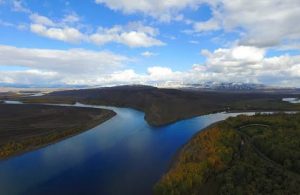
It was observed that there is a rising Brown Bear attack outside the settlement of Podtesovo, located on the banks of the Yenisei River.
- Yenisei River is a river in central Russia.
- It is the largest river system draining into the Arctic Ocean and ranks as the fifth-largest river in the world.
- It is formed as a result of the confluence of the Great Yenisei and Little Yenisei rivers at Kyzyl in Russia.
- The Great Yenisey rises on the Eastern Sayan Mountains of Tyva, and the Little Yenisey which rises in the Darhadïn Bowl of Mongolia.
- It runs from south to north across the great expanse of central Siberia.
- It ultimately empties into the Kara Sea, a marginal sea of the Arctic Ocean.
- The Angara River, which drains the Lake Baikal, is one of the major headwater tributaries of the Yenisei.
- The river plays a crucial role in the ecosystem of the Siberian taiga, characterized by its vast boreal forests.
- The Yenisei River hosts around several native fish species in its waters. Siberian sturgeons, Arctic flounders, Common roaches, Northern pikes.
Prosopis Juliflora: In News
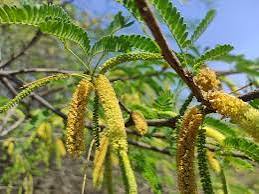
The Water Resources Department (WRD) started removing of invasive Prosopis Juliflora from irrigation tanks along Palar River in Vellore, Tamil Nadu.
- Prosopis Juliflora is a shrub in the family Fabaceae, a kind of mesquite.
- It is native to Mexico, South America and the Caribbean.
- It is an invasive species in arid and semi-arid areas.
- It was brought to Delhi by the British in the 1920s, when the national capital was being built.
- In India it is known locally by many names such as Bellary jaali, seemai karuvelam, seemai jaali, gando baval, vilayati kikar.
- Characteristics of Prosopis Juliflora:
- Adaptability: It has a very wide ecological adaptability which can grow on soils from sand dune to clay soil, and from saline to alkaline soil type.
- It is characterized by vigorous growth which helps them to out compete indigenous plant species.
- Impacts of Prosopis Juliflora on Environment:
- This shrub absorbs huge water to obtain one kilogram of biomass.
- It can also turn the groundwater poisonous.
- It causes land erosion due to the loss of the grasslands that are habitats for native plants and animals.
Kanha Tiger Reserve : Wild buffaloes
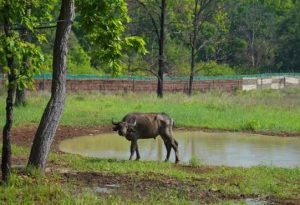
Eight wild buffaloes brought from Assam’s Kaziranga National Park were released into a 17-hectare enclosure at Madhya Pradesh’s Kanha Tiger Reserve.
- Kanha Tiger Reserve is located in the “Maikal” ranges of the Satpuras in Madhya Pradesh.
- It has an active corridor between Kanha and Pench Tiger Reserves. Kanha is also connected with the Achanakmar Tiger Reserve of Chhattisgarh.
- It is characterized mainly by forested shallow undulations, hills with varying degrees of slopes, plateaus, and valleys.
- The region is known for some of the ancient tribal communities, like the Gond and Baiga still inhabit the region.
- It is also the first tiger reserve in India to officially introduce a mascot, “Bhoorsingh the Barasingha”.
- It primarily consists of a moist Sal and moist mixed deciduous forest.
- Flora: Bamboo, Tendu, Sal, Jamun, Arjun, and Lendia flourish.
- Fauna: The Park has a significant population of Royal Bengal Tigers, leopards, sloth bears, and Indian wild dogs.
Maritime State Development Council:
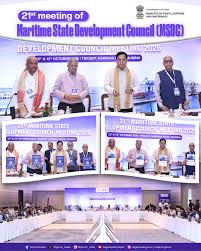
The 21st Maritime State Development Council (MSDC) concluded in Mumbai with landmark outcomes for India’s maritime sector.
- Maritime State Development Council is an apex advisory body which was constituted in 1997 for the development of the Maritime sector.
- The Indian Ports Act, 2025 grants statutory status to the Maritime State Development Council.
- Its primary aim is to promote the integrated growth of Major and Non-Major ports in close coordination with State governments.
- The Council, chaired by the Union Minister for Ports, Shipping, and Waterways.
- It comprises Ministers responsible for ports from all Maritime States, Administrators of UTs, and key stakeholders, including representatives from the Navy, Coast Guard, and other agencies.
- Functions:
- It monitors the development of minor ports, captive ports and private ports in the Maritime States with a view to ensure their integrated development with Major Ports and to assess the requirements of other infrastructure requirements like roads/rail/IWT and make suitable recommendations to the concerned Ministers.
- The Council guide data collection and dissemination and transparency across ports, and advise the central government on national planning, legislative reforms, port efficiency, and connectivity.
Ceropegia tamilnaduensis:
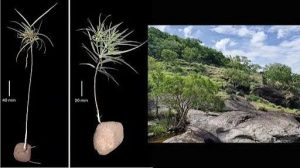
Botanists from the Botanical Survey of India have discovered and described a new plant species, named Ceropegia tamilnaduensis.
- Ceropegia tamilnaduensis is a new plant species discovered from the hill slopes of the Nellai Wildlife Sanctuary in Tamil Nadu.
- It features solitary flowers growing directly from the leaf axils with drooping stems.
- It possesses a glabrous (hairless) central corona and a pollinial corpusculum with lateral wings.
- It produces unusually large seeds.
- It shows close morphological similarity to Ceropegia annamacharyae (in flower structure) and Ceropegia swarupa (in narrow leaves/body structure).
Nellai Wildlife Sanctuary
- It is located in the state of Tamil Nadu.
- It earned the title of wildlife sanctuary in 2015.
- It features several mountain peaks, including Sivagiri Mala (highest peak at 1,748 m), Totti Malai, Kalli Malai, and Aruitalai Mottai.
- It is sustained by the drainage network of the Cauvery, Moyar, Bhavani, Vaigai, and Tamirabarani River Systems.
- It Santalum album (Sandalwood), Shorea, Tectona grandis, Shola tree species, Avicennia mangroves, Strobilanthes kunthiana.
- It is home to Nilgiri Tahr, Bengal Tiger, Asian Elephant, Lion-tailed Macaque, Grizzled Giant Squirrel, Gaur, Sloth Bear.
INS Samarthak: Set To Commission

The Indian Navy is set to commission Samarthak at Naval Base, Karwar.
- INS Samarthak is the first of four Multi-Purpose Vessels being inducted into the Indian Navy.
- It is built by M/s Larsen and Toubro Ltd under the Government of India’s Make in India initiative.
- Motto: The ship’s motto: Victory is Our Sole Aim.
- The ship’s crest features an Indian elephant emerging from the waves, symbolising strength, intelligence, and agility.
- The ship’s integrated combat suite combines indigenous sensors, weapons and electronic systems optimised for operations in challenging maritime conditions.
- Functions:
- It is designed primarily for maritime surveillance and patrol.
- It is also capable of undertaking Low Intensity Maritime Operations (LIMO), Target Deployment & Trials Platform, Unmanned/ autonomous System Mothership, Humanitarian Assistance and Disaster Relief (HADR), conversion to a limited hospital ship and fighting for salvage operations.
- It will add a new indigenous multi-purpose platform to the Navy’s fleet and underline the growing role of domestic shipbuilding in meeting India’s maritime security requirements.
Foreign Exchange Risk Reserve:
The Reserve Bank of India (RBI) has unveiled a comprehensive suite of emergency measures to stem the ongoing slide of the Indian rupee. A central highlight of this intervention is the Foreign Exchange Risk Reserve (FERR).
- The RBI’s strategic deployment of the FERR is being widely analyzed by economists as a reversal of the “China playbook” on currency management.
- The Mechanism: In October 2026, the RBI introduced a 20% FERR on specified rupee-linked forex derivative contracts involving the purchase of foreign currency against INR.
- Initially, the 20% cash reserve requirement applied to eligible customer contracts exceeding USD 2 million.
- It is extended to authorised dealers’ own hedging contracts, regardless of the contract value.
- The reserve must be maintained daily with the RBI in cash until the contract ends.
- By mandating this reserve, the central bank intentionally makes purchasing forward dollar protection more expensive for domestic banks and traders.
- The mandate disincentivizes entities from indiscriminately forward-booking dollars to hedge against potential future rupee depreciation, which itself fuels immediate downward pressure on the currency.
- The measure specifically targets domestic institutions and onshore traders rather than offshore entities, penalizing local market activity contributing to self-fulfilling sell-offs and curbing localized speculative bets.
1st BIMSTEC Home Ministers’ Meeting Adopts Delhi Declaration:
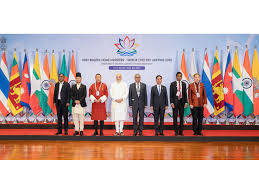
The first BIMSTEC Home Ministers’ Meeting concluded in New Delhi with the adoption of the Delhi Declaration, under the chairmanship of Union Home Minister.
- Seven BIMSTEC members—Bangladesh, Bhutan, India, Myanmar, Nepal, Sri Lanka and Thailand—reaffirmed cooperation based on sovereign equality, territorial integrity, non-interference and peaceful coexistence.
- The declaration strongly condemned terrorism, including cross-border terrorism, and called for effective implementation of UN Security Council sanctions, particularly the 1267 Sanctions Committee.
- Emphasised combating radicalisation, terrorist recruitment, money laundering and terror financing, while preventing the misuse of emerging technologies for terrorist activities.
- Called for coordinated action against human trafficking, cyber slavery, online scams and forced criminality, adopting a victim-centred approach.
- Urged implementation of the Convention on Combating International Terrorism, Transnational Organised Crime and Illicit Drug Trafficking (in force since March 2021) and the Convention on Mutual Legal Assistance in Criminal Matters (signed in March 2022).
- Called for early finalisation of conventions on extradition, transfer of sentenced persons and combating trafficking in persons, along with an SOP for rescuing, repatriating and reintegrating trafficking victims.
- Called for developing the BIMSTEC Drug Offences Monitoring Desk (BDOMD), exploring regional information-sharing mechanisms and strengthening training and capacity-building against transnational crimes.
- Recognised the role of the Joint Working Group on Counter-Terrorism and Transnational Crime (JWG-CTTC), welcomed BIMSTEC’s observer status in the Asia/Pacific Group on Money Laundering (APG) and encouraged partnerships with UNODC, INTERPOL and FATF, alongside regular Home Ministers’ Meetings.
BIMSTEC:
- The Bay of Bengal Initiative for Multi-Sectoral Technical and Economic Cooperation (BIMSTEC) was established on 6th June 1997 through the Bangkok Declaration. It serves as a bridge between South Asia and Southeast Asia, with its Secretariat in Dhaka, Bangladesh.
Khajuraho’s Javari Temple:
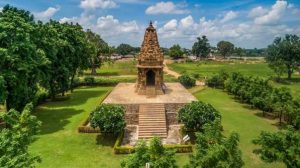
The Archaeological Survey of India (ASI) announced that the missing head of the 11th-century Vishnu idol at Khajuraho’s Javari Temple has been traced in an ASI store, ending a long-standing legal controversy that reached the Supreme Court.
- It is a compact, exquisitely sculpted Hindu temple dedicated to Lord Vishnu, forming an integral part of the Khajuraho Group of Monuments (inscribed as a UNESCO World Heritage Site in 1986).
- Located in: Situated in the Eastern Group of Temples in Khajuraho, Chhatarpur district, Madhya Pradesh.
- Built during the zenith of the Chandela dynasty between 1075 and 1100 CE.
- Local traditions trace its name either to a devout local landowner who commissioned the shrine or to a regional linguistic derivation of javara, reflecting deep agrarian connections.
Key Features of the Temple:
- Nirandhara Architectural Layout: Designed as a compact nirandhara temple (lacking an internal ambulatory circumambulatory path/pradakshinapatha), comprising four well-proportioned longitudinal units: an entrance portico (ardhamandapa), assembly hall (mandapa), vestibule (antarala), and sanctum sanctorum (garbhagriha).
- Ornate Makara-Torana: Famous for its resplendent, delicately carved makara-torana (mythical crocodilian archway) adorning the entrance portico, considered one of the finest entrance arches in Chandela temple art.
- SoaringCurvilinear Shikhara: Features a slender, soaring shikhara decorated with minor miniature spires that create a distinct silhouette above a raised stone plinth (jagati).
- Intricate Sculptural Bands: The exterior walls are carved with two to three continuous horizontal bands of sculptures depicting celestial nymphs (apsaras), divinities, composite mythological beasts (vyalas), and erotic motifs (mithunas) that reflect Chandela aesthetic traditions.
- Sanctum Lintels &Nava-Graha Reliefs: The doorway to the sanctum showcases carvings of the Trinity (Brahma, Vishnu, and Shiva) accompanied by the Nava-grahas (nine celestial planetary deities) on the upper lintel.
Soybean Varieties NRC 268 and NRC 270:

The ICAR–National Soybean Research Institute, Indore, organized a Soybean Harvest Day, where newly developed improved soybean varieties NRC 268 and NRC 270 demonstrated promising preliminary yields of approximately 20 quintals per hectare.
- High-yielding, climate-resilient, improved soybean (Glycine max) crop varieties engineered to enhance farm productivity, seed quality, and economic returns for oilseed growers across Indian agro-climatic zones.
- Developed by: ICAR–National Soybean Research Institute (ICAR-NSRI), Indore (Madhya Pradesh).
- Aim is to bridge the yield gap in domestic oilseed production, counter weather unpredictability, and replace aging, lower-yielding cultivars to double farm productivity.
Key Characteristics of NRC 268 and NRC 270:
- High Yield Potential: Both varieties yield around 20 quintals/hectare under adverse weather conditions, potentially reaching 22–25 quintals/hectare with optimal farming practices.
- Superior Grain Quality (NRC 270): Developed as a bold-seeded soybean variety with larger grains, higher seed weight, and better market value.
- Climate and Disease Resilience: Enhanced tolerance to irregular rainfall, dry spells, pests, and diseases helps maintain crop productivity under challenging conditions.
- Adaptation to Soybean-Growing Regions: Suited to major soybean-producing states like Madhya Pradesh, Maharashtra, and Rajasthan, particularly during the kharif season.
- High Oil and Protein Content: Provides improved oil extraction and protein-rich soybean meal, supporting edible oil production and livestock feed industries.
Lakshadweep Achieves 100% Literacy Under ULLAS Scheme:
Lakshadweep was officially declared a 100% literate Union Territory by Administrator Praful Patel under the ULLAS–Nav Bharat Saaksharta Karyakram.
- ULLAS (Understanding Lifelong Learning for All in Society) – Nav Bharat Saaksharta Karyakram (New India Literacy Programme / NILP) is a Centrally Sponsored Scheme aligned with the National Education Policy (NEP) 2020 to empower adults aged 15 and above who missed formal schooling with functional literacy and life skills.
- Approved for implementation over a five-year cycle covering Financial Years 2022 to 2027 with the vision of achieving ‘Jan Jan Saakshar’.
- Organisation: Administered by the Department of School Education and Literacy (DoSEL), Ministry of Education.
Objectives:
- To cover non-literate citizens aged 15 years and above across all States and UTs, targeting 5 crore learners (1 crore learners annually) between FY 2022–27.
- To deliver an integrated curriculum built on five core pillars: Foundational Literacy & Numeracy, Critical Life Skills (financial, digital, legal, healthcare), Basic Education (formal equivalence), Vocational Skills, and Continuing Education.
10th National Convention of Agrivision–2026:
The 10th National Convention of Agrivision–2026 was held in New Delhi (October 13–14), emphasising India’s transition from production-centric agriculture to market-oriented agri-food value chains.
10th National Convention of Agrivision–2026:
- A national-level agricultural convention bringing together students, scientists, policymakers, entrepreneurs, and farmers to promote innovation, agricultural education, entrepreneurship, and farmer-centric development.
- Organised by: Agrivision, under the aegis of the ICAR Agricultural Education Division, at the ICAR–NASC Complex, Pusa, New Delhi.
- Aim is to strengthen collaboration among agricultural stakeholders, promote market-driven agriculture, and improve farmer profitability through innovation and value addition.