
Today’s Current Affairs: 1st jul 2026 for UPSC IAS exams, State PSC exams, SSC CGL, State SSC, RRB, Railways, Banking Exam & IBPS, etc
Table of Contents
The SUMAN Roadmap 2030:
Union Minister of Health and Family Welfare, launched the ‘SUMAN Roadmap 2030’ during the 16th Conference of the Central Council of Health and Family Welfare (CCHFW).
- The SUMAN (Surakshit Matritva Aashwasan) Roadmap 2030 is a multi-dimensional, data-driven national health strategy.
- Moving away from a one-size-fits-all model, it serves as a specialized operational matrix designed to eliminate preventable maternal and newborn deaths through localized, tech-enabled public health interventions.
- Ministry: Ministry of Health and Family Welfare (MoHFW), Government of India.
- Aim:
- To aggressively push down India’s MMR to below 70 per 100,000 live births by 2030, aligning perfectly with the United Nations Sustainable Development Goals (SDGs).
- To achieve steep reductions in both the Neonatal Mortality Rate (NMR) and the Infant Mortality Rate (IMR).
- To secure universal, equitable, and top-tier healthcare saturation for all pregnant women and newborns across every state and union territory in India.
Himayat Sagar Lake:
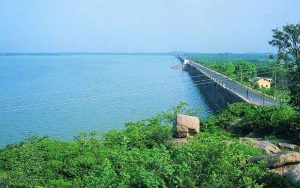
The Hyderabad Metropolitan Water Supply and Sewerage Board (HMWSSB) recently opened the floodgates of the Himayatsagar reservoir and began releasing water downstream following increased inflows caused by rainfall in the catchment areas.
- Himayat Sagar Lake is an artificial lake in Telangana.
- It was built on the Esi River (a tributary of the Musi River) during the rule of the last Nizam of Hyderabad.
- The main objective was to provide drinking water and, at the same time, save the city from floods.
- The construction of the lake was completed in 1927 and was named after Himayat Ali Khan, the son of the last Nizam of Hyderabad.
- It lies parallel to Osman Sagar Lake.
- The Himayat Sagar and Osman Sagar reservoirs provide water supply to the twin cities of Hyderabad and Secunderabad.
Aldabra Giant Tortoise:
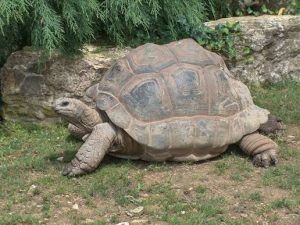
On the first day of his Seychelles visit, the Prime Minister of India visited the Seychelles National Botanical Garden and fed native Aldabra giant tortoises.
- Aldabra Giant Tortoise is the second-largest species of land tortoise in the world, after the Galapagos giant tortoise (Chelonoidis nigra).
- Scientific Name: Geochelone gigantea
- It is endemic to the Aldabra Atoll of the Seychelles, an archipelago nation in the western Indian Ocean.
- It is terrestrial and occurs in a wide variety of habitats, including scrub forests, mangrove swamps, and coastal dunes and beaches, each with their respective vegetation.
- The largest populations of tortoises are found on grasslands called “platins.”
- Their heavy grazing has formed a special kind of grassland habitat called “tortoise turf.”
- Males are considerably larger than females and have longer, thicker tails.
- Their carapace (or upper shell) is highly domed and thick, with a small neck plate that is usually visible, a feature absent in other species of giant tortoises.
- It is among the longest-living vertebrates, with many individuals living over 100 years and some believed to exceed 150 years.
- Conservation Status:
- IUCN Red List: Vulnerable.
K9 Vajra-T:
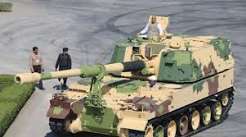
After the successful collaboration on the K9 Vajra-T self-propelled howitzer, India and South Korea are set to deepen their defence partnership.
- K9 Vajra-T is a 155 mm, 52-caliber tracked self-propelled artillery system (howitzer).
- It is an Indian adaptation of South Korea’s K9 Thunder 155 mm self-propelled howitzer.
- It is built by Larsen & Toubro with technology transferred from South Korean defence major Hanwha Defense based on its K9 Thunder.
- It is customised to suit the requirements of the Indian Army for operations in varied terrains, including deserts, plains, and high-altitude regions.
- It has all-welded steel armour up to 19 mm thick.
- It is powered by an MTU MT 881 Ka-500 diesel engine producing 1,000 horsepower.
- The main weapon is the 155mm /52 calibre gun capable of firing high-explosive, smoke, and guided projectiles.
- It has a burst rate of fire of three rounds per 15 seconds and a maximum rate of fire of six to eight rounds per minute for three minutes.
- It can strike enemy targets at around 50 kilometres.
- It can also turn around at zero radius, basically at the same place where it is standing.
- The K9 uses a digital fire control system by which it can fire multiple rounds that can impact a given area at the same time (this mode of operation is called Multiple Round Simultaneous Impact, or MRSI).
National Investment and Infrastructure Fund (NIIF):

The Union Cabinet recently approved an additional Government of India’s investment commitment of Rs. 30,000 crore towards new and upcoming funds of the National Investment and Infrastructure Fund.
- National Investment and Infrastructure Fund (NIIF) is a fund created by the Government of India for enhancing infrastructure financing in the country.
- It is India’s first-ever sovereign wealth fund (SWF).
- NIIF got registered with SEBI as Category II Alternative Investment Fund (AIF) in 2015.
- It is a collaborative investment platform for international and Indian investors with a mandate to invest equity capital in domestic infrastructure.
- NIIF invests across asset classes such as infrastructure, private equity, and other diversified sectors in India, with the objective of generating attractive risk-adjusted returns for its investors.
- It invests in greenfield (new), brownfield (existing), and stalled projects.
- NIIF is 49% owned by the Indian government and has more than $5 billion in assets under management, making it the country’s biggest infrastructure fund.
- NIIF benefits from its association with the Government yet is independent in its investment decisions.
- It is professionally run and managed by National Investment and Infrastructure Fund Limited (NIIFL).
- Over the years, NIIF has attracted investments from leading global sovereign wealth funds, pension funds, multilateral development institutions, and domestic financial institutions.
- Currently, there are four funds under the NIIF Umbrella.
- NIIF Master Fund: This fund primarily invests in infra-related projects such as roads, ports, airports, and power. It is the largest infrastructure fund in India.
- NIIF Private Markets Fund: Invests in funds managed by third-party managers in infrastructure and associated sectors.
- NIIF Strategic Opportunities Fund: It invests and develops large-scale businesses and greenfield projects that are of strategic importance to the country.
- India-Japan Fund:
- NIIF’s first bilateral fund invests in environment preservation in India.
- It also seeks to enable opportunities for collaboration between Indian and Japanese companies in India.
- The Fund has a target corpus of US$600 million, with the Government of India contributing 49% and the remaining 51% contributed by the Japan Bank for International Cooperation, a policy-based financial institution wholly owned by the Government of Japan.
PM Family Care Tracker:
The Union Home and Cooperation Minister recently launched the PM Family Care Tracker (PM-FCT) as a pilot project in Gujarat.
- It is a digital platform aimed at strengthening maternal and child health, nutrition, and family welfare.
- The digital platform would ensure that pregnant women, mothers, and children receive all eligible government benefits through continuous monitoring and timely intervention.
- It has been designed to digitally monitor every stage of a child’s development, from pregnancy through 18 years of age, while helping eligible families receive welfare benefits on time.
- The PM-FCT provides end-to-end monitoring of key health milestones, including antenatal and postnatal care, immunisation, nutrition, growth monitoring, school enrolment and attendance, and adolescent health services.
- The platform also features digital Health Passports for individuals and families, dashboards to facilitate delivery of government welfare schemes, and automated alerts for missed vaccinations and other essential health services.
- Alerts will be generated automatically if a child misses vaccination or drops out of school.
- Notifications will reach local officials, legislators and Members of Parliament, enabling volunteers and government authorities to intervene promptly and ensure that every child receives essential services.
- It is expected to enable timely interventions, reduce maternal and infant mortality, address malnutrition, and minimise gaps in service delivery.
- PM-FCT is designed as a family-centric digital platform, rather than maintaining separate records for different schemes, allowing authorities to track the health and welfare status of every family member through a single interface.
- The initiative aims to improve convergence across multiple government departments by integrating data from birth and death registration systems, and health, nutrition and education databases.
- The pilot project will initially be implemented in Gandhinagar and, if successful, is proposed to be expanded across Gujarat and later replicated in other states.
Samagra Shishu Bal Swasthya Karyakram:
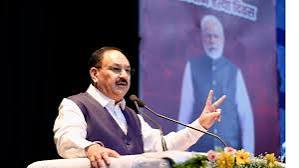
The Union Minister of Health and Family Welfare launched the Samagra Shishu Bal Swasthya Karyakram (SSBSK)
- Samagra Shishu Bal Swasthya Karyakram is a unified national programme that provides a seamless continuum of home and community-based care for every child from birth to 36 months of age.
- The programme embodies the vision of Comprehensive care during the first three years.
- It integrates the existing Home-Based Newborn Care (HBNC) and Home-Based Care for Young Child (HBYC) programmes into a single comprehensive framework.
- It introduces a risk-stratified approach, providing intensified follow-up for newborns and children identified as “at-risk”, due to conditions such as low birth weight, prematurity, delayed initiation of breastfeeding etc.
- Under the programme, ‘At-risk’ newborns will receive up to nine home visits during the first 42 days of life, while ‘At-risk’ children will receive up to eight home visits up to the age of 36 months.
- It introduces Well-Baby Sessions at every Village Health, Sanitation and Nutrition Day (VHSND) and a monthly Shishu Shivir at Ayushman Arogya Mandirs.
- It incorporates post-partum maternal mental health screening as an integral component of community-based care.
- ASHAs will undertake early screening and facilitate timely referral for further assessment and support whenever necessary.
- It also mainstreams Nurturing Care for Early Childhood Development (ECD) by promoting responsive caregiving, early learning opportunities.
- It envisages use of digital technologies to enhance service delivery, monitoring and continuity of care.
- Decision-Support Systems (DSS), child-wise digital tracking, referral mechanisms and alert systems will strengthen follow-up and case management of ‘At-risk’ newborns and children.
- These digital systems will be integrated with the JANANI Portal, U-WIN Portal, MPCDSR Portal, RBSK 2.0 Portal and POSHAN Tracker, enabling seamless data exchange through ABHA and Baal-ABHA IDs.
- It includes tailored strategies to strengthen home-based care in urban areas, particularly for children residing in slums, migrant settlements and other underserved communities.
Satkosia Tiger Reserve: Resume tiger re-introduction
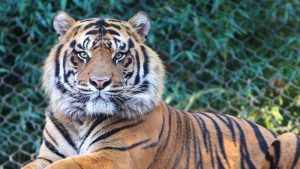
The Odisha government’s proposal to resume tiger re-introduction in Satkosia Tiger Reserve has received in-principle approval of the National Tiger Conservation Authority (NTCA).
- Satkosia Tiger Reserve is located in the state of Odisha, India
- This reserve encompasses the Satkosia Gorge Sanctuary and Baisipalli Wildlife Sanctuary.
- The river Mahanadi flows through the valleys in the middle of the Reserve.
- The area is also a part of the Mahanadi Elephant Reserve.
- It is the meeting point of two biogeographic regions of India, the Deccan Peninsula and the Eastern Ghats.
- The terrain is hilly with moderate to steep slopes and narrow valleys.
- The forest vegetation comprises North Indian tropical moist deciduous forests and Moist peninsular low-level sal.
- The main tree species is sal, which grows in gregarious formations.
- Other associate species are Asan (Terminalia alata), Dhaura (Anogeissus latifolia), Bamboo (Dendrocalamus strictus), and Simal (Bombax ceiba).
- The flagship species among the fauna include tiger, leopard, elephant, spotted deer, sambar, chowsingha, barking deer, bison, wild dog, sloth bear, jackal, giant squirrel, and porcupine.
- It is the natural habitat of two endangered species, viz., the freshwater crocodile and the gharial.
Unified Health Interface:

The Union Minister of Health and Family Welfare launched the Unified Health Interface (UHI).
- Unified Health Interface is an interoperable digital network under the Ayushman Bharat Digital Mission (ABDM).
- UHI aims to solve for information asymmetry, accessibility to health services and wider choice of verified providers across services without being tied to a single application.
- It was launched as the service layer of the ABDM.
- UHI operates through open protocols on a core Gateway of the Ayushman Bharat Digital Mission, developed and maintained by the National Health Authority (NHA).
- When a citizen uses a UHI-enabled app to search for a health service, the request is routed through the Gateway to registered service providers.
- The entire journey from discovery and booking to fulfillment is facilitated through a common language, irrespective of the platform used to seek or provide the service.
- The network uses Ayushman Bharat Health Account (ABHA) as the patient identifier, the Healthcare Professionals Registry (HPR) and Health Facility Registry (HFR) for provider verification, and the Health Information Exchange for consent-based data sharing.
- Key Objectives:
- Interoperability: Patients and providers can use any UHI-enabled platform to seek or offer care, removing the dependency on shared platforms that currently limits digital health access.
- Fair discoverability: Every verified healthcare provider, regardless of size, geography, or platform, has an equal opportunity to be found on the network.
- Verification: Only verified doctors and facilities credentialed through ABDM registries (HPR and HFR) are permitted to participate, ensuring citizens can trust the network.
- UHI is built on open specifications accessible to all, enabling developers of any size to build and offer health applications in any language, on any devices.
Scheme for Strengthening of Medical Device Industry:
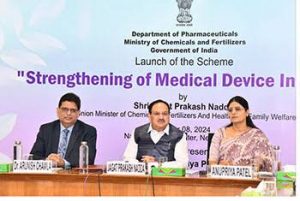
The Department of Pharmaceuticals, Ministry of Chemicals and Fertilizers, has invited applications from eligible entities under the Scheme for Strengthening of Medical Device Industry (SMDI) to promote domestic manufacturing.
- It is a comprehensive scheme which targets critical areas of the medical device industry.
- It covers manufacturing of key components and accessories, skill development, support for clinical studies, development of common infrastructure and industry promotion.
- It consists of five sub-schemes:
- Common Facilities for Medical Devices Clusters: Common facilities for medical devices clusters, the Central Government will provide financial assistance to medical device clusters for creating common infrastructure facilities such as R&D labs, Design and Testing Centre, Animal Labs etc.
- Marginal Investment Scheme for Reducing Import Dependence: It is designed to deepen the MedTech supply chain in the country, by focusing on manufacturing of key components, raw materials, and accessories within the country. It offers a one-time capital subsidy of 10-20%, with a maximum cap of Rs 10 crore per project.
- Capacity Building and Skill Development for Medical Devices: It focuses on capacity building and skill development for the medical device sector. Its goal is to develop a skilled technical workforce capable of designing and developing MedTech products.
- Medical Device Clinical Studies Support Scheme: It is designed to assist both established companies and start-ups in conducting clinical studies. It provides financial support for animal studies, human trials, clinical investigation of investigational devices, clinical performance evaluations.
Medical Device Promotion Scheme: It aims to support industry associations and export councils to organize conferences, conducting surveys and studies.
SUMAN Roadmap 2030:
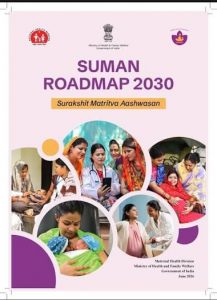
The Union Minister of Health and Family Welfare launched the SUMAN Roadmap 2030 during the 16th Conference of the Central Council of Health and Family Welfare (CCHFW).
- During the event, other health initiatives like Aarogya Setu 2.0, eSushrut@clinic, Ayushman Sarathi PM-JAY WhatsApp Chatbot, Drug Registry and Unified Health Interface were also launched.
- SUMAN Roadmap 2030 is a comprehensive strategic framework developed by the Ministry of Health and Family Welfare to strengthen maternal and newborn healthcare across India.
- It is an evidence-driven strategy that combines national priorities with local realities to deliver equitable, high-quality care and accelerate India’s progress towards SDG targets on maternal and newborn health by 2030.
- RMNCHA+N Framework is anchored in the RMNCHA+N framework, which stands for Reproductive, Maternal, Newborn, Child, Adolescent Health and Nutrition, and adopts a life-cycle approach covering pre-pregnancy, pregnancy, childbirth and the postnatal period.
- It focuses on identification, tracking and management of high-risk pregnancies across antenatal care, third-trimester care, intrapartum care and the postnatal period.
- The Roadmap addresses transport, tribal and hard-to-reach areas, emergency obstetric care, community participation through SUMAN Panchayats, and climate-related risks to mothers and newborns.
- It introduces time-bound interventions in 130 districts across 13 high-focus States, including Assam, Bihar, Chhattisgarh, Haryana, Jharkhand, Karnataka, Madhya Pradesh, Odisha, Punjab, Rajasthan, Uttar Pradesh, Uttarakhand and West Bengal.
- The Roadmap aims to reduce Maternal Mortality Ratio (MMR) below 70 per 100,000 live births by 2030, lower Neonatal Mortality Rate (NMR) and Infant Mortality Rate (IMR), ensure universal coverage of quality maternal and newborn care, and achieve zero preventable maternal and newborn deaths.
- It includes pre-pregnancy folic acid supplementation, nutrition support for maternal anaemia and undernutrition, high-risk pregnancy surveillance, Maternal Death Surveillance and Response (MDSR), Maternal Near Miss (MNM) reviews, Non-Pneumatic Anti-Shock Garments (NASG) for obstetric haemorrhage, AI-enabled labour rooms, climate-responsive planning, Caesarean section optimisation and Samagra Shishu Bal Swasthya Karyakram (SSBSK) integration.
- It envisages Centres of Excellence, a centralised SUMAN Call Centre for grievance redressal, stronger referral linkages and JANANI Portal-based digital monitoring.
Anemia Mukt Bharat Abhiyaan Operational Guidelines:
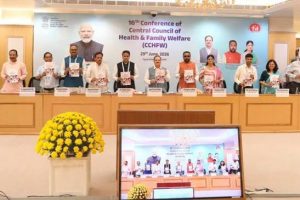
The Union Ministry of Health and Family Welfare has released the Anemia Mukt Bharat Abhiyaan Operational Guidelines, marking eight years of the Anemia Mukt Bharat initiative and outlining a strengthened strategy to accelerate India’s fight against anemia.
Key Highlights of the Anemia Mukt Bharat Abhiyaan Operational Guidelines:
- The revised framework transitions India’s anemia management from prophylactic care (preventive) to therapeutic care (treatment and active management) through intensified testing, tracking, and case-based protocols.
- The legacy 6x6x6 strategy has been upgraded by adding critical structural layers:
- 7th Beneficiary Group: Low Birth Weight (LBW) babies (0–6 months) to disrupt the intergenerational cycle of anemia at the earliest stage.
- 7th Intervention: The “Eating Right” approach, promoting daily conscious consumption of diversified, iron-rich diets.
- 7th Institutional Mechanism: A digitally integrated Monitoring and Evaluation framework to ensure end-to-end accountability.
- The core operational anchor shifts from T3 (Test, Treat, Talk) to T4 (Test, Treat, Talk, and Track), which enforces a strict continuum of care, including systematic referral and follow-up.
- For severe cases and non-responders among pregnant and lactating women, Intravenous Iron Therapy using Ferric Carboxymaltose (FCM) and Iron Sucrose is institutionalized as a vital clinical standard.
- A centralized Anemia Mukt Bharat Abhiyaan Portal will achieve intra-departmental data convergence by integrating real-time records from:
- JANANI Portal (maternal screening)
- RBSK Portal (Rashtriya Bal Swasthya Karyakram – child screening)
- U-WIN Portal (universal immunization tracking)
- The mission adopts a ‘Whole of Government’ approach for inter-ministerial convergence, alongside ‘Jan Bhagidari’ (community mobilization) and ‘Jan Chetna’ campaigns to de-normalize anemia across civil society.
- The interventions are explicitly mapped to drive down the Infant Mortality Rate (IMR) and Maternal Mortality Ratio (MMR) while improving holistic maternal and child health lifecycle outcomes.
India’s First 3D-Printed Artificial Reefs:
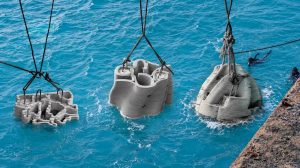
Tamil Nadu is set to deploy India’s first 3D-printed artificial reef modules under the second phase of the Pradhan Mantri Matsya Sampada Yojana to support marine habitat restoration.
- The pilot deployment is scheduled off the Ramanathapuram coast and will test six newly developed reef designs in coastal waters.
Scientists will assess the durability and ecological performance of the modules under local coastal conditions before considering larger-scale deployment. - The project is being carried out in collaboration with the Visakhapatnam Regional Centre of ICAR-Central Marine Fisheries Research Institute. Each module weighs about 1 tonne and has been developed by Chennai-based startup Tvasta, an IIT Madras-incubated company.
- Unlike conventional reinforced concrete reefs, these modules are made without iron reinforcement and have complex 3D-printed structures with crevices, folds and attachment surfaces.
- The design aims to increase porosity, surface area and habitat suitability for corals, sponges and other reef-associated marine organisms.
- The initiative, funded jointly by the Centre and State in a 60:40 ratio, is part of a wider artificial reef project across 213 sites in Tamil Nadu and is expected to benefit traditional fishing communities through improved fish stocks and healthier marine ecosystems.
Army to Raise Baaz Battalions:

The Indian Army is set to raise specialised drone units called Baaz Battalions to strengthen its unmanned warfare capabilities and expand the use of drones in future military operations.
- Baaz Battalions will be dedicated units focused on operating, managing and sustaining the Army’s growing ecosystem of drones and Remotely Piloted Aircraft systems.
- These Battalions will build on the Army’s existing Remotely Piloted Aircraft Flights and create a specialist cadre of trained drone personnel.
- Baaz Battalions will enhance surveillance, reconnaissance, intelligence gathering, target tracking and battlefield assessment through specialised drone operations and real-time aerial inputs for frontline units.
- Remotely Piloted Aircraft (RPAs) will improve situational awareness, enable faster command decisions, support rapid operational response and reduce risks to personnel in sensitive or hostile areas.
- The initiative reflects lessons from recent conflicts, especially the Russia-Ukraine war, LAC standoffs with China and Operation Sindoor against Pakistan, where drone capabilities proved crucial.
- Baaz Battalions will strengthen border monitoring, drone warfare preparedness, operational readiness along sensitive frontiers and coordination between frontline units and intelligence systems.
Garudastra Mortar System:
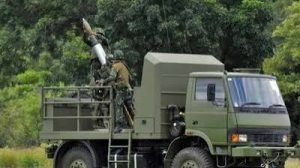
India successfully tested Garudastra, an indigenous long-range 120 mm vehicle-mounted mortar system in Mhow, Madhya Pradesh, demonstrating its advanced mobility, precision engagement and rapid firing capabilities.
- Garudastra is a long-range, vehicle-mounted 120mm mortar system designed to provide accurate indirect fire support with high mobility and rapid battlefield response.
- It offers rapid deployment, high rate of fire, shoot-and-scoot capability, Multiple Rounds Simultaneous Impact (MRSI), precision-guided munitions and command-and-control network integration.
- It can engage targets at ranges of 7–10 km using Global Positioning System (GPS) and laser guidance for pinpoint accuracy with minimum collateral damage
- It can take firing position in less than 30 seconds, fire two rounds within 15 seconds, and relocate in under 15 seconds to avoid counter-battery fire.
- It can be operated by a two-member crew and is capable of firing 12 rounds in 60 seconds while maintaining accuracy.
- It carries a 17-kg penetrating warhead capable of defeating reinforced concrete, making it effective against bunkers and hardened structures.
- It strengthens India’s indigenous defence manufacturing capability and supports the Make in India and Aatmanirbhar Bharat initiatives.
Sujalam Sufalam Jal Abhiyan:
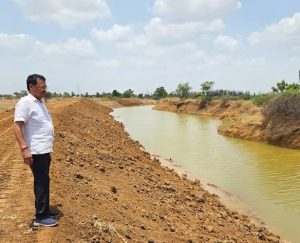
Gujarat’s Sujalam Sufalam Jal Abhiyan increased the state’s water storage capacity by 20,789 lakh cubic feet in 2026.
- Over the last eight years, the campaign has created 1,38,039 lakh cubic feet of additional water storage through large-scale water conservation works.
- Sujalam Sufalam Jal Abhiyan is Gujarat’s flagship water conservation and groundwater recharge campaign aimed at enhancing water storage through public participation, desilting, and restoration of water bodies.
- It complements the ‘Catch the Rain’ initiative by strengthening sustainable water resource management across the state.
- Aim is to increase water storage capacity, improve groundwater recharge, and strengthen climate-resilient water infrastructure through community participation.
- Key Features:
- Water Conservation Works: Undertakes pond deepening, check dam desilting and repair, and restoration of traditional water bodies.
- Canal &Drain Rejuvenation: Cleans canals and drainage networks to improve water flow, storage, and irrigation efficiency.
- Convergence Approach: Implemented jointly by six departments with support from MGNREGA, departmental agencies, and public participation.
- Employment Generation: Creates rural employment through large-scale conservation works while strengthening long-term water security
Bangladesh joins International Big Cat Alliance:
Bangladesh has officially joined the International Big Cat Alliance (IBCA) as its 27th member country.Bangladesh (officially the People’s Republic of Bangladesh) is a sovereign, unitary, parliamentary republic located in South Asia. As one of the world’s most densely populated nations, it is characterized by its dynamic deltaic topography, prominent fertile agricultural lands, and critical vulnerability to oceanic climate change anomalies.Situated on the northern apex of the Bay of Bengal, positioned within the geopolitical convergence zone between the Indian subcontinent and Southeast Asia.National Capital: Dhaka,Border nations: India, Myanmar and Bay of Bengal.
Project BRAHMANK:
Project BRAHMANK of the Border Roads Organisation (BRO) celebrated its 16th Raising Day on June 29, 2026, at Ranaghat, Arunachal Pradesh.Project BRAHMANK is a highly specialized, forward-deployed engineering and infrastructure development unit. Operating under extreme geographical conditions, it serves as a core baseline asset tasked with building heavy-duty roads, multi-ton tactical bridges, and military-grade aviation assets along India’s frontier lines.
Parent Organisation: It functions directly under the Border Roads Organisation (BRO).Aim is to construct, upgrade, and maintain all-weather operational lines of communication to ensure rapid forward movement for the Indian Armed Forces,to link cut-off border outposts and remote indigenous border villages with the national mainstream, accelerating socio-economic growth in frontier zones.
Nadaprabhu Kempe Gowda:
The Vice-President of India, paid tribute to Nadaprabhu Sri Kempe Gowda on his 517th Birth Anniversary (27th June 2026) in Bengaluru, highlighting his enduring legacy in urban planning, sustainable development, inclusive governance, and environmental conservation.Kempe Gowda (1510 – 1569) descendant of the Morasu Gowda lineage, served as a prominent ruler and chieftain under the Vijayanagara Empire.After receiving permission from Emperor Achyuta Deva Raya (reigned 1529–42), Kempe Gowda founded Bengaluru in 1537 by constructing the Bengaluru Fort and establishing Bengaluru Pete (the central market area). He also shifted his capital from Yelahanka, laying the foundation for the modern city.He envisioned a city where farmers, traders, artisans, scholars, and people of different faiths could live and prosper together, laying the foundation for Bengaluru’s identity as “Mini Bharat.”He is historically celebrated for abolishing regressive societal norms, most notably prohibiting the amputation of the last two fingers of the left hand of unmarried women during “Bandi Devaru”, a prevailing custom among the Morasu Vokkaligas.Beyond urban planning, he was a great patron of art and learning, significantly contributing to public welfare by building numerous temples and water reservoirs to ensure drought resilience and cultural flourishing. The 108-foot Statue of Prosperity in Bengaluru honours Kempe Gowda. It is recognized by the World Book of Records as the world’s tallest bronze statue of a city’s founder.



