
Today’s Current Affairs: 21st Nov 2026 for UPSC IAS exams, State PSC exams, SSC CGL, State SSC, RRB, Railways, Banking Exam & IBPS, etc
Table of Contents
Hydrogels for Targeted Micronutrient Delivery in Crops:
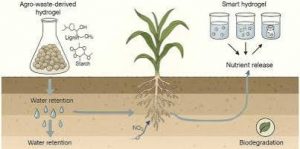
Researchers at IIT Gandhinagar (IITGN) developed pH-responsive, seaweed-based hydrogel microbeads for targeted delivery of micronutrients to plant roots by adapting the controlled-release principle used in medical treatments, including cancer therapy.
- Three-dimensional hydrophilic polymer networks capable of absorbing and retaining large amounts of water and releasing encapsulated substances in a controlled manner.
- Measuring roughly 3.5 mm, the biodegradable beads are made from Kappa Carrageenan (-carrageenan), a gelling agent extracted from red seaweed (such as Kappaphycus farmed along India’s southern coast) and trans-ferulic acid, a natural antioxidant found in rice, wheat, and oats.
Calcium chloride (CaCl₂) is used to facilitate gel formation. - Mechanism in the Rhizosphere: When plant roots lack micronutrients like iron or zinc, they secrete organic acids into the rhizosphere (the biologically active soil zone surrounding roots), lowering the soil pH.
- The microbeads detect this acidic cue, swell, and release encapsulated micronutrients (zinc, iron, manganese, and copper) directly near the roots.
- Under acidic conditions (pH 4), the beads swelled by nearly 80% in two days and released 68% of iron and 66% of zinc over 14 days, significantly higher than under neutral (46% iron, 44% zinc) or alkaline (pH 9) conditions (28% iron, 27% zinc).
- Standard micronutrient salts applied to soil are often chemically locked (fixed) or washed away (leached) before root absorption; foliar sprays are impractical on large fields, and chelated micronutrients are expensive and difficult to degrade in soil.
- Supported by IITGN grants and the Department of Biotechnology (DBT), the study was published in ACS Omega (American Chemical Society) and won the first prize at the SOMS 2026 Summit (organised by the Soluble Fertiliser Industry Association) at GIFT City, Gandhinagar.
- With an Indian patent application filed, the team is seeking industry partnerships for large-scale field trials to evaluate crop yield, nutritional quality, and long-term ecological safety on soil microbes, advancing an Aatmanirbhar precision-agriculture solution.
India Re-elected to ITU Council (2027–2030):

India was re-elected to the International Telecommunication Union (ITU) Council for the 2027–2030 term during the ITU Plenipotentiary Conference held in Doha, Qatar.
- The 48-member Council acts as the governing body of the ITU between its quadrennial Plenipotentiary Conferences.
- India has been continuously represented on the ITU Council since 1952.
- Council members are elected from five geographical regions to ensure equitable representation. India was elected to one of the 13 seats allocated to Region E (Asia and Australasia) for the 2027–2030 term.
- The Council oversees ITU activities, policies and strategies, manages designated working groups, and prepares draft strategic and financial plans for consideration by the Plenipotentiary Conference.
- India’s re-election strengthens its participation in shaping international telecommunication policies, promoting digital connectivity and contributing to a secure, inclusive and sustainable global digital ecosystem.
- International Telecommunication Union (ITU)
- Founded in 1865 as the International Telegraph Union, renamed the International Telecommunication Union in 1934, with its headquarters in Geneva, Switzerland.
- A specialised agency of the United Nations for information and communication technologies (ICTs).
- It comprises 194 Member States and more than 1,000 companies, universities, and international and regional organisations.
- Facilitates international connectivity, allocates global radio-frequency spectrum and satellite orbits, develops international ICT standards, and promotes universal digital connectivity to bridge the digital divide.
WHO Global Tuberculosis Report 2026:
The World Health Organization (WHO) Global Tuberculosis Report 2026 (released in November 2026) presents a mixed picture for India, showing that while the country missed its ambitious 2025 TB elimination target (set five years ahead of the global 2030 deadline), it recorded its highest-ever 38% reduction in TB mortality between 2015 and 2025.
- India’s TB mortality rate fell from 28 per lakh (2015) to 18 per lakh (2025), a 38% decline compared to the 35% global decline, with estimated annual TB deaths dropping to 2.63 lakh (down from over 3 lakh in 2024), accounting for roughly 23% of the 1.13 million global TB deaths.
- India notified 25.3 lakh TB cases in 2025 (down from 26.18 lakh in 2024). The country accounts for approximately ~25% of the estimated 10.6 million global incident TB cases, while achieving a 94% treatment success rate for drug-susceptible TB under the National TB Elimination Programme (NTEP)
- India remains on all three WHO high-burden country lists, covering TB, TB/HIV, and Multidrug-Resistant/Rifampicin-Resistant TB (MDR/RR-TB).
- India’s National Strategic Plan for TB Elimination (2017–2025) targeted an 80% reduction in TB incidence and a 90% reduction in TB mortality by 2025, compared with its 2015 baselines.
- In contrast, the WHO End TB Strategy set global 2025 milestones of a 50% reduction in incidence and a 75% reduction in deaths, rising to 80% and 90%, respectively, by 2030.
Climate Risk Index 2027:

India is the tenth most climate vulnerable country in the world over the past three decades (1996-2025), showed the Climate Risk Index 2027.Heatwaves were by far the deadliest extreme weather events in 2025.Costliest hazards: Storms are by far the costliest hazard over the three-decade period, accounting for 58% of economic losses in 1996–2025.
Climate Risk Index 2027:
- It is a tool that assesses extreme weather events’ impacts on countries and regions.
- Published by: Climate Risk Index is being published since 2006 by the Germanwatch.
- It analyses climate-related extreme weather events’ degree of effect on countries.
- It is one of the longest running annual climate impact-related indices.
- It ranks countries based on these events’ economic and human impacts one year before publication and over the preceding 30 years.
- It examines hydrological, meteorological, and climatological events. Fatalities and economic loss from seven hazard types are included in these categories.
- A composite score is then generated for ranking countries.
Palaeoloxodon Namadicus : Fossil

Researchers discovered a fossilised jaw along the Narmada River in Madhya Pradesh and revealed that this 75-cm-long remains may belong to Palaeoloxodon namadicus.
- Palaeoloxodon Namadicus is an extinct straight-tusked elephant species that was among the largest elephants to have ever lived.
- The species is considered one of the largest land mammals known to have existed.
- Its remains have been found in geological deposits associated with the Pleistocene period, which lasted from around 2.6 million years ago to approximately 11,700 years ago.
- It was found at Patai Ghat near Patai village in the Deori tehsil of Madhya Pradesh’s Raisen district.
- Features of Palaeoloxodon Namadicus:
- It is the largest proboscidean currently known, making it slightly larger than the European Straight Tusked Elephant
- It is mostly known from several post-Siwalik hills Pleistocene beds of India.
- The type locality is in Narmada-Godavari region of Madhya Pradesh and Maharashtra-Telangana respectively, with additional report from Ganga valley of Uttar Pradesh and Bankura district of West Bengal.
Indian National Space Promotion and Authorization Center:

The Indian National Space Promotion and Authorization Centre (IN-SPACe) has selected three Indian space companies to develop high-resolution 3D reconstruction technologies for mapping human settlements across Indian cities.
- Indian National Space Promotion and Authorization Center is a single-window, independent, nodal agency that functions as an autonomous agency in the Department of Space (DOS).
- It is formed following the Space sector reforms to enable and facilitate the participation of private players.
- IN-SPACe is responsible to promote, enable, authorize and supervise various space activities of non-governmental entities (NGEs) including
- building launch vehicles & satellites and providing space-based services;
- sharing space infrastructure and premises under the control of DOS/ISRO; and
- establishing of new space infrastructure and facilities.
- The agency acts as an interface between ISRO and NGEs and assesses how to utilize India’s space resources better and increase space-based activities.
- It also assesses the needs and demands of private players, including educational and research institutions, and explores ways to accommodate these requirements in consultation with ISRO.
- Headquarters: Ahmedabad, Gujarat
- Three Directorates viz., Promotion Directorate (PD), Technical Directorate (TD) and Program Management and Authorization Directorate (PMAD) are carrying out the functions of IN-SPACe.
White-Bellied Heron:
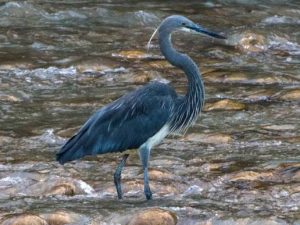
Researchers from the Wildlife Institute of India (WII) recorded a sighting of the critically endangered White-Bellied Heron along the Lohit River in Arunachal Pradesh recently.
- White-Bellied Heron is a large, fish-eating bird found across parts of the Eastern Himalayas.
- Scientific Name: Ardea insignis
- It is also known as the imperial heron or great white-bellied heron.
- It is regarded as one of the world’s most threatened bird species – listed amongst the top 100 most Evolutionarily Distinct and Globally Endangered (EDGE) species.
- It is mainly living in the foothills of the eastern Himalayas in northeast India and Bhutan to northern Myanmar.
- There are few records of observation from southern China.
- In India, it occurs in the states of Assam and Arunachal Pradesh.
- It inhabits undisturbed, pristine river systems and wetland habitats in the subtropical and temperate forests of the eastern Himalayas.
- Its global population is estimated to be extremely small, with fewer than 100 mature individuals.
- India is believed to have fewer than 10 individuals surviving in the wild.
- Features:
- It is the second largest living species of heron.
- Conservation Status:
- IUCN Red List: Critically Endangered
Barak Point Defence Missile System:
The Ministry of Defence recently signed a contract with Israel Aerospace Industries for the upgradation and obsolescence management of Barak Point Defence Missile System onboard Indian Navy ships at an overall cost of Rs 1,976.40 crore.
- Barak Point Defence Missile System is a shipborne surface to air missile system built for point defence.
- Point defence is the last layer of a warship’s air defence.
- It is meant to destroy threats that get close to the ship, such as anti-ship missiles, aircraft and drones.
- The system was developed in Israel by Israel Aerospace Industries (IAI) along with Rafael Advanced Defense Systems.
- The original Barak point-defence system is generally identified as Barak-1.
- The Indian Navy acquired it in 2000, and it has since been fitted on several frontline warships.
- It is fitted on several major platforms, including the aircraft carrier INS Vikramaditya, Delhi-class destroyers, and Shivalik- and Brahmaputra-class frigates.
- The Barak-1 is slated eventually to give way to the Vertical Launch Short Range Surface-to-Air Missile (VL-SRSAM), being developed indigenously by the Defence Research and Development Organisation (DRDO).
- Features:
- Range: 10 km
- Velocity: In excess of Mach 2
- It is fully automated with the fire control system capable of calculating the level of threats, allocating missile(s) and launching them automatically upon acquisition of the target(s) by the ship’s radar.
- Barak-8 is a modern medium-range air defence system jointly developed by India and Israel.
- It is designed to defend against any type of airborne threat including aircraft, helicopters, anti-ship missiles, UAVs, ballistic missiles, cruise missiles and combat jets.
- The missile has a maximum speed of Mach 2 with a maximum operational range of 70 km, which was later increased to 100 km.
- Barak-8 features a dual pulse rocket motor as well as thrust vector control (TVC), and possesses high degrees of manoeuvrability at target interception range.
- A second motor is fired during the terminal phase, at which stage the active radar seeker is activated to home in on to the enemy track.
- When coupled with a modern air defence system and multi-function surveillance track and guidance radars, Barak-8 is capable of simultaneously engaging multiple targets during saturation attacks.
What is CancerSpot?
The blood test, CancerSpot, that looks for cancer-related changes in DNA has shown the potential to detect multiple types of cancer.
- CancerSpot is a blood test that looks for cancer-related changes in DNA.
- It was developed by Bengaluru-based Strand Life Sciences.
- Cells in the body release small fragments of DNA into the bloodstream. These are known as circulating or cell-free DNA.
- In people with cancer, some of these fragments originate from tumour cells and carry changes that can help identify the disease.
- CancerSpot combines DNA sequencing with AI-based analysis to examine patterns of DNA methylation.
- Methylation refers to chemical modifications of DNA that influence how genes function.
- These patterns differ between cancer cells and normal cells and can be used to identify cancer-associated signals in a blood sample.
- By analysing these patterns, the test aims to detect multiple types of cancer through a single blood test, without requiring a tissue biopsy for the initial detection.
- Recent Study:
- It examined how DNA released by different cells in the body influences the detection of cancer.
- An important finding was that higher levels of circulating DNA were associated with stronger cancer-related signals and better detection sensitivity, even among patients at the same stage of cancer.
- Researchers had expected that the increased release of DNA from immune cells in cancer patients would dilute the tumour-derived DNA signals, making cancer detection more difficult. However, the study found the opposite.
- The findings suggest that DNA released by tumour cells and immune cells increases together in cancer patients, helping strengthen the cancer-related signals in the blood.
- This provides new insights into the interaction between tumours and the immune system and its role in blood-based cancer detection.
What is Surveillance Pricing?

The New York City Council recently passed a bill to ban surveillance pricing, a practice in which businesses use personal data to determine what consumers pay.
- Surveillance Pricing is the practice of collecting personal information about consumers and charging different prices to individual (or groups of) consumers for the same goods or services.
- Businesses can use algorithms to analyse information about an individual and estimate how much they might be willing to pay.
- This can result in consumers shopping for the same exact product paying vastly different prices.
- It often involves the use of data analytics, artificial intelligence, and machine learning algorithms to personalize prices based on a variety of factors.
- These factors may include their location, income, browsing history, previous purchases, demographic characteristics, and online shopping behaviour.
Key Features:
- Data-Driven: Relies on extensive data collection—clicks, time spent on page, demographics, etc.
- Dynamic: Prices can change frequently, even minute-to-minute, based on live signals.
- Personalized: Different users may see different prices for the same product or service.
- Algorithmic: Driven by machine learning models that continuously learn from new data
- Surveillance pricing is different from dynamic pricing: while airlines and ride-hailing platforms commonly adjust prices in response to demand, availability, and other market conditions, surveillance pricing relies on customer-specific information to determine what they are charged.
- Example:
- E-commerce: A customer in a wealthier zip code might see higher prices than one in a lower-income area.
Surveillance pricing is only possible if the merchant has your data. This is gathered via multiple channels, including:- Cookies and device and browser fingerprinting
- Mobile apps that access location or device data
- Loyalty cards and programs that log your past purchases
- Social media activity
- Search behavior (especially when you’re logged into accounts).
- E-commerce: A customer in a wealthier zip code might see higher prices than one in a lower-income area.
Himalayan Marmot:

Scientists have found that the faeces of Himalayan marmots could serve as a valuable biological archive for understanding climate change, vegetation patterns and environmental shifts in the higher Himalaya.
- Himalayan Marmot is a type of herbivorous mammal.
- Himalayan marmots are about the size of a large housecat.
- They are closely related to the woodchuck, the Hoary marmot, and the Yellow-bellied marmot.
- They have a dark chocolate-brown coat with contrasting yellow patches on their face and chest.
- They have stout limbs and short tails. They have five toes on each hind foot and four toes on each forefoot with long concave claws adapted for burrowing.
- It inhabits alpine grasslands throughout the Himalayas and on the Tibetan Plateau.
- It is found in South Asia and in China.
- These are social creatures that live in colonies and excavate deep burrows which colony members share during hibernation.
- These marmots are diurnal and are mostly active in the morning and late afternoon. They hibernate for 6-8 months during the coldest times of the year.
- It relies on local vegetation for food and shelter.
- The important plant groups in the diet of the marmot were Artemisia, Asteroideae, Caryophyllaceae, Poaceae, Cyperaceae and Chenopodiaceae.
- Conservation Status
- IUCN Red List: Least Concern.