
Today’s Current Affairs: 22nd Oct 2026 for UPSC IAS exams, State PSC exams, SSC CGL, State SSC, RRB, Railways, Banking Exam & IBPS, etc
Table of Contents
Low Level Light Weight Radar:
The Ministry of Defence has signed a contract with Bharat Electronic Limited (BEL) to procure Improved Low Level Light Weight Radar (LLLR-I) at a cost of approximately ₹ 770 Cr.

- Low Level Light Weight Radar is a next-generation, multi-mission radar designed to detect and track different types of aerial targets.
- The radar’s four antenna panels are mounted on tripods and are passively cooled.
- This system does not require mechanical movement or liquid cooling.
- It features a built-in self-test function to help identify technical issues.
- It operates via a control and display unit (CDU) which allows operators to remotely control radar modes and view the air situation through a human-machine interface.
- It uses four fixed phased-array antenna panels to provide complete 360-degree surveillance.
- Technology:
- Active Electronically Scanned Array (AESA) technology: The system uses Active Electronically Scanned Array (AESA) technology, which allows it to electronically direct radar beams rather than physically move the antenna.
- It also incorporates Gallium Nitride (GaN) amplifiers and digital beamforming technology to improve radar performance.
- Three-Dimensional Processing: It uses advanced three-dimensional processing capabilities to distinguish targets from unwanted radar returns and reduce the effects of multipath interference.
- It is crucial for detecting small drones and other low-RCS (low radar cross-section) targets.
- Tracking:
- It can automatically track targets while continuing to scan the surrounding airspace through its Track While Scan capability.
- It can also prioritise detected aerial targets, allowing the Army to identify threats that require attention.
- Its monopulse tracking technique provides accurate target tracking in elevation.
- It has ability to provide target information to weapon systems through wired or wireless communication links.
- Electronic Counter-countermeasure (ECCM) Capabilities: It also incorporates ECCM capabilities, designed to help maintain radar performance in the presence of electronic interference.
- Adoptability: It is light weight operable in plains, desert and high altitude terrain.
- It has the capability of detecting and tracking fighter size targets and mini/ micro drone and also has additional capability of prioritizing aerial targets.
Diamondiyne:

Scientists have created a new form of carbon called diamondiyne.
- Diamondiyne is a newly synthesized, three-dimensional carbon allotrope.
- It consists of a three-dimensional network of carbon atoms that resembles a diamond but with a more open structure.
- It is created using relatively inexpensive equipment, with the material forming as a thin film where two liquids meet.
- The researchers describe diamondiyne as a carbo-mer of diamond: diyne units are inserted between carbon centres in the diamond-topology network, expanding the structure.
- Structure:
- Diamondiyne crystallizes with the carbon atoms arranged as tetrahedra connected corner to corner in all three dimensions.
- It preserves the overall diamond-like topology but incorporates carbon atoms with different bonding arrangements.
- The ideal diamondiyne model has a face-centred cubic crystal structure, with sp and sp³ carbon in an 8-to-1 ratio.
- The structure combines sp-hybridised carbon atoms, which participate in triple bonds, with sp³-hybridised carbon atoms connected through single bonds.
- The resulting diyne groups expand the repeating network compared with diamond, creating more space within the structure. (The ‘y’ in the material’s name comes from the presence of carbon-carbon triple bonds.)
What is GSAT-7B?

In a major leap for India’s military communication infrastructure, the ISRO is slated to launch the Indian Army’s first dedicated communications satellite, the GSAT-7B, by mid-2028.
GSAT-7B:
- It is the Indian Army’s first dedicated communications satellite.
- It is part of the GSAT-7 series
- It is expected to be launched by the Indian Space Research Organisation (ISRO) around mid-2028.
- It will be the heaviest communication satellite India has ever built.
- It will sit in a geostationary orbit.
- Till now, the Indian Army has been dependent on GSAT-7A and other surveillance satellites like the RISAT 2BR1 imaging satellite for communication and surveillance operations.
- GSAT-7B is designed to provide Indian Army beyond-line-of-sight communications for deployed troops and military formations, as well as weapon systems, airborne platforms, and other mission-critical assets.
- It will provide the army with secure, round-the-clock connectivity across remote border areas and challenging terrain, supporting day-to-day military operations and effective battlefield command and control.
GSAT 7 Series Satellites:
- They are advanced communication satellites developed by the ISRO to meet the communication needs of the Indian defence services.
- GSAT-7 (Rukmini):
- It is an advanced communication satellite developed by ISRO and primarily provides communication services to the Indian Navy.
- It is India’s first military satellite.
- It was launched in 2013 from an Ariane 5 ECA rocket from Kourou in French Guiana.
- GSAT 7A:
- It was launched in 2018.
- It primarily provides communication services to the Indian Air Force.
- It also helps in satellite-controlled operations of UAVs.
- GSAT-7R (CMS-03):
- It was launched in 2025, a replacement for the Rukmini satellite.
- The homegrown satellite enables seamless and secure communications between warships, aircraft, submarines, and maritime operations centres
Kharg Island:

Trump is reportedly considering strikes on Iran’s strategic Kharg Island oil hub to pressure Tehran over its nuclear programme and the Strait of Hormuz, although the claims remain unconfirmed.
- Kharg Island is a small coral island in Iran located in the northern Persian Gulf.
- It is one of relatively few Persian Gulf islands with natural freshwater resources, making it suitable for settlement by small populations.
- The island experiences hot and humid summers, and its highest point, Mount Didehban, stands at 87 meters above sea level.
- It facilitates as much as 90 percent of the country’s oil exports and is vital for Iran’s economy.
- Its strategic significance lies in its proximity to the Strait of Hormuz, a crucial global oil passage.
Taleju Bhawani Temple:

On the occasion of Maha Navami, the ninth day of the festival, the historic Taleju Bhawani Temple in Kathmandu recently opened its doors to devotees.
- Taleju Bhawani Temple is located in Kathmandu, Nepal.
- The temple lies within Kathmandu Durbar Square, part of the Kathmandu Valley UNESCO World Heritage property.
- It is dedicated to Goddess Taleju Bhawani, regarded as a form of Goddess Durga.
- The temple was constructed in the 16th century by King Mahendra Malla.
- The Malla dynasty, which ruled the Kathmandu Valley from the 12th to the 18th century, is deeply intertwined with the worship of Goddess Taleju Bhawani.
- For the general public, the temple opens its doors just once a year during Maha Navami (the ninth day of Dashain).
- It is a masterpiece of Newar pagoda architecture.
- Key architectural features include:
- Three-tiered pagoda roof with elaborately carved eaves and gilded finials.
- 12-stage plinth representing the layers of the universe and spiritual ascent.
- Four main decorative gateways, each guarded by stone lions.
- Golden statues of the ten-armed goddess inside the inner sanctum.
- Elaborately carved wooden windows and torana (ornamental arches above doorways).
- The overall layout is modeled on the Shri Yantra, the sacred geometric diagram believed to embody the goddess herself.
Puzhal Lake:
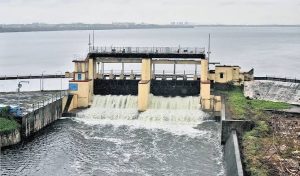
The bodies of two 14-year-old schoolboys who drowned in Puzhal Lake near Murugambedu were recovered recently.
- Puzhal Lake, also known as Red Hills Lake, is a manmade freshwater lake located in Tamil Nadu.
- It was built in the 19th century, during the British Period.
- It is one of the three main rain-fed reservoirs from where water is being drawn to be supplied in the city of Chennai, the other two being the Chembarambakkam Lake and Porur Lake.
- It’s like a giant natural storage tank that collects rainwater and water from other sources.
- This water is then treated and sent through pipes to homes and businesses across the city.
- At the lake, there is a tower esteemed as Jone Tower, which is used to calculate the depth of the water level in the lake.
- This tower was built in the year 1881 and is the main attraction of the lake.
- It provides critical refuge for resident waterbirds and long-distance migratory avifauna.
- During autumn and winter, trans-continental migrants arrive across the Central Asian Flyway (CAF), seeking open water and abundant foraging grounds.
People for the Ethical Treatment of Animals (PETA) : In News
 Animal rights organisation PETA India recently called for withdrawal of the Centre’s proposed rules on animal experimentation, claiming it could weaken existing protections for animals.
- People for the Ethical Treatment of Animals (PETA) is a nongovernmental organization (NGO) committed to ending abusive treatment of animals in business and society and promoting consideration of animal interests in everyday decision-making and general policies and practices.
- It is the largest animal rights organization in the world.
- PETA was founded in 1980 by Ingrid Newkirk and Alex Pacheco, who were influenced by Australian ethicist Peter Singer’s book Animal Liberation (1975).
- It is based in Norfolk, Virginia, United States, with entities worldwide.
- Initially recognized for exposing cruelty in research laboratories, PETA has grown into a global entity with over ten million members and considerable annual expenditures.
- The very heart of all of PETA’s actions is the idea that it is the right of all beings—human and nonhuman alike—to be free from harm.
- PETA advocates that animals should not be used for human benefit and promotes alternatives made possible by technological advancements.
- PETA opposes speciesism, a human-supremacist worldview, and focuses on the four areas in which the largest numbers of animals suffer the most intensely for the longest periods of time:
- in laboratories
- in the food industry
- in the clothing trade and
- in the entertainment business
- PETA also works on a variety of other issues, including the cruel killing of rodents, birds, and other animals who are often considered “pests” and cruelty to domesticated animals.
- PETA works through public education, investigations, research, animal rescue, legislation, protests, and negotiations with companies and regulatory agencies.