
Today’s Current Affairs: 23rd jul 2026 for UPSC IAS exams, State PSC exams, SSC CGL, State SSC, RRB, Railways, Banking Exam & IBPS, etc
Table of Contents
Hedychium zubeengargianum : New species of ginger lily
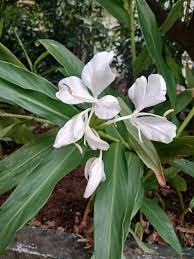
A new species of ginger lily named Hedychium zubeengargianum was recently discovered in Shillong.
- Hedychium zubeengargianum is a new species of ginger lily.
- It was identified by botanists at the Botanical Survey of India (BSI), Eastern Regional Centre, Shillong, Meghalaya, after years of studying an unusual plant growing in the institute’s botanical garden.
- Although it had been growing there since at least 2018, its original source could not be traced because no collection records were available.
- The species was named after Meghalaya-born Assamese music legend Zubeen Garg.
- Popularly known as ginger lilies, Hedychium species are among the Northeast’s most striking flowering plants.
- India is home to about 41 taxa, most of them occurring in the biodiversity-rich landscapes of the Northeast and the Western Ghats.
- Hedychium zubeengargianum stands apart from its closest relative, Hedychium gracile, by its creamy-white fragrant flowers, yellow anthers, densely hairy flowering stalk, and an earlier flowering season from April to May.
Borophene:
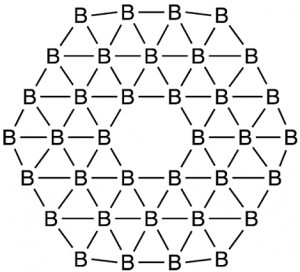
Scientists in India recently achieved a significant breakthrough in sustainable lubrication by demonstrating, for the first time, the use of borophene as a high-performance lubricant additive in castor oil.
Recent Findings:
- Friction and wear are major causes of energy loss and equipment failure in industries worldwide.
- Developing advanced lubricants that can effectively minimize these losses is therefore a key scientific and technological challenge.
- While castor oil is an attractive renewable and biodegradable lubricant, its performance can be further enhanced using suitable additives.
- The recent study found that adding just 0.1 percent borophene by weight to castor oil reduced friction by around 42 percent compared to pure castor oil, while also improving wear resistance and load-bearing capacity.
- The researchers found that borophene disperses uniformly in castor oil without requiring chemical modification.
- During operation, it forms a durable protective layer, known as a tribofilm, comprising iron oxides, carbon-based compounds, and boron-containing compounds.
- This layer reduces shear stress, protects contact surfaces, and minimises wear.
- This research has the potential to transform the lubrication industry by advancing renewable energy systems, marine applications, green lubrication technologies, and sustainable manufacturing.
Borophene:
- It is an allotrope of boron.
- It is composed of a single-atom-thick sheet of boron atoms arranged in a two-dimensional (2D) lattice.
- Unlike graphene, which consists of carbon atoms in a perfect hexagonal structure, borophene is highly polymorphic — meaning its atomic structure can vary depending on the synthesis conditions, leading to multiple possible configurations.
- First predicted by theory in the mid-1990s, different borophene structures were experimentally confirmed in 2015.
- It is known for its ultra-light weight, flexibility, and exceptional strength.
- It has excellent properties, including thermal and electrical conductivity, high capacitance, metallic nature, etc.
- Its electrical and mechanical properties vary with direction, offering tunable features for specialized applications.
- It is highly reactive, allowing strong interaction with other atoms or molecules, which is valuable in catalysis, energy storage, and sensor t
- Due to these outstanding properties, borophene is mainly used in a range of applications in the fields of thin-layer electronics, optoelectronics, capacitors, and biosensors.
Karlapat Bauxite Block:
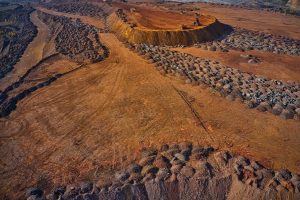
Some of India’s biggest industrial groups, including Adani, Reliance Industries, Hindalco, Vedanta Aluminium, Naveen Jindal-backed Powercem and Coal India, are eyeing Odisha’s Karlapat bauxite block.
- Karlapat Bauxite Block is a bauxite deposit in Odisha’s Kalahandi
- It is a greenfield mining block, which means it has not previously been commercially mined.
- The deposit is classified under proved and possible resource categories and records an alumina content of about 45.2 per cent with low silica content.
- India’s major bauxite resources are concentrated in the East Coast deposits of Odisha and Andhra Pradesh.
- Odisha accounted for 41 percent of India’s bauxite resources.
- In Odisha, bauxite occurs in Balangir, Kalahandi, Kandhamal, Kendujhar, Koraput, Malkangiri, Rayagada and Sundargarh districts.
- Bauxite is the only commercial ore used to produce aluminium.
- Aluminium is the second most abundant metal used by industry after silica-based materials and finds applications across transport, construction, power, chemicals and manufacturing.
Kawal Tiger Reserve : Priority Recipient Site For Tiger Recovery
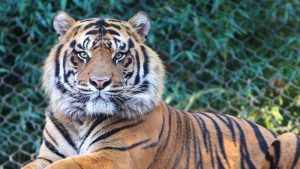
The National Tiger Conservation Authority (NTCA) recently identified Kawal Tiger Reserve in Telangana as a ‘priority recipient site’ for tiger recovery.
- Kawal Tiger Reserve is located in the Telangana.
- It is along the banks of the river Godavari, forming part of the Deccan peninsula-central highlands.
- Geographically, the reserve is situated at the southernmost tip of the Central Indian Tiger Landscape, having linkages with the Tadoba-Andhari (Maharashtra) and Indravati (Chhattisgarh) tiger reserves.
- It is a major catchment of the river Godavari and local rivulets like Peddavagu and Kadam.
- It has diverse habitats comprising dense forests, grasslands, rivers, streams, and water bodies.
- Southern Tropical Dry Deciduous Forest.
- It consists of teak along with bamboo and other species like Anogeissus latifolia, Mitragyna parviflora, Terminalia crenulata, Terminalia arjuna, Boswellia serrata, etc.
- It has a faunal diversity which is typical of the Deccan Plateau.
- The major wild animals include: tiger, nilgai, chousinga, chinkara, black buck, sambar, spotted deer, wild dog, wolf, jackal, fox, leopard, and the jungle cat.
Samudra Pradakshina : In News

Raksha Mantri flagged-in ‘Samudra Pradakshina’, the first ever Tri-service all-women circumnavigation sailing expedition through video conferencing recently.
- Samudra Pradakshina was the first ever Tri-service all-women circumnavigation.
- The expedition brought together officers from the Army, Navy and Air Force on a single mission.
- The expedition successfully fulfilled all internationally recognised criteria for a circumnavigation by
- crossing all meridians of longitude;
- crossing the Equator twice;
- crossing the International Date Line; and
- rounding the Three Great Capes – Cape Leeuwin (Australia), Cape Horn (South America) and the Cape of Good Hope (Africa).
- The successful passage through the formidable Drake Passage and rounding of Cape Horn earned the crew membership of the prestigious fraternity of Cape Horners, an honour reserved for sailors who conquer one of the world’s most demanding maritime passages.
- The mission was made possible through meticulous planning, nearly two years of intensive training, and a dedicated 24X7 shore-based support network.
Methane : New Study In Nature Food
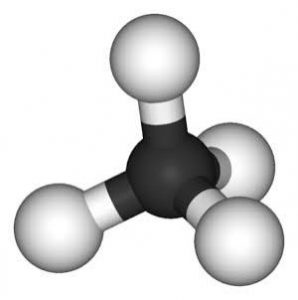
A new study in NatureFood has found that India’s rice fields now rank among world’s top methane hotspots.
- Methane is a hydrocarbon that is a primary component of natural gas.
- It is a potent greenhouse gas, responsible for about 30% of the global temperature rise since the Industrial Revolution.
- It is the primary component of natural gas and a byproduct of fossil fuel exploration.
- It is more efficient at trapping heat over a 20-year-period than carbon dioxide.
- The three major anthropogenic sources of methane emissions are agriculture, energy, and waste sectors.
- It is a colourless, odourless, and highly flammable gas, also known as marsh gas.
- It remains in the atmosphere for a shorter period — about 12 years — than carbon dioxide,
- It traps far more heat in the near term, making it a key driver of short-term climate change, contributing to global warming, more than carbon dioxide for every tonne.
Sal Borer:
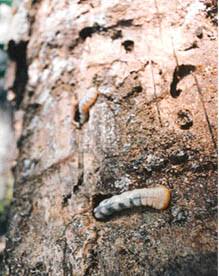
The Madhya Pradesh forest department has sought permission from the central government to fell nearly 150,000 sal trees in Dindori district after a severe infestation of sal borer insects.
- Sal Borer is a beetle of the order- Coleoptera, family-Cerambycydae.
- It is the most devastating insect pest responsible for catastrophic damage of sal forests of the country.
- It looks dark brown in color and has about the size of a human finger.
- It causes extensive damage to sal trees both in standing as well as freshly felled timbers.
- The less vigorous, weak, unhealthy trees or those with reduced vitality are easily attacked or killed due to borer.
- The attack of the borer is considered epidemic when the sal trees affected are more than 1% of the total number of trees.
- Sal Tree is called the ‘Sentinel of the Forests’ because it can live for dozens of years and has the ability to withstand environmental changes.
- It is found naturally in Uttarakhand, Terai region of Uttar Pradesh, Jharkhand, Odisha, Madhya Pradesh, Chhattisgarh and West Bengal.
- It can tolerate temperatures as high as 40-45°Celcius in summers and as low as 5°Celcius in winters.
- It can be grown in the plains, provided there is light loamy soil with good drainage and the area receives approximately 1000 mm – 3000 mm of annual rainfall.
- It requires a warm and humid climate and can thrive at altitudes up to 1500 metres above the sea level.
- This tree can live up to 100 years and doesn’t require frequent watering or care.
Harishchandragad Fort:
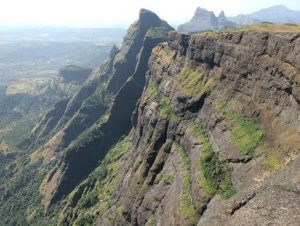
Four tourists from Mumbai were seriously injured recently during a landslide while they were descending the Harishchandragad fort in Ahilyanagar district of Maharashtra.
- Harishchandragad Fort is a hill fort located in the Ahmednagar district of Maharashtra.
- The fort originally dates back to the 6th century during the rule of the Kalchuri dynasty.
- The citadel was built during this era, and various caves probably have been carved out in the 11th century
- Later the fort was under the control of the Mughals and the Marathas captured it in 1747
- Remnants of microlithic human inhabitants have been discovered here.
- The various Puranas, like Matsyapurana, Agnipurana, and Skandapurana, have many references about Harishchandragad.
- One of the most prominent structures on the fort is the Harishchandreshwar Temple, dedicated to Lord Shiva.
- Built in the Hemadpanti architectural style, the temple boasts intricate carvings and a massive Nandi sculpture at its entrance.
- The temple’s sanctum houses a shivling, making it a revered pilgrimage site.
- The Konkan Kada, or the Konkan Cliff, is one of Harishchandragad’s most striking features.
- This semicircular overhanging cliff offers stunning views of the Konkan region, and during certain seasons, a rare phenomenon called the “Brocken Spectre” can be observed, where one’s shadow appears on the clouds with a rainbow halo.
Okinotori Island:
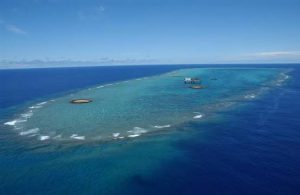
A Chinese navy destroyer, alongside Russian vessels, recently conducted live-fire drills near Japan’s Okinotori Island, marking the first such disclosure by Japan.
- Okinotori, also known as Parece Vela, is a tiny, uninhabited island that belongs to Japan.
- It’s located far out in the Philippine Sea, which is part of the big Pacific Ocean.
- It’s actually an atoll, which is a ring-shaped coral reef with a lagoon in the middle.
- At high tide, only two tiny rocky outcrops remain above sea level.
- This atoll is part of a long underwater mountain range called the Palau-Kyushu Ridge.
- Okinotori is part of a group called the Ogasawara Islands governed by Japan.
- It is Japan’s southernmost island.
- It is the only Japanese territory south of the Tropic of Cancer and lies to the south of Hong Kong and Taiwan.
- Japan says that the waters around Okinotori are its Exclusive Economic Zone (EEZ).
- However, some other countries, like China, do not agree with Japan’s claim over this specific EEZ.
- It is in a very important spot for military and shipping routes.
- It sits about halfway between Taiwan and Guam (island territory of the United States).
- This makes its location strategic in the Pacific Ocean.
Internet Shutdowns in India:
Following a mobile internet shutdown in Central Delhi during the Cockroach Janta Party’s (CJP) ‘Chalo Sansad’ protest, concerns have been raised over the use of internet shutdown powers under the Telecommunications Act, 2023.An internet shutdown is an intentional, state-ordered disruption of telecommunications or digital communications. It renders internet services inaccessible or unusable within a specific geographic location—ranging from throttling network bandwidth and blocking targeted social platforms to executing complete network blackouts.As affirmed by the judiciary, shutdowns directly impact Article 19(1)(a) (Freedom of Speech and Expression), Article 19(1)(g) (Right to Practice Trade/Profession), and Article 21 (Right to Life and Personal Liberty).Governed under Section 20(2)(b) of the Telecommunications Act, 2023 and the Telecommunications (Temporary Suspension of Services) Rules, 2024.
Polymer Currency Notes:
The Reserve Bank of India (RBI) is actively reviving a decade-old plan to introduce polymer (plastic) currency notes.The Bharatiya Reserve Bank Note Mudran Private Limited (BRBNMPL), a wholly-owned subsidiary of the RBI, issued a global Expression of Interest (EOI) for the supply of Biaxially Oriented Polypropylene (BOPP)-based polymer substrate.This marks a significant step towards a potential pilot rollout of polymer notes, expected to begin with lower denominations of Rs 10 and Rs 20. Polymer banknotes are currency notes made from biaxially oriented polypropylene (BOPP) unlike traditional Indian currency which is made of 100% cotton-pulp paper,Polymer banknotes are more durable, water-resistant, tear-resistant, and difficult to counterfeit due to advanced security features such as transparent windows and embedded security elements.Over 60 countries, including Australia (the first to introduce a full polymer banknote series in 1988), use polymer currency in some form.Polymer notes generally last 2.5–4 times longer than paper banknotes.



