
Today’s Current Affairs: 7th Oct 2026 for UPSC IAS exams, State PSC exams, SSC CGL, State SSC, RRB, Railways, Banking Exam & IBPS, etc
Table of Contents
What is the M51.3 Missile?

France recently test-fired for the first time its new M51.3 nuclear-capable ballistic missile from a nuclear-powered submarine.
- The M51.3, built by ArianeGroup, entered service on 24 October 2025.
- It was developed as a further evolution of the M51 missile family.
- It is being considered as the primary weapon system for France’s next-generation SNLE 3G strategic nuclear-powered ballistic missile submarines, which are expected to gradually replace the Le Triomphant-class submarines after 2035.
- It is a solid-propellant, three-stage launcher weighing over 50 metric tons and measuring 12 meters long.
- It is equipped with new oceanic nuclear warheads (TNO-2).
- Public estimates for the wider M51 family put its range at around 9,000 km (5,600 miles) or more, while French officials have indicated that the latest variant has a greater reach.
- For navigation, the missile uses, among other systems, Europe’s Galileo satellite navigation system.
Who are Maldharis?

The Gujarat government recently announced a scheme for the voluntary relocation of maldharis (semi-nomadic pastoralists) from the Barda sanctuary in Porbandar and Devbhumi Dwarka districts, being developed as a ‘second home’ for Asiatic lions.
- They are a semi-nomadic pastoralist community primarily residing in Gujarat’s Banni grasslands, Gir Forest, and parts of Rajasthan.
- The term “Maldhari” translates to “keeper of livestock,” reflecting their deep-rooted tradition of herding cattle, sheep, goats, and camels.
- Their livelihoods revolve around the production of milk, ghee, wool, and artisanal crafts, which they trade in local markets.
Women play a significant role in livestock rearing, while men typically handle foraging, selling milk to dairies, and selecting grazing routes.
Maldhari women are known for their artistic skills, particularly their unique embroidery, which varies by caste and is passed down through generations.
Language: They speak Kachchhi in the Sindhi dialect.
Religion: They are predominantly Muslim, accounting for about 90% of the population, while the remaining 10% belong to Hindu communities.
Chamkharchhu-I Hydropower Project:
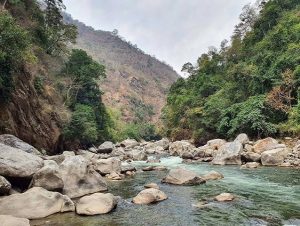
Adani Power and Bhutan’s state-owned generation utility, Druk Green Power Corporation Ltd (DGPC), have signed a Shareholders Agreement to develop the 770 MW Chamkharchhu-I Hydroelectric Project in Bhutan.
- It is a 770 MW run-of-river hydropower project planned on the Chamkharchhu River in the Zhemgang district of central Bhutan.
- The project will be developed through a 49:51 equity partnership, with Adani Power holding 49% and Bhutan’s state-owned DGPC holding 51%.
- It will be implemented under the Build, Own, Operate, and Transfer (BOOT) model and will have a 30-year concession from the date of commercial operation (COD).
- Key project components include a 108-m concrete gravity dam, a 19.2-km headrace tunnel, and an underground powerhouse.
- Chamkharchhu-I is expected to help meet Bhutan’s peak winter electricity requirements while enabling surplus generation to be exported to India during the summer.
Veerangana Durgavati Tiger Reserve (VDTR):

Madhya Pradesh is planning to establish its third cheetah habitat at Veerangana Durgavati Tiger Reserve (VDTR), earlier known as Nauradehi, with the first pair of cheetahs scheduled for release into the reserve.
- Veerangana Durgavati Tiger Reserve (VDTR) is spread across three districts, i.e. Sagar, Damoh and Narsinghpur, of Madhya Pradesh.
- It encompasses areas within the Nauradehi Wildlife Sanctuary and Durgavati Wildlife Sanctuary.
- The entire Sanctuary is situated on a plateau, forming part of the upper Vindhyan range.
- The Reserve is classified under the Deccan Peninsula biogeographic region.
- It covers an area of 2,339 sq.km.
- It is named for Rani Durgavati, the queen of the Gondi people.
- The reserve boasts a diverse landscape, with hills, valleys, rivers, streams, waterfalls, and grasslands.
- It straddles parts of the Narmada and Yamuna River basins.
- The north-flowing Kopra River, Bamner River, and Bearma River, which are tributaries of the Ken River, are the major rivers of this protected area.
- Some smaller streams flow south to the Narmada River in the south of the Reserve.
- The Singorgarh Fort is located within the reserve.
- It mainly consists of Dry deciduous
- The chief floral elements include Teak, Saja, Dhaora, Ber, Amla, etc.
- Tiger, leopard, wolf, jackal, Indian fox, striped hyena, Nilgai, Chinkara, Chital, Sambhar, Black Buck, Barking deer, Common Langur, Rhesus Macaque, etc.
- It is one of the few remaining strongholds for the White-Rumped and the Indian Vultures, critically endangered raptors of India.
Advanced High-Altitude Parachute:
The Defence Research and Development Organisation (DRDO) has conducted the maiden live jump of the indigenously developed Advanced High-Altitude Parachute (AHAP) at Nyoma (Mudh DZ) in Ladakh.
- Advanced High-Altitude Parachute is a static-line parachute system for the mass drop of paratroopers.
- It has been designed and developed by DRDO’s Aerial Delivery Research and Development Establishment (ADRDE), Agra.
- The system has been manufactured by Ordnance Parachute Factory (OPF), Kanpur.
- It is certified by the Centre for Military Airworthiness and Certification (CEMILAC), RCMA Kanpur.
- The parachute offers multiple deployment modes and an operational altitude range of up to 18,000 feet, with a rate of descent suited to the tactical requirements of the Indian Defence Forces in high-altitude terrain.
- Static-line parachute jumps at such altitudes pose significant challenges due to high opening shock and rate of descent.
- Centre for Military Airworthiness and Certification is the certification agency of Defence Research and Development Organisation (DRDO)
- Its primary function is the certification of military aircraft and airborne systems.
- The Airworthiness function is implemented through the fourteen Regional Centres of Military Airworthiness (RCMAs) located across India.
- CEMILAC, along with RCMAs with a specific core competence carries out airworthiness certification of military airborne products designed and developed by DRDO laboratories, other government agencies, ordnance factories, defence public sector units and private industries.
Press Council of India:
It was observed that the Press Council of India (PCI), has been operating at half its sanctioned strength for nearly a year now, without a single working journalist or newspaper editor.
- Press Council of India is a statutory quasi-judicial autonomous authority, re-established in 1979 under the Press Council Act, 1978.
- Objectives
- Preserving the freedom of the press.
- Maintaining and improving the standards of newspapers and news agencies in India.
- The Chairman, typically a retired Supreme Court judge, is nominated by a committee that includes the Chairman of the Rajya Sabha, the Speaker of the Lok Sabha, and an elected representative from the 28 members.
- Of the 28 members, 13 represent working journalists, which include six editors and seven other working journalists, other than editors of newspapers.
- 6 members represent newspaper owners or managers, with two each from large, medium, and small newspapers.
- One member comes from the news agency sector.
- The Press Council of India comprises 5 representatives from Parliament—3 nominated by the Speaker of the Lok Sabha and 2 by the Chairman of the Rajya Sabha.
- 3 members representing education, law, and literature are nominated by the University Grants Commission, Bar Council of India, and Sahitya Akademi.
- Powers of Press Council of India:
- Helping newspapers to maintain their independence;
- Building up a code of conduct for journalists and newspapers according to high professional standards;
- Reviewing any development which is likely to restrict the supply and dissemination of news of public interest and importance;
- Reviewing such cases where assistance has been received by any newspaper or news agency in India from foreign sources, as referred to it by the Central Government;
- It adjudicates the complaints either against the Press for violation of journalistic ethics or by the Press for interference with its freedom.
SME Growth Fund:

The Union Cabinet approved the Government of India’s commitment of Rs.10,000 crore towards the establishment of the SME Growth Fund (SGF).
- SME Growth Fund is aimed at catalysing growth-oriented capital for India’s Small and Medium Enterprises (SMEs).
- It enables the emergence of champion Indian enterprises across manufacturing, services, technology, innovation-driven sectors, and strategic value chains.
- It is envisioned as a transformational instrument to support enterprises at critical inflection points in their growth journey.
- It is designed as a direct equity investment fund 10,000 crore and will operate in the form of Alternative Investment Fund (AIF) established under the SGF framework.
- Strategic Focus of the SME Growth Fund:
- A major share of the SME Growth Fund’s allocations will be directed towards small and medium manufacturing-focused enterprises.
- It will consider SMEs operating in industrial clusters in Tier-II and Tier-III cities.
- It is intended to support firms seeking to expand manufacturing capacity, adopt advanced technologies, improve productivity and strengthen export competitiveness.
- This is expected to support balanced regional industrial development, strengthen local supply chains and generate quality employment opportunities.
Integrated Transport & Logistics Authority:

The Union Cabinet chaired by Prime Minister of India has approved the setting up of a Special Purpose Vehicle (SPV) — Integrated Transport and Logistics Authority (ITLA).
- Integrated Transport & Logistics Authority will function as a specialised institutional mechanism for research, planning, project appraisal, monitoring and impact assessment across transportation and logistics.
Key responsibilities of Integrated Transport & Logistics Authority:
- ITLA will function as the apex body for integrated transport and logistics planning, research, project appraisal and monitoring, policy support and data analytics.
- ITLA will prepare a comprehensive National Transport Master Plan with a planning horizon of ten years or more,
- It covers roads, railways, ports and shipping, civil aviation, inland waterways, coastal shipping, urban mobility and logistics.
- ITLA will evaluate short-term sectoral plans (5 years or so) and annual plans of transport Ministries to ensure their alignment with the National Transport Master Plan and promote multi-modal infrastructure development.
- It will undertake technical appraisal of infrastructure projects of the Government of India, costing Rs.500 crore or more.
- It will monitor implementation of transport & infrastructure projects above Rs.500 crore and provide a coordinated mechanism to resolve issues.
- National Transport Data Repository (NTDR): The repository will integrate transport and logistics data from multiple sources, including GSTN e-way bills, FASTag, Vahan, GPS-based systems and urban traffic management systems.
- The authority will use the integrated data for analytics, including freight-flow and origin-destination analysis, to support planning, project monitoring and impact assessment.
- It advises and assists in the review and updating of the National Logistics Policy (2022)
- Promote Research & Innovations in transport and logistics sectors.



