
Today’s Current Affairs: 8th Sep 2026 for UPSC IAS exams, State PSC exams, SSC CGL, State SSC, RRB, Railways, Banking Exam & IBPS, etc
Table of Contents
Hindon River: In News
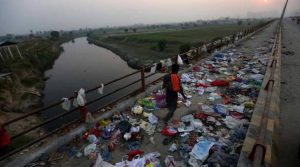
Two men are feared to have drowned in the Hindon River near Haibatpur in Greater Noida recently.
- Hindon River is a tributary of the Yamuna River.
- It originates in the Saharanpur district of Uttar Pradesh, in the Siwalik Hills.
- It flows across the industrial belt of Western Uttar Pradesh and Haryana before merging with the Yamuna River near Noida.
- The river is entirely fed by rain, with a significant increase in water flow during the monsoon
- The Kali (West) River and Krishni River are the main tributaries.
- It is on the banks of this river that archeologists found traces of the Harappan civilization with sites dating back to as long as 2500 BC.
- The Hindon River was a site for several skirmishes between Indian troops and British soldiers in the first revolt of independence 1857, including the battle of Badli-ki-serai, and the graves of British soldiers and officers can still be seen.
- Due to urban, agricultural, and industrial waste which is being released without sufficient treatment into its waters, the Hindon is now one of the most polluted stretches in the Ganga basin.
- In 2015, the Central Pollution Control Board (CPCB) found the Hindon’s pollution levels were so severe that it was declared a ‘dead river’ and ‘unfit’ even for bathing in several sections of the river.
Shekhawati Havelis:
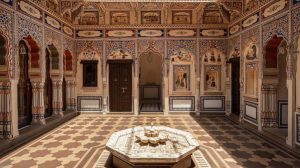
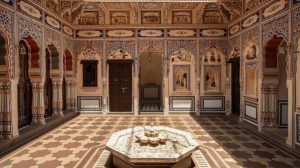
The state government announced recently that the historic and richly frescoed havelis of Rajasthan’s Shekhawati region have been included in UNESCO’s tentative list.
- Havelis are old mansions or large townhouses constructed around an open courtyard.
- The name comes from the Arabic hawali, a “private space,” since they were originally enclosed family dwellings.
- This type of building is found throughout India, but particularly in northwestern India (Rajasthan, Punjab, and Gujarat), where large climatic variations pose challenges in terms of living comfort.
- These multi-story houses—frequently constructed by royalty or merchants—have central courtyards (generally with fountains) that bring in light and ventilation in the hot climate of India.
- Contrary to Western mansions, havelis focus on inwardly facing design with intricately ornamented balconies (jharokhas), latticework screens, and frescoed walls.
- Originally busy family residences, numerous havelis now are “living museums” of India’s history, restored as heritage hotels or cultural centers.
- Shekhawati Havelis located in the northeastern Rajasthan, the Shekhawati region is often associated with its magnificent havelis covered in intricate wall paintings.
- Towns and villages across the region feature historic mansions whose façades, courtyards and interiors showcase detailed frescoes.
- These paintings depict a fascinating mix of themes, ranging from Hindu mythology and royal and local traditions to scenes influenced by everyday life and changing times.
- Some artworks also reflect the arrival of modern technology and foreign influences, creating a distinctive visual record of the region’s history.
- The havelis themselves are equally notable for their architectural details, including ornate gateways, balconies, courtyards, carved elements, and decorative façades.
- Together, the buildings and paintings create a unique urban landscape that sets Shekhawati apart from other heritage regions of Rajasthan.
Barakuru:
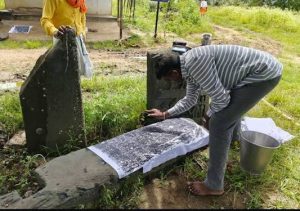
A historically significant Siditale hero stone has been recently discovered at Barakuru during an epigraphical survey of the Panchalingeshwara Temple.
- Barakuru, also known as Barkur, is an ancient historical port town located in Udupi district, Karnataka.
- It is situated on the banks of the river Sita.
- The place was called by several names in ancient times as Varakula, Barakanur, and Barahkanyapura.
- The port town was a busy commercial centre almost from the 2nd century B.C.
- Evidence of Megalithic and Mesolithic ages has been discovered recently.
- The maritime port enjoyed massive economic prosperity, trading extensively with foreign nations across the wide Arabian Sea.
- The Alupa rulers converted this commercial centre into a political centre by making it their capital during the 10th-11th centuriesD.
- It led to further development of socio-economic activities. With new vigour the city became the heart and hearth of the Tuluva culture.
- In later times, the city became the provincial headquarters of the Hoysalas and then the Vijayanagara Empire. The city was expanded with a new fort during this period.
- Further, Barakur witnessed the rule of Keladi Nayaks, Haider, and Tipu of Mysore and the British.
- The city had ten extensions called Keris–each being named after its professional residents. Each Keri had a tank and a number of temples.
- The town’s main attractions are the temples with typical tiled roofs.
- It once housed an incredible network of exactly 365 temples. The deeply pious Alupa kings strictly visited one unique temple each day of the entire calendar year.
- The Panchalingeshwara Temple situated at the southern end of the town is the most famous among the temples here.
- Barkur was also a Jain settlement in the ancient days.
- The place abounds with history and has yielded a little over 100 stone and several copper plate inscriptions.
- They belong to the Alupa, the Hoysala, the Vijayanagara, and the Keladi periods.
What is a Virtual Private Network?
Authorities in Jammu and Kashmir’s Doda recently ordered a complete ban on the use of Virtual Private Networks (VPNs) across the district for two months, citing concerns over cyber security, unlawful activities and maintaining public order.
- Virtual Private Network (VPN) is a service that creates a secure, encrypted connection between a user’s device and the internet.
- It works by creating an encrypted connection, often called a tunnel, between a device and a secure server operated by the VPN provider.
- By routing web traffic through the isolated digital tunnel, it hides the user’s actual IP address and protects their data from unauthorized interception.
- This ensures privacy and data security when accessing corporate networks or utilizing public internet connections.
- VPNs protect data from hackers, mask IP addresses, and are commonly used for secure remote access and bypassing geographic restrictions.
- However, VPNs don’t provide total anonymity, as ISPs can still see the size of incoming and outgoing traffic, but not the content.
- VPNs used for:
- Regular internet users and organizations use VPNs for virtual privacy.
- Organizations deploy VPNs to ensure authorized users can access their data center using encrypted channels.
- VPNs also enable users to connect to a database from the same organization located in a different area.
- VPNs provide remote employees, gig economy freelance workers, and business travelers with access to software applications hosted on proprietary networks.
- When an internet user surfs the web, an attacker could access information, including browsing habits or IP addresses. VPN use banned for two months in Jammu-Kashmir’s Doda.
What is MatsyaMetri?

The Central Marine Fisheries Research Institute (CMFRI), headquartered in Kochi, Keralam, has claimed to have developed a smartphone application that can measure the length and width of fish without physically handling them.
- MatsyaMetri is a smartphone application developed by the Central Marine Fisheries Research Institute (CMFRI).
- It can measure the length and width of fish without physically handling them.
- The application, which has been designed for fisheries scientists, researchers, and field survey teams, facilitates rapid and systematic collection of biological data to support fisheries assessment and management.
- The application simplified biological data collection by automatically recording measurements and generating length-frequency datasets.
- It allows multiple individuals of the same fish species or aquatic resource to be measured under a single sampling session.
- Once measurements are completed, the system automatically generates length-frequency distributions using appropriate class intervals.
- The recorded measurements and the corresponding photographs can be saved along with the sampling session and subsequently exported as a CSV file for further analysis.
RVV BD Missile:
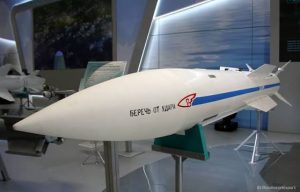
To significantly enhance the beyond-visual-range (BVR) combat capabilities of the IAF, the Ministry of Defence is evaluating a critical proposal to equip the Su-30MKI fighter fleet with Russian-made RVV-BD long-range air-to-air missiles.
- The RVV-BD (Raketa Vozduh-Vozduh Bolshoy Dalnosti) is a Russian-developed beyond-visual-range air-to-air missile.
- The RVV BD is the export version of the R-37M missile, one of the world’s longest-range air-to-air missiles.
- It is specifically designed to engage strategic targets such as Airborne Early Warning and Control (AEW&C) aircraft, airborne command platforms, and other critical aerial assets.
- It is known that the missile that has a maximum firing range in the forward hemisphere of up to 200 kilometres.
- The missile travels at hypersonic speeds of around Mach 6.
- It carries a 60 kg high-explosive fragmentation warhead and uses a radioactive proximity fuse plus contact sensor for assured detonation.
- It is equipped with an active-passive radar homing head, an inertial guidance system, and a radio correction link.
The National Commission for Safai Karamcharis (NCSK):
The Department of Social Justice and Empowerment appointed Shri Bhagwat Prasad Makwana as Chairperson, Shri Kaishab Bihari as Vice-Chairperson, and three Members to the National Commission for Safai Karamcharis (NCSK).These appointments are effective until March 31, 2028, completing the tenure of the present 10th Commission. A non-statutory body under the Ministry of Social Justice and Empowerment mandated to look after the welfare, dignity, socioeconomic rehabilitation, and rights of sanitation workers (Safai Karamcharis) and manual scavengers in India.Originally constituted on August 12, 1994, as a statutory body under the National Commission for Safai Karamcharis Act, 1993.Following the sunset/lapse of the 1993 Act on February 29, 2004, it has continued to function as a non-statutory body whose tenure is renewed periodically via Central Government executive resolutions (currently extended up to March 31, 2028). Consists of one Chairperson (rank and status of Union Minister of State), one Vice-Chairperson, and five Members (including at least one woman member), all holding the status of Secretary to the Government of India, supported by an administrative Secretary (Joint Secretary rank).Aim is to eliminate social, economic, and occupational inequalities faced by Safai Karamcharis and their dependents, abolish hazardous manual scavenging practices, ensure statutory compensation and safety gear, and facilitate their comprehensive rehabilitation.