
Millipede:
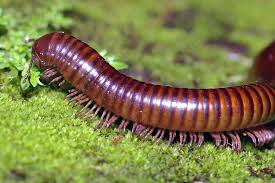
A recent study has revealed the self-cleaning mechanism similar to the famous ‘lotus effect’ (the natural self-cleaning property of lotus leaves) to stay clean by green pill millipede, a species endemic to the Western Ghats.
- Millipedes are cylindrical or slightly flattened invertebrates.
- They constitute the class Diplopoda within the subphylum Myriapoda.
- The name ‘millipede’ derives from the Latin words ‘mille’, meaning thousand, and ‘pes’, meaning foot.
- They are slow-moving arthropods having long, segmented bodies, with most segments bearing two pairs of legs attached to the underside of the body.
- Their exoskeleton is typically brown to black in color, and thus, they can easily remain camouflaged in the soil
- Their highest diversity is found in the tropical region, where they inhabit moist microhabitats on the forest floor, including leaf litter, dead wood, and soil.
- These arthropods are found on all continents except Antarctica.
Features: - They lack speed or the ability to bite or sting, their primary defensive mechanism is curling into a coil, exposing their protective exoskeleton to the predator.
- Most species are typically detritivores, feeding on rotting leaves, wood, and other decomposing plant debris.
- They act as decomposers, conserving soil erosion and nutrient cycling, and are among the greatest vital foliage litter creatures.



