
Strengthening India’s Supply Chains through Inland Waterways:
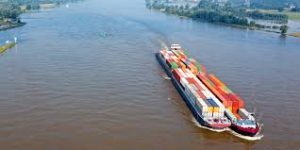
The Chief Economic Advisor (CEA) highlighted the importance of inland waterways in strengthening India’s supply chains and logistics efficiency.
- He stressed that amid disruptions in global shipping routes due to the West Asian conflict 2026, developing internal transport networks is essential for logistics resilience and economic stability.
- Inland Water Transport (IWT) is the most economical mode of freight movement.
- Moving goods via waterways costs approximately Rs 0.25– Rs 0.30 per ton-km, drastically lower than rail (Rs 1.0) and road (Rs 1.5).
- This directly reduces the overall logistics cost for domestic industries, making Indian goods more competitive globally.
- Waterways offer incredible scale for heavy cargo. A single standard 2,000-tonne inland vessel can carry the equivalent of 125 standard trucks.
- This makes it the ideal mode for transporting bulk commodities essential to the economy, such as coal, cement, fertilizers, and food grains.
- India’s road and rail networks are heavily burdened, leading to delayed shipments and higher maintenance costs.
- By absorbing a large share of heavy cargo, waterways alleviate severe congestion on national highways and freight corridors, reducing wear-and-tear on infrastructure and minimizing transit delays.
- As recent geopolitical crises (like the West Asian conflict) have shown, international shipping lanes are vulnerable to massive disruptions and surging freight/insurance costs.
- Inland waterways provide a secure, domestic channel that is completely insulated from these external shocks, ensuring that internal trade continues without interruption.
- Aligning with India’s Panchamrit climate goals, IWT is highly eco-friendly. It consumes 3 to 6 times less energy than road transport and produces a fraction of the greenhouse gas emissions.
- Transitioning supply chains to waterways helps industries reduce their carbon footprint.
- Waterways unlock the logistical potential of landlocked and underdeveloped regions, particularly states like Bihar, Jharkhand, and the Northeast.
- By linking these hinterlands directly to major maritime ports via rivers like the Ganga (National Waterway-1) and Brahmaputra (National Waterway-2), local MSMEs and farmers are seamlessly integrated into national and global supply chains.
- Waterways offer predictable travel times without traffic bottlenecks and have huge expansion potential, as most of India’s 20,000+ km navigable network remains underutilised, requiring minimal land acquisition.



