
Evolution of India’s Labor Movements:
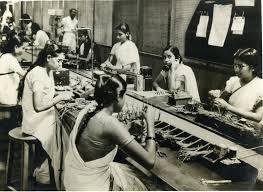
The history of Indian labor movements is a saga of transitioning from colonial “criminal conspiracy” charges to constitutional protections, currently facing new challenges under the Industrial Relations Code, 2020.
- Early Period (1850–1900): During this initial phase of industrialization (textile and jute mills), there were no formal unions. The movement was largely philanthropic, led by social reformers.
- In 1875, SS Bengalee led a protest in Bombay to highlight the poor conditions of women and children in factories.
- NM Lokhande is considered the father of the Indian labor movement. He founded the Bombay Mill-Hands Association (1890). However, this was more of a welfare group than a modern trade union.
- The Factories Act, 1881 was passed to regulate child labor and working hours.
- The period surrounding World War I transformed the movement from welfare-oriented associations to organized political bodies.
- The Madras Labour Union (1918), founded by BP Wadia, is considered India’s first systematic trade union.
- AITUC Formation (1920) was formed to represent India at the International Labour Organization (ILO). Lala Lajpat Rai was its first president.
- In 1921, the Buckingham and Carnatic Mills case exposed the absence of legal protection, as union leaders were penalised for organising workers, treating unions as conspiracies under common law.
- N.M. Joshi pushed for legal safeguards, leading to sustained pressure for legislation.
- The Trade Unions Act, 1926, was a watershed, granting legal recognition to unions and protecting members from civil suits and criminal charges.
- Despite legalisation, colonial authorities imposed repression through measures like the Meerut Conspiracy Case (1929-1933) and restrictive laws such as the Trade Disputes Act, 1929 and Public Safety Bill 1928.
- This created a contradiction between the “letter” (legal protections) and the “spirit” (continued suppression) of labour rights.
- The labour movement became closely linked with the nationalist struggle, with leaders like Lala Lajpat Rai and Jawaharlal Nehru advocating worker mobilisation.
- Splits occurred along ideological lines (Communist vs. Nationalist), leading to the formation of groups like the Indian Federation of Labour (established in 1941 by MN Roy after he split from AITUC due to ideological differences regarding World War II).
- After independence, the movement became deeply fragmented based on political party affiliations. Major labor federations formed were:
- Formed by the Congress party to counter communist influence.
- Hind Mazdoor Sabha (HMS) (1948): Formed by the Socialists like Ashok Mehta, T.S. Ramanujam and G.G. Mehta.
- Bharatiya Mazdoor Sangh (BMS) (1955): Formed by the RSS (Bharatiya Mazdoor Sangh), now India’s largest trade union.
- Centre of Indian Trade Unions (CITU) (1970): Formed as a split from AITUC by the CPI(M).
- Post-Liberalization Era (1991–Present): Increased outsourcing and contractualization have weakened traditional union power in the formal sector.
- As of March 2026, India (Ministry of Labour & Employment) has 12 recognised central trade union organisations.
- In recent years, the government consolidated 29 labor laws into 4 Labor Codes (Code on Wages (2019), Industrial Relations Code (2020), Code on Social Security (2020), and Occupational Safety, Health and Working Conditions (OSH) Code (2020)).
- While aimed at ease of doing business, unions have expressed concerns over the dilution of strike rights and collective bargaining. E.g., while the Industrial Relations Code 2020 retains immunity clauses, it introduces a high 51% support threshold for union recognition and a 60-day notice period for strikes.
- Despite an estimated 23.5 million platform workers by 2030, the new Code remains silent on gig and platform workers, classifying them as “independent contractors” and denying them formal collective bargaining rights.



