
Rainbow Clouds:
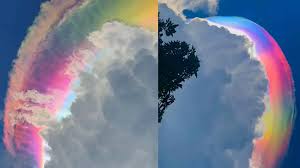
Indonesia recently witnessed a breathtaking ‘rainbow cloud’ phenomenon, captivating residents and going viral online.
- A rainbow cloud can occur because of something called cloud iridescence.
- Cloud iridescence occurs when sunlight is diffracted by extremely small water droplets or tiny ice crystals suspended in clouds.
- Diffraction happens when light bends and spreads after encountering particles similar in size to the wavelength of visible light.
- This process separates sunlight into multiple colours, creating the striking pastel shades and rainbow-like patterns seen across the clouds.
- They form most clearly when cloud particles are unusually small and relatively uniform in size.
- Cloud iridescence does not appear frequently because several atmospheric conditions must align at the same time.
- The clouds need to be thin enough for sunlight to pass through while also containing droplets or ice crystals that are nearly identical in size.
- Even small differences between particles can weaken the colours or prevent the phenomenon from appearing altogether.
- The position of the Sun and the observer’s viewing angle are extremely important.
- Newly forming clouds and semi-transparent clouds are more likely to produce vivid iridescence because their particles tend to be more uniform.
- It is commonly seen in altocumulus, cirrocumulus, cirrus, and lenticular clouds.
- Lenticular clouds are especially known for dramatic iridescent displays because their smooth shape and stable airflow often allow highly uniform droplets to form.
- These clouds typically develop at high altitudes where atmospheric conditions remain relatively stable, making it easier for sunlight to interact consistently with suspended particles.
- Despite the popular nickname, rainbow clouds are not technically rainbows.
- Traditional rainbows form when sunlight is refracted, reflected, and dispersed inside raindrops after rainfall.
- Cloud iridescence, on the other hand, is mainly caused by diffraction and interference involving microscopic droplets or ice crystals.
- Iridescent clouds usually appear much closer to the Sun and often produce softer, less structured colour patterns than ordinary rainbows.
- Instead of forming a large arc across the sky, the colours spread unevenly across sections of cloud.



