
Today’s Current Affairs: 22nd May 2026 for UPSC IAS exams, State PSC exams, SSC CGL, State SSC, RRB, Railways, Banking Exam & IBPS, etc
Table of Contents
Kumbhalgarh Fort:
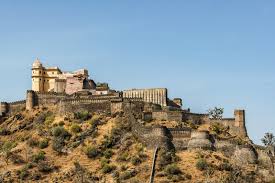
Kumbhalgarh Fort Wall in Rajasthan, often called the Great Wall of India, has been named the second-longest surviving wall in the world by a UNESCO survey.
- It is located in the Rajsamand district of Rajasthan.
- It is strategically located in the western Aravalli hills.
- Considered to be the second most significant citadel in the Mewar region after Chittorgarh, this majestic fort was constructed in the 15th century AD by Rana Kumbha, the ruler of the Kingdom of Mewar.
- Spanning over 36 kilometers, its walls are second only to the Great Wall of China, earning it the moniker “the Great Wall of India.”
- The fort has also been designated a UNESCO World Heritage Site as part of the group of Hill Forts of Rajasthan.
- The fort contains seven fortified gateways and ancient temples—both, Hindu and Jain, as well as the Lakhola Tank, the most famous tank within the fort, which was built by Rana Lakha.
- For centuries, Kumbhalgarh Fort served as a refuge for Mewar rulers during times of war.
- It is the birthplace of Mewar’s legendary king, Maharana Pratap. Maharana Pratap led numerous battles against the Mughal Empire, with Kumbhalgarh serving as his sanctuary..
- The fort is surrounded by the Kumbhalgarh Wildlife Sanctuary.
Loktak Lake:
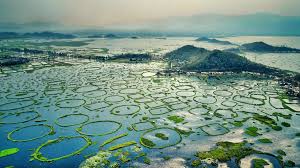
The northeastern state of Manipur contains the amazing freshwater body of Loktak Lake, known for its perfect circular floating islands called phumdis.
- It is located in the state of Manipur.
- It is the largest freshwater lake in Northeast India.
- The lake is famous for its phumdis.
- Phumdis are unique, heterogeneous masses of vegetation, soil, and organic matter that float on the water’s surface.
- Only 20% of a phumdis’ thickness floats above the water surface; the other 80% remains submerged.
- The floating masses are strong enough to support fishing huts, human settlements, and animal habitats.
- The Keibul Lamjao National Park is an integral part of the lake. It is the world’s only floating national park.
- The park is best known as the habitat of the endangered sangai deer, also called the brow-antlered deer, which is native to Manipur.
- Rivers like Khuga, Western, Nambul, Imphal, Kongba, Iril, Thoubal, Heirok, and Sekmai drain into this lake.
- It was designated as a wetland of international importance under the Ramsar Convention in 1990.
- It features under the Montreux Record in 1993, “a record of Ramsar sites where changes in ecological character have occurred, are occurring, or are likely to occur”.
- It supports hydropower, fisheries, transport, and tourism.
Kashmir Flycatcher:
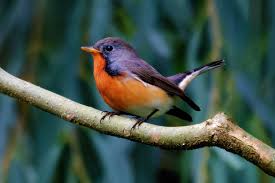
The rare Kashmir Flycatcher, a migratory bird species, has been recently spotted at the Chemmattamavayal wetlands in Kasaragod district, Kerala.
- Kashmir Flycatcher is a small passerine bird in the flycatcher family Muscicapidae.
- Scientific Name: Ficedula subrubra
- It is endemic to the Indian Subcontinent.
- It makes its home in the northwest Himalayas. It breeds in the Kashmir region.
- It is a migratory bird.
- It winters largely in the high altitudes of the Nilgiris in the Western Ghats and in Sri Lanka.
- Conservation Status:
- IUCN Red List: Vulnerable
Zwan-Wolf Effect:
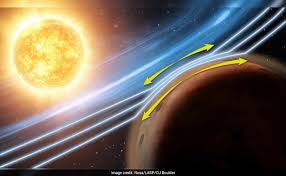
NASA’s MAVEN spacecraft recently recorded something Mars has never shown before, which is the Zwan-Wolf effect.
- Zwan-Wolf Effect is a process where charged particles are squeezed along magnetic structures, known as flux tubes.
- The Zwan-Wolf effect was discovered in 1976 and has so far only been observed in planetary magnetospheres and not their atmospheres.
- The solar wind is a stream of charged particles flowing outwards from the sun.
- As the solar wind nears the magnetic field of a planet, it becomes compressed near the magnetic boundaries.
- This creates a difference in pressure, or pressure gradient, that squeezes the charged particles along the magnetic field, away from the stream.
- As a result, closer to the stream is an area with a lower density of charged particles. This is called the Zwan-Wolf effect.
- On Earth, this mechanism deflects much of the solar wind and protects us from the Sun’s constant bombardment.
New Findings Important:
- Unlike Earth, Mars is not protected by a global magnetic field, affecting how it interacts with the solar wind and space weather.
- The Zwan-Wolf effect was observed in the ionosphere — deep within the Martian atmosphere below 200 km — which contains significant numbers of electrically charged particles.
- The data showed that these charged particles were being squeezed and distributed around Mars’ atmosphere.
- It suggests that Mars, despite lacking a global magnetic field, experiences similar interactions with the solar wind, offering valuable insights into the planet’s atmospheric dynamics.
MAVEN Spacecraft:
- Mars Atmosphere and Volatile EvolutioN (MAVEN) is the first spacecraft mission dedicated to surveying the upper atmosphere of Mars.
- It is part of NASA’s Mars Exploration Program.
- It aims to understand the role that loss of atmospheric gas to space played in changing the Martian climate over time.
- It was launched in 2013 and arrived at Mars in 2014.
- It carries three packages of instruments:
- One package studies the solar wind and its impact on Mars’s ionosphere. (Since Mars has no magnetic field, its atmosphere would be slowly removed by interaction with the solar wind.)
- The second package is an ultraviolet spectrometer that studies the upper atmosphere.
- The third package is a mass spectrometer that studies the composition of the upper atmosphere.
- MAVEN found that Mars lost about 2/3 of its early atmosphere to space.
Trachischium lalremsangai:
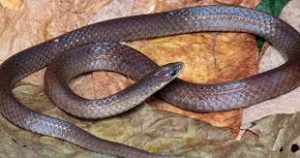
Scientists recently discovered a new species of burrowing snake named Trachischium lalremsangai in Mizoram near the India–Myanmar border.
- Trachischium lalremsangai is a new species of burrowing snake.
- It was discovered in Murlen National Park, Mizoram, a biodiversity-rich forest landscape within the Indo–Burma biodiversity hotspot.
- The species was named after Dr. Lalremsanga in recognition of his remarkable contributions to herpetology (the study of reptiles and amphibians) in India, especially in Northeast India.
- The snake is distinguished by its smooth iridescent scales; brown body with a white-speckled underside; and a unique arrangement of head scales.
Murlen National Park:
- 1It is located in the Champhai district of Mizoram near the Indo-Myanmar border.
- It lies within the Mizo Hills, part of the Patkai range.
- The climate is subtropical, with heavy rainfall from May to September and mild winters from November to February.
- It has different forest types, namely tropical semi-evergreen, subtropical broadleaved, submontane, bamboo, grassland, and cliff vegetation.
- It is home to a variety of plant species, including species of medicinal plants and many varieties of orchids.
- Among others, bamboo brakes, rhododendrons, and unique flowering trees cover vast expanses of the forest.
- It harbours mammal species, including the Bengal tiger, leopard, Himalayan black bear, and the endangered hoolock gibbon.
- Avian life thrives here hosting bird species such as Hume’s pheasant (State bird) and the kalij pheasant.
International Booker Prize 2026:

Taiwan Travelogue by Yáng Shuāng-zǐ, translated by Lin King won the 2026 International Booker Prize.
- International Booker Prize is awarded annually.
- It was established in 2005 as the Man Booker International Prize.
- It celebrates the best works of long-form fiction or collections of short stories translated into English and published in the UK and/or Ireland.
- It recognises the vital work of translators, with the £50,000 prize money divided equally between authors and translators.
- In addition, shortlisted authors and translators each receive £2,500.
- This prize aims to encourage more reading of quality fiction from all over the world.
Unmanned Aerial Vehicle Launched Precision Guided Missile-V3:
Defence Research & Development Organisation (DRDO) has successfully completed the final development trials of Unmanned Aerial Vehicle Launched Precision Guided Missile (ULPGM)-V3 in Air-to-Ground and Air-to-Air modes.
- Unmanned Aerial Vehicle Launched Precision Guided Missile-V3 is a precision-guided air-to-surface missile launched from drones.
- It has been developed by Research Centre Imarat Hyderabad as the nodal lab along with other DRDO laboratories.
- The ULPGM-V3 is equipped with a high definition dual-channel seeker that can strike a wide variety of targets.
- It can be fired in plain and high-altitude areas.
- It has day-and-night capability and two-way data link to support post-launch target/aim-point update.
- It is equipped with three modular warhead options
- Anti-armour to destroy modern age armoured vehicles equipped with Rolled Homogeneous Armour (RHA) with Explosive Reactive Armour (ERA); Penetration-cum-Blast warhead with Anti Bunker application and Pre-fragmentation warhead with a high lethality zone.
- The ULPGM-V3 can be carried and operated by individual soldiers in remote and mountainous regions.
- It can achieve a maximum range of 4 km during the day and 2.5 km at night.
- Weight:5 kg which enables integration with lightweight drones.
Ayush Anudan Portal:
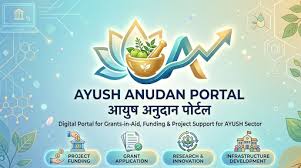
The Union Minister of State (IC) for Ayush and Minister of State for Health and Family Welfare launched the Ayush Anudan Portal.
- Ayush Anudan Portal is developed by the Ministry of Ayush under the Ayush Grid initiative.
- It is a digital platform to streamline the submission, processing, and monitoring of funding proposals under Central Sector Schemes of the Ministry of Ayush i.e.
- Ayurgyan, Ayurswasthya, Conservation, Development and Sustainable Management of Medicinal Plants, International Co-operation and Promotion of Information, Education and Communication.
- The primary objective of this portal is to ensure 100% transparency, efficiency, accountability and easy accessibility in the grant management process.
- The portal can be accessed through the Ministry’s My Ayush Integrated Services Portal (MAISP), which serves as the Ministry’s single-window digital platform.
- Features of the Portal:
- It has scheme-wise application management system, enabling proposals to be categorised, processed, and monitored according to the specific requirements of different Central Sector Schemes of the Ministry.
- It also incorporates a real-time application tracking mechanism, allowing applicants and officials to monitor proposal status at every stage of processing.
- It is integrated with the NGO Darpan Portal.
Blue Straggler Star:
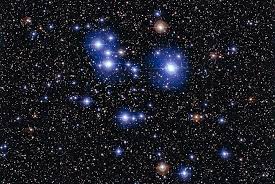
Researchers have made the world’s first confirmed discovery of a blue straggler star hosting a brown dwarf companion in an extraordinarily compact binary system.
- Blue Straggler Stars are hot, blue, massive stars seem to have a different trajectory of evolution from the norm.
- These are a class of star observed in old, dense stellar systems such as globular clusters.
- They lie on an extension of the main sequence star and are bluer and brighter than the main-sequence turn-off stars.
- These objects are found in star clusters, dwarf galaxies, and in the field.
- There are a few stars, when they are expected to start expanding in size and cooling down, do just the opposite.
- They grow brighter and hotter as indicated by their blue colour, thus standing out from the cooler red stars in their vicinity in the colour-magnitude diagram.
- Since they lag behind their peers in the evolution, they are called stragglers, more specifically, blue stragglers, because of their hot, blue colour.
- Possibility 1: They do not belong to the family of stars in the cluster, and hence not expected to have the group properties.
- Possibility 2: The straggler draws matter from the giant companion star and grows more massive, hot and blue, and the red giant to end up as a normal or smaller white dwarf.
- Possibility 3: The straggler draws matter from a companion star, but that there is a third star that facilitates this process.
SHE-MART Initiative:
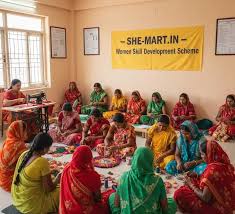
The Ministry of Rural Development (MoRD) has initiated a nationwide roadmap for the creation of women-led rural marketing ecosystems through SHE-MARTs initiative.
- SHE-MART (Self Help Entrepreneurs-Marketing Avenues for Rural Transformation) is a Government of India initiative to empower women entrepreneurs by creating community-owned retail outlets within cluster-level federations of self-help groups.
- It is aimed at creating stronger market linkages, improving visibility of local products, strengthening SHG institutions, and enabling women entrepreneurs to expand and scale their businesses.
- Key Features of SHE-MART Initiative:
- Community-Owned Retail Outlets: Retail outlets owned and managed by local women’s groups within cluster-level federations, ensuring community control and ownership.
- Direct Market Access: Creating structured retail platforms for women entrepreneurs to sell products and access formal markets without intermediaries.
- Economic Growth: Moving women up the economic value chain from income generation to enterprise ownership, transforming them from earners to business owners.
- Permanent Infrastructure: Permanent retail points for SHG-made goods with value-added product support, ensuring sustainable business operations.
- Empowerment: Greater control over markets, branding, and sustainable income generation, empowering women economically and socially.
- SHE Mart will primarily support SHG-made goods including handicrafts, textiles, food products, agricultural produce, and value-added processed products.
- Nodal Ministry: Ministry of Rural Development, implemented under Deendayal Antyodaya Yojana-National Rural Livelihoods Mission.
What is the Captagon?

The Narcotics Control Bureau (NCB) has intensified its crackdown on transnational drug syndicates, culminating in Operation RAGEPILL, which resulted in India’s first-ever seizure of the psychotropic substance Captagon.
- The agency arrested the kingpin of an India-Myanmar drug network in Delhi and promoted Himachal Pradesh’s ‘anti-heroin’ model, highlighting India’s shift from local policing to targeting transnational narcotics networks.
- Captagon is a highly addictive psychotropic substance and central nervous system (CNS) stimulant.
- Captagon was originally the brand name for Fenethylline, a synthetic stimulant developed in the 1960s to treat conditions like ADHD, narcolepsy, and depression.
- The illicit Captagon circulating now is a clandestine cocktail of amphetamines, methamphetamine, caffeine, and other chemical fillers.
- The “Jihadi Drug” earned this moniker (along with “Captain Courage”) because it is heavily consumed by extremist and militant groups, such as ISIS, in conflict zones.
- Fighters use it to induce a state of euphoria, block out trauma, stay awake for days, and completely suppress fear, fatigue, and hunger.
- It is widely abused across the Middle East (especially in Saudi Arabia and the Gulf states) as a cheap recreational drug.
- Syria is currently recognized as the global epicenter for illicit Captagon production, with the trade forming a multi-billion-dollar shadow economy that heavily funds regional conflicts.
- Due to its high potential for abuse, Captagon was banned in most countries in the 1980s.
- It is tightly regulated under Schedule II of the UN Convention on Psychotropic Substances, 1971.
- The International Narcotics Control Board (INCB) stated that legitimate industrial manufacture of fenetylline (Captagon) ceased globally in 2009
- It is illegal and regulated under the Narcotic Drugs and Psychotropic Substances (NDPS) Act, 1985.
India–Nordic Summit 2026:
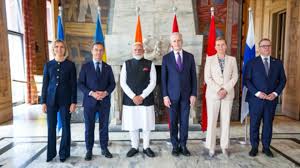
The Prime Minister of India concluded a highly significant diplomatic tour of the Nordic region, visiting Oslo, Norway, to participate in the 3rd India-Nordic Summit.
- Hosted by Norway, the summit brought together the Prime Minister of India and the leaders of the five Nordic nations (Denmark, Finland, Iceland, Norway, and Sweden) to review bilateral ties and address contemporary global challenges.
- The 3rd India–Nordic Summit strengthened cooperation in green technology, innovation, trade, maritime security, AI, space, and climate action, while also deepening strategic ties through agreements such as India-EFTA TEPA and the Indo-Pacific Oceans Initiative.
- Despite strong potential, India–Nordic relations face challenges such as geopolitical differences over Russia, strict ESG standards, low trade volume, regulatory barriers, and technology-related concerns, requiring stronger investment, connectivity, and policy coordination.
- The summit officially elevated the relationship between India and the Nordic nations (Denmark, Norway, Finland, Iceland, and Sweden) to a trusted Green Technology and Innovation Strategic Partnership.
- The collaboration is heavily anchored in shared democratic values, a rules-based global order, and a mutual focus on sustainable development and tech innovation.
- The leaders highlighted the implementation of the India-EFTA Trade and Economic Partnership Agreement (TEPA) and the conclusion of the India-EU Free Trade Agreement.
- A major shared objective under TEPA is driving USD 100 billion in investments into India, projected to create one million direct jobs.
- Climate Action & The Blue Economy: Iceland was welcomed as a new member of LeadIT2.0, a public-private platform focused on decarbonizing heavy industries.
- This includes transitioning the shipping industry to low-carbon models and adhering to the Hong Kong Convention for environmentally safe ship recycling.
- Technology, Space & Defense: The summit emphasized democratizing AI, securing 5G/6G infrastructure, and building global AI governance frameworks (building on India’s successful hosting of the AI Impact Summit in 2026).
- Announced a new Framework Agreement between ISRO and the Norwegian Space Agency, as well as a confirmed Swedish payload for India’s upcoming Venus Orbiter Mission (Shukrayaan 1).
- India highlighted that Nordic defense firms can now take advantage of 100% Foreign Direct Investment (FDI) in Indian Defense Industrial Corridors.
Genomic Mapping of Pangolin Trafficking:
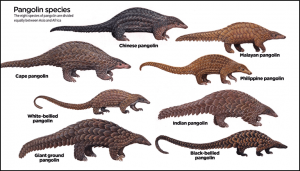
A study published in PLoS Biology has developed a DNA-based “genetic map” that can accurately trace the origin and trafficking routes of illegally traded pangolins, strengthening efforts to combat global wildlife crime.
- The genomic map pinpointed three primary transnational extraction zones:
- Southwestern Cameroon (white-bellied), Southwestern Borneo (Sunda), and the border region surrounding Myanmar (Chinese pangolin).
- Northeast India-China Illicit Axis: The genomic data revealed an active illicit wildlife network originating from northeastern India (around Arunachal Pradesh and Assam) and potentially Bhutan, directly supplying Yunnan province in China.
- The study disproved the assumption that local and international pangolin trafficking operate separately, showing that domestic supply hubs overlap with global trafficking networks linked to China and Vietnam.
- Pangolin are shy, solitary, and mostly nocturnal mammals that feed exclusively on ants and termites (myrmecophagy).
- They play an important ecological role by aerating and enriching the soil through digging.
- Due to their secretive behaviour and slow reproduction rate, with females usually giving birth to a single young, their populations recover very slowly after decline.
- It is adaptable to a wide range of habitats including primary and secondary tropical forests, limestone and bamboo forests, grasslands and agricultural fields.
- There are eight distinct species globally, evenly split between Africa (Black-bellied, White-bellied, Giant Ground, and Temminck’s Ground) and Asia (Indian, Philippine, Sunda, and Chinese pangolins).
- They possess unique, overlapping scales made of keratin covering their bodies and exhibit volvation (rolling into a tight ball) as an evolutionary defense mechanism against predators.
- Pangolins have zero teeth. Instead, they catch prey using an extremely long, muscular, and sticky tongue that is uniquely anchored near their pelvis and the last pair of ribs rather than the jaw.
- While the Indian Pangolin (Manis crassicaudata) is found across the broader Indian subcontinent.
- In India, the Chinese Pangolin (Manis pentadactyla) is mainly restricted to the Northeast and is extremely rare.
- Conservation Classifications: All eight species of pangolins are strictly regulated under Appendix I of CITES.
- On the IUCN Red List, the Indian Pangolin is classified as Endangered (EN), while the Chinese Pangolin is categorized as Critically Endangered (CR).
- Within India, both the Indian and Chinese pangolins are afforded the highest level of legal immunity under Schedule I of the Wildlife (Protection) Act, 1972.
- World Pangolin Day is observed on the third Saturday of February.
SC Allows Euthanasia of Rabid and Dangerous Stray Dogs:
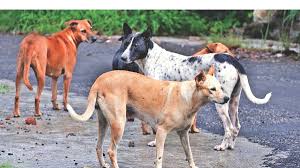
The Supreme Court of India has permitted civic authorities to take legally permissible measures, including euthanasia, for rabid, incurably ill, or aggressively dangerous stray dogs in accordance with the Animal Birth Control (ABC) Rules, 2023.
- Strict Ban on Street Feeding: The bench upheld its previous directives banning the feeding of stray dogs on public streets, requiring local bodies to allot dedicated feeding spots instead.
- Article 21 (Right to Life): The Court ruled that it casts an affirmative, non-negotiable duty on the State to secure citizens against threats to life and safety arising from stray dog attacks.
- Article 19(1)(d) guarantees citizens the right to move freely. The Court observed that unchecked stray dog populations in public spaces can violate this fundamental right.
- However, animal welfare groups relied on Article 51A(g) of the Constitution, which places a fundamental duty on citizens to show compassion towards living creatures.
- Mandatory District ABC Infrastructure: Every State and Union Territory must establish at least one fully functional Animal Birth Control (ABC) centre in each district, equipped with surgical facilities, supporting logistics, and trained veterinary personnel.
- Clearing High-Footfall Public Areas: The Court ordered the strict implementation of previous directives regarding the removal of free-ranging dogs from public utilities, schools, hospitals, and high-density transit zones to ensure a secure environment.
- Public Health Response Mandate: States must ensure unhindered and adequate availability of anti-rabies vaccines and immunoglobulin across all government healthcare facilities to manage dog-bite cases effectively.
- Highway Safety Mechanism: The National Highways Authority of India (NHAI) has been directed to formulate a time-bound mechanism using specialized transport vehicles to safely handle and relocate stray cattle and animals from national highways and expressways.
- Legal Immunity for Implementing Officers: To facilitate strict implementation, the Court granted administrative officers protection from FIRs or criminal proceedings for bona fide actions taken under these directives, unless a prima facie case of malice or gross abuse of authority is established.
- Roots in Institutional Failure: The judgment took note of a continuous institutional failure at the municipal level to implement the Animal Birth Control Rules since 2001, which allowed the free-roaming dog population to swell significantly.
US Clears Apache & Howitzer Support for India:
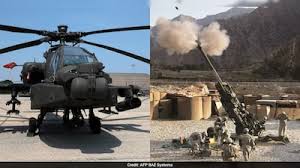
The United States approved sustainment support and related equipment for AH-64E Apache helicopters and M777A2 Ultra-Light Howitzers for India, further boosting bilateral defence ties.
- Apache Helicopters: The AH-64 Apache is an advanced multi-role combat helicopter used by the US Army and several international defence forces.
- The Apache support package, worth approximately $198.2 million, includes engineering, technical and logistics support, technical data, publications, personnel training and programme support.
- M777A2 Howitzer: M777A2 howitzers, recognised for their lightweight structure and high mobility in difficult mountainous terrain, are widely deployed by the Indian Army, especially across strategically important border areas.
- The M777A2 howitzer support package, worth about $230 million, includes spares, repair and return, training, technical assistance, field service representatives, depot capability and other logistics support.
- Major acquisitions from the US include MQ-9B drones, MH-60R helicopters, Sig Sauer rifles and M777 howitzers. Negotiations are also underway for manufacturing GE F-414 jet engines in India, while deliveries of GE-F404 engines for the LCA Tejas Mark-1A are underway.



