
Pyrite : New Discovery
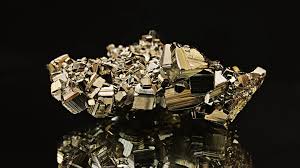
Geologists have discovered a rare, microscopic sunflower-shaped mineral, pyrite, commonly known as fool’s gold, within the lignite coal reserves of Gujarat, India.
- Pyrite is a naturally occurring iron disulfide mineral.
- It has the chemical formula FeS2 and is the most common sulfide mineral.
- It is a brass-yellow mineral with a bright metallic luster.
- The name comes from the Greek word pyr, “fire,” because pyrite emits sparks when struck by metal.
- Pyrite is called fool’s gold because its colour is deceptively similar to that of a gold
- Nodules of pyrite have been found in prehistoric burial mounds which, suggests their use as a means of producing fire.
- Pyrite is found in a wide variety of geological settings, from igneous, sedimentary, and metamorphic rock to hydrothermal mineral deposits, as well as in coal beds and as a replacement mineral in fossils.
- It can be either disseminated throughout igneous rock or concentrated in layers, depending on the depositional mechanism and environment.
- It forms in sedimentary rocks in oxygen-poor environments in the presence of iron and sulfur. These are usually organic environments, such as coal and black shale, where decaying organic material consumes oxygen and releases sulfur.
- Pyrite often replaces plant debris and shells to create pyrite fossils or flattened discs called pyrite dollars.
- In calcite and quartz veins, pyrite oxidizes to iron oxides or hydroxides such as limonite, an indicator that there is pyrite in the underlying rock. Such oxidized zones are called “gossan,” which appears as rusty zones at the surface.
- For many years, Spain was the largest producer.
- Today Italy and China are the world’s largest producers, followed by Russia and Peru.
- It is a source of iron and sulfur and is used for the production of sulfuric acid.
- It is used to create iron sulfate that is used to make nutritional supplements, ink, lawn conditioner, water treatment and flocculation, moss killer, and many other chemical processes.
- Iron sulfate, which comes from pyrite, is used to treat iron-deficiency anemia.
- Some types of pyrite contain enough microscopic gold to warrant mining them as a gold ore.



