
Fast X-ray Transient:
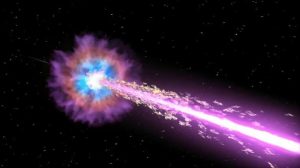
Astronomers have uncovered new clues about the origin of a rare and powerful cosmic X-ray flash known as a Fast X-ray Transient (FXT).
- Fast X-ray Transient are energetic, non-repeating bursts of low-energy X-rays associated with violent cosmic events.
- They typically last from a few minutes to several hours before fading rapidly, making them difficult to study and leaving their origins largely uncertain.
- Many FXTs are associated with high-redshift long period gamma-ray bursts (lGRBs).
- Known X-ray transient types with these timescales include stellar flares, X-ray binary outbursts, supernova shock breakouts (SN SBOs) and gamma-ray bursts (GRBs).
Gamma-Ray Burst:
- It is a powerful astronomical cosmic burst of high-energy gamma-ray.
- It emits more energy in a few seconds than our Sun will emit in its lifetime.
- It has two distinct emission phases: the short-lived prompt emission (the initial burst phase that emits gamma-rays), followed by a long-lived multi-wavelength afterglow phase.
- They are produced by the hottest and most energetic objects in the universe, such as neutron stars and pulsars, supernova explosions, and regions around black holes.
- On Earth, gamma waves are generated by nuclear explosions, lightning, and the less dramatic activity of radioactive decay.



