
Yak : Smart System To Monitor The Health
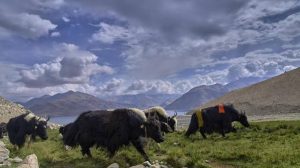
A team of scientists has developed an Internet of Things (IoT)-based smart system to monitor the health of the high-altitude yaks (Bos grunniens) and keep tabs on their movement near the international border in the Himalayas.
Core Features of the Smart Yak System:
- Real-Time Health Monitoring: Tracks vital signs and early indicators of illness to allow for timely veterinary intervention.
- Stress Prediction: Uses embedded algorithms to predict physiological stress in the animals, preventing severe health declines.
- Geo-Fencing: Establishes virtual boundaries to keep tabs on grazing herds.This prevents yaks from straying across sensitive international borders (such as near China and Bhutan) and helps reduce livestock loss.
- Yaks belong to the Bovini tribe, which also includes bison, buffaloes, and cattle.
- Wild yaks inhabit alpine tundra at altitudes of 5000 to 7000 meters. They thrive in environments such as alpine meadows, alpine steppes, and desert steppes.
- Found throughout the Himalayan region, Tibetan plateau, Mongolia, and parts of South-Central Asia.
- In India, yaks are reared in Arunachal Pradesh, Sikkim, Himachal Pradesh, and the union territories of Jammu & Kashmir and Ladakh.
- Characteristics of Yak:
- This bovine animal has long been recognised for its resilience and adaptability to extreme conditions.
- It features thick, shaggy coat. This woolly fur, provides insulation against the biting cold of high altitudes.
- They have large hearts and lungs, compact bodies, thick outer hair covering, and nonfunctional sweat glands, which help to withstand hypoxia and cold stress.
- Diet: Yaks are herbivorous, feeding on grasses and alpine plants.
- Conservation Status:
- IUCN: Vulnerable
- CITES: Appendix I
- Wildlife Protection Act of 1972:Schedule I



