
Gandak River : In News
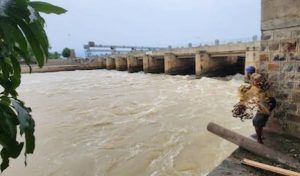
Due to heavy rainfall in Nepal’s catchment area, the water levels of the Gandak River in Bihar have been rising continuously.
- Gandak River is one of the major rivers of North India and a significant left-bank tributary of the Ganga River.
- It is mentioned in the ancient Sanskrit epic Mahabharata.
- It originates to the north of Dhaulagiri Mountain in Tibet near the Nepal border.
- It is formed by the union of the Kali and Trisuli Rivers, which rise in the Great Himalayas of Nepal.
- From their meeting point till the Indian border, the river is known as the ‘Kali Gandaki’ and ‘Narayani’ in Nepal.
- It enters India near Valmikinagar in Bihar and briefly touches Uttar Pradesh, forming a small stretch of boundary.
- The entry point of the river is at the Indo–Nepal border and is known as Triveni.
- After this, the river flows mainly through Bihar, covering districts like West Champaran, East Champaran, Gopalganj, and Saran.
- The Gandak finally joins the Ganga River opposite Patna, near Hajipur in Vaishali district, Bihar.
- The basin is bounded by the Himalayas to the north and the Ganga River to the south.
- On the sides, it lies between the Kosi basin in the east and the Karnali (Ghaghara) basin in the west.
- The basin includes: Dhaulagiri, Manaslu, and Annapurna Massif.
- Due to the steep slope and loose soil in the upper catchment, Gandak carries a lot of silt and other deposits to the Indian side, resulting in a continuous shifting course of the river.
- While flowing through the Nepal Himalayas, it forms the Kali Gandaki Gorge, one of the deepest river gorges in the world.
- Two important protected areas, Chitwan National Park in Nepal and the adjacent Valmiki Tiger reserve in India, have been established in the basin.
- Major Tributaries: Daraudi, Seti, Madi, Marsyandi, and Budhi Gandaki.