
EVEREST: India’s 1st Private 800 kN FFSC LOX-Methane Engine:
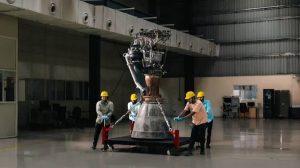
Bengaluru-based Astrobase Space Technologies unveiled EVEREST, India’s first privately built 800 kN Full-Flow Staged Combustion (FFSC) LOX-Methane rocket engine, marking another major milestone for India’s private space sector after the launch of Vikram-1.
- The engine delivers 800 kN thrust, has a specific impulse of about 340 seconds, and offers a 50%-110% throttle range. It is being designed for reusable medium-lift launch vehicles.
- In a Full-Flow Staged Combustion engine, both the fuel and oxidiser pass through separate pre-burners before entering the main combustion chamber.
- The gases generated drive the turbopumps and are then fed into the main chamber, ensuring more complete utilisation of propellants and higher efficiency.
- LOX-methane’s relatively clean combustion, combined with an FFSC architecture designed for multiple cycles, makes the system well suited to reusable launch applications.
- Astrobase is developing the engine as part of a reusable launch system aimed at improving turnaround time, precision control and launch economics. Its published vehicle architecture targets about 3 tonnes to 500-km LEO with return-to-launch-site recovery.
- Development began in 2024 and engine subsystems have already undergone testing. Full-scale engine hot-fire testing at Astrobase’s Anantapur(Andhra Pradesh) facility is a key 2026 development milestone, followed by stage-level testing and vehicle integration.
- The company plans to manufacture and test around 20 engines before its first orbital flight, which is targeted for 2028.
- Astrobase is a recipient of IN-SPACe’s Technology Adoption Fund, which supports private-sector development of technically demanding space technologies such as advanced propulsion systems.
- According to Astrobase, India is the fourth country after Russia, the US and China to develop FFSC technology, and Astrobase is the fourth commercial company globally to develop a high-thrust FFSC engine.
- If successfully tested and operationalised, the engine could strengthen India’s capabilities in reusable launch vehicles, high-cadence launches, indigenous propulsion and commercial access to space, expanding opportunities in the global space economy.



