
India’s 1st “Green Forge” Complex Inaugurated:
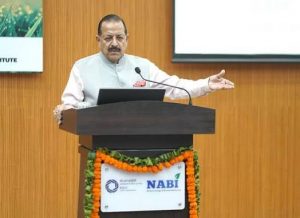
India’s first-of-its-kind Green Forge Complex was inaugurated at National Agri-food & Biomanufacturing Institute (BRIC-NABI) (an Autonomous Institute of the Department of Biotechnology) in Mohali, marking a major step in agricultural biotechnology and genetically modified (GM) crop research.
- The facility was inaugurated during the National Conclave on BioE3 (Biotechnology for Economy, Environment and Employment), 2026 reflecting India’s shift toward high-performance biomanufacturing.
- It provides advanced simulation chambers that can precisely regulate light, humidity, and temperature.
- This allows researchers to cultivate and experiment with GM crops to assess their suitability across varied and controlled environmental conditions before field deployment.
- The facility highlights the convergence of biotechnology with advanced simulation and Artificial Intelligence (AI), accelerating complex research in both agricultural and medical sciences.
- India’s bioeconomy has expanded from USD 10 billion in 2014 to approximately USD 200 billion, driven by private sector engagement and an enabling policy environment.
- Under BioE3 (Biotechnology for Economy, Environment and Employment) 2024 policy, the focus is shifting towards industry-ready manufacturing and translating research into products and technologies.
- The government is developing 22 biomanufacturing hubs and a National Bio-Foundry Network comprising eight specialized facilities to support start-ups, SMEs, and the translation of research into commercial products.
- The Department of Biotechnology (DBT) is actively supporting around 38 Carbon Capture and Utilisation (CCU) projects to capture emissions from hard-to-abate sectors like cement and steel through integrated biomanufacturing.
- The initiative is expanding into sustainable aviation fuels (SAF), the I3 PhD programme, and Space Biotechnology—including collaborations with ISRO on myogenesis and cyanobacteria growth experiments in space.
- BRIC-NABI is heavily integrating agri-biotechnology with bioprocess engineering to convert agricultural waste into high-value nutraceuticals (products derived from food sources that provide extra health and medical benefits besides basic nutrition) and biomaterials.
- The overall transformation toward a low-carbon, circular bioeconomy is directly aligned with India’s long-term climate and economic goals of achieving Net Zero by 2070 and Atmanirbhar Bharat.