
Planet Mercury:
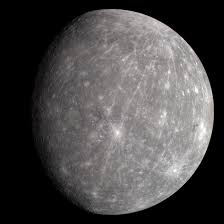
Mercury may have shrunk more than scientists previously estimated, with the planet’s diameter potentially reducing by as much as 23 km, a recent study has revealed.
- It is the smallest planet in our solar system and the nearest to the Sun.
- It is one of the four terrestrial (rocky) planets, along with Venus, Earth, and Mars.
- As the closest planet to the Sun, it experiences extreme temperature variations at its surface, from about +450ºC (day) down to –180ºC (night).
- However, Mercury is not the hottest planet; Venus has the highest average surface temperature because of its thick atmosphere and strong greenhouse effect.
- It has permanently shadowed regions at its poles that never see sunlight and thus enables ice to exist on its floor.
- Mercury’s ancient, cratered surface shows signs of past volcanic and tectonic activity and is heavily weathered by the harsh space environment.
- The planet has huge impact basins, including the Caloris Basin, one of the largest impact features in the solar system.
- Mercury has a large iron-rich core, which occupies a substantial portion of the planet’s interior.
- Its closeness to the Sun and its smallness make it the most elusive of the planets visible to the unaided eye.
- NASA’s MESSENGER spacecraft became the first spacecraft to orbit Mercury, entering orbit in 2011 and studying the planet until 2015.
- The BepiColombo mission, a joint mission of the European Space Agency (ESA) and Japan Aerospace Exploration Agency (JAXA), is studying Mercury and is expected to enter orbit in 2026.



