
Bhakra Dam : In News
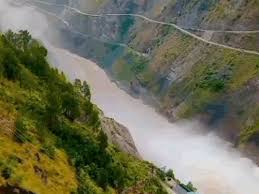
The Bhakra Beas Management Board (BBMB) recently commissioned an emergency study after detecting that the main wall of the Bhakra dam on the Sutlej river along the Punjab-Himachal Pradesh border is tilting outward beyond permissible limits.
- It is a concrete gravity dam across the Sutlej River.
- It is located at a gorge near the upstream Bhakra village in the Bilaspur district of Himachal Pradesh.
- It is near the border between Punjab and Himachal Pradesh.
- It is the highest straight gravity dam in the world, with a height of about 207.26 meters.
- It is Asia’s second tallest dam, next to the Tehri Dam.
- The Bhakra Dam is one of the earliest river valley development schemes undertaken by India after independence.
- The construction of this dam started in 1948, when Jawahar Lal Nehru, the first prime minister of India, poured the first bucket of concrete into the foundations of Bhakra.
- The dam was completed by the end of 1963.
- Bhakra Dam was described as the ‘New Temple of Resurgent India’ by Jawaharlal Nehru.
- Operation and maintenance of the Bhakra dam is done by the Bhakra Beas Management Board (BBMB).
- The dam created the massive Gobind Sagar reservoir and plays a crucial role in irrigation, flood control, and hydroelectric power generation for Punjab, Haryana, Rajasthan, Himachal Pradesh, and Chandigarh.
- It is the second largest reservoir in India, the first being Indira Sagar Dam in Madhya Pradesh with a capacity of 12.22 billion cu m.
- Nangal Dam is another dam downstream of Bhakra Sometimes both the dams together are called the Bhakra-Nangal Dam, though they are two separate dams.
- It serves as an auxiliary dam to channel the water released from Bhakra Dam to two powerhouses.
- The installed capacity of Bhakra Right Bank Power House is 785 MW, and that of Bhakra Left Bank Power House is 630 MW.



