
Blazar:
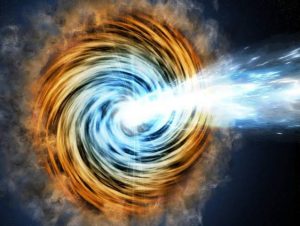
Astronomers tracked some of the blazars with the highest energy radiations revealing new clues about the sources of X-ray emission in these energetic objects.
- Blazars are among the most energetic objects in the Universe.
- They typically form in young galaxies or galaxies undergoing a collision.
- A blazar consists of a supermassive black hole, the accretion disk and the galaxy that hosts them.
- They are active galaxies powered by supermassive black holes at their centres, where matter falling towards the black hole releases large amounts of energy.
- These systems also emit high-speed particle jets directed close to Earth’s line of sight, making them appear exceptionally bright.
- A particularly extreme group of these objects are TeV blazars, which produce very-high-energy gamma rays reaching tera-electron volt energies.
- They are instrumental for exploring extreme physics that cannot be recreated on Earth.
- The relativistic jets they produce offer clues about how matter behaves near supermassive black holes.
- As the powerful jets from blazars are directed almost toward Earth, their X-ray spectra are generally dominated by emission from the jet.
- This makes it difficult to identify radiation from other parts of the galaxy, such as the accretion disk around the black hole.



