
EOS-05 Mission : Successfully Launched
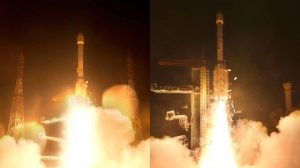
The Indian Space Research Organisation (ISRO) successfully launched the Earth Observation Satellite-05 (EOS-05) aboard the GSLV-F17 launch vehicle from the Satish Dhawan Space Centre, Sriharikota. This marks a major milestone as it is India’s first dedicated imaging satellite designed to operate from a geosynchronous orbit.
- EOS-05 Mission dubbed the “Eye in the Sky,” EOS-05 is a state-of-the-art Earth observation spacecraft equipped with advanced optical and infrared imaging payloads to provide continuous, real-time imagery.
- Weighing 2,367 kg, it represents the heaviest payload successfully injected into orbit by a standard GSLV configuration.
- The mission was executed by GSLV-F17, marking the 19th operational flight of India’s Geosynchronous Satellite Launch Vehicle.
- The GSLV is a three-stage launch vehicle. The first stage uses a solid core with four liquid strap-on boosters, followed by a liquid second stage and an indigenous cryogenic upper stage (CUS) for launching heavier payloads into deep transfer trajectories.
- Unlike conventional Earth observation satellites that circle close to the planet in Low Earth Orbit (LEO) with limited revisit windows, EOS-05 is India’s first dedicated imaging satellite designed to operate from a Geosynchronous Orbit (GEO), roughly 36,000 km above the Earth.
- GSLV-F17 precisely injected the spacecraft into a Sub-Geosynchronous Transfer Orbit (Sub-GTO).
- The satellite will progressively fire its onboard liquid apogee motor (LAM) over multiple orbit-raising maneuvers to reach its designated geostationary orbital slot over the Indian subcontinent.
- LEO imaging platforms pass over a specific area in minutes, leaving blind spots of hours or days before the next satellite passes. GEO provides continuous persistence and an unblinking, wide-area view.
- GEO imaging enables persistent, high-frequency tracking of rapidly evolving meteorological hazards, such as cloudbursts, cyclones, flash floods, and forest fires, where hourly updates are vital for disaster relief.



