
Epidermolysis Bullosa:
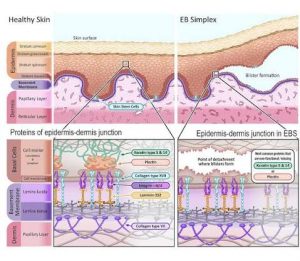
A medical college in Karnataka has received a ₹ 5.5-crore research grant from the Indian Council of Medical Research (ICMR) to develop affordable diagnostic and precision treatment approaches for epidermolysis bullosa (EB).
- Epidermolysis Bullosa is a rare genetic disorder that causes extreme skin fragility.
- It comprises a group of inherited disorders in which minor friction or trauma can cause blistering and wounds.
- Patients can develop chronic wounds, scarring, nutritional complications and an increased risk of skin cancer.
- There are four types of epidermolysis bullosa (EB), all caused by different genetic mutations:
- EB simplex (EBS)
- Junctional EB (JEB)
- Dystrophic EB (DEB)
- Kindler’s syndrome
- EB simplex is the mildest and most common form of EB, while Junctional EB and Dystrophic EB are relatively less common and affect the patient more severely. Kindler’s syndrome is a mix of the other types of EB.
- It is caused by an inherited gene. One may inherit the disease gene from one parent who has the disease (autosomal dominant inheritance) or from both parents (autosomal recessive inheritance).
- There’s currently no cure for EB, so treatment aims to relieve symptoms and prevent complications developing.



