
Flash Floods in Himalayas:
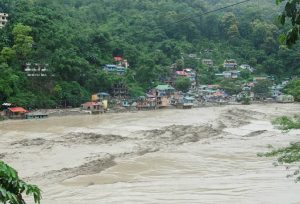
A sudden flash flood carrying dense mud, boulders, and debris swept through settlements along Nepal’s Budhi Gandaki River in Gorkha district, washing away over 35 homes and bridges.
- A flash flood is a sudden, rapid surge of water characterized by high peak discharges occurring within a very short timeframe—often under six hours—typically triggered by intense rainfall, cloudbursts, landslide-dam failures, or glacial outbursts.
- The Recent Nepal Flash Flood occurred on October 11 in Chumnubri village along the Budhi Gandaki River in Gorkha district.
- In the absence of heavy rainfall, the surge was likely triggered by the breach of an upstream landslide dam or an avalanche-induced blockage near Chekampar/Siuribas.
- The Indian Himalayan Region (IHR) is characterized by fractured bedrock, steep gradients, and high seismic sensitivity, making slopes prone to mass wasting.
- E.g., The 2021 Chamoli disaster in Uttarakhand, where a massive rock-and-ice slope detachment in the Rishiganga valley triggered a flash flood that destroyed downstream hydropower dams.
- Rapid glacial retreat in the high Himalayas creates fragile moraine-dammed lakes susceptible to catastrophic breach.
- E.g., The South Lhonak lake outburst in Sikkim triggering flash floods down the Teesta basin that destroyed the Chungthang dam.
- Localized Cloudburst Events in Micro-Catchments: Orographic lifting of monsoon winds causes concentrated, hyper-local cloudbursts along steep river valleys.
- E.g., The 2013 Kedarnath disaster, where extreme localized rainfall overwhelmed the Chorabari lake moraine and unleashed debris flows onto pilgrim settlements.
- Anthropogenic encroachment on narrow river channels leaves roads, tunnels, and human habitations directly in the path of debris flows.
- E.g., Flash flooding in Himachal Pradesh’s Beas river basin during 2023 washing away commercial properties and highways built on active riverbeds.
Causes of Flash Floods:
- Sudden Landslide Dam Outburst Floods (LDOFs): Heavy slope failures block narrow mountain gorges; the temporary debris dam pools water until hydrostatic pressure triggers a breach. E.g., Blockage of the Chumke Khola stream above Siuribas in Nepal breaking under water pressure to unleash the Budhi Gandaki surge.
- Loss ofCryospheric Cohesion: Global warming melts permafrost and interstitial glacial ice that naturally binds mountain bedrock and moraines together, causing slope collapses.E.g., Summer heatwaves accelerating moraine instability and rock avalanches across the high-altitude peaks of Ladakh and Uttarakhand.
- Massive Loose Sediment Mobilization: Pre-existing glacial deposits, moraines, and eroded gravel are picked up by surging water, transforming thin runoff into destructive, high-density slurry.E.g., Heavy boulder-and-gravel slurry visible in the Budhi Gandaki floodwaters exerting hydro-dynamic force that crushed reinforced concrete bridge pillars.
- Hydro-Meteorological Extremes: Intense convective precipitation dumping more than 100 mm of rain per hour over small catchment areas.E.g., Cloudburst-triggered flash floods sweeping through urban Leh (Ladakh) within hours in 2010.