
Gene-Edited Rice Varieties:
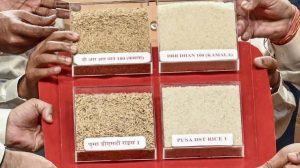
India developed two genome-edited rice varieties — DRR Dhan 100 (Kamala) and Pusa Rice DST1 and is set to release Pusa Rice DST1 for commercial production in the upcoming rabi season.
- Pusa DST Rice 1 is derived from MTU1010, which is suitable for rabi season in southern states.
- It is developed by Indian Council of Agricultural Research (ICAR)-Indian Agricultural Research Institute (IARI), New Delhi.
- The edit in its genome targets the Drought and Salt Tolerance (DST) gene, with the aim of improving the plant’s ability to cope with drought and salt-affected soils.
- It is expected to be grown in Andhra Pradesh, Telangana, Karnataka, Tamil Nadu, Kerala, Chhattisgarh, Odisha, Madhya Pradesh, Maharashtra, Jharkhand, Bihar, Uttar Pradesh and West Bengal.
- DRR Dhan 100 is also called Kamala variety.
- It was developed by ICAR-Indian Institute of Rice Research, Hyderabad, from the popular Samba Mahsuri (BPT 5204) variety.
- Scientists edited a gene involved in cytokinin metabolism, with the aim of increasing the number of grains produced by each panicle.
- The resulting variety is said to mature about 20 days earlier than Samba Mahsuri, in around 130 days, and has a stronger stalk that is less prone to lodging, or falling over.



