
Hidden Giant Exoplanet:
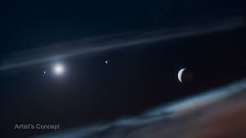
Astronomers using NASA’s James Webb Space Telescope (JWST) discovered a hidden giant exoplanet, Beta Pictoris d, in the well-studied Beta Pictoris star system, located 63 light-years from Earth in the Milky Way.
- Beta Pictoris is a young planetary system, around 23 million years old, providing insights into planetary formation and interactions between planets and the surrounding dust and debris disk.
- Before this discovery, the system was known to host two giant planets: Beta Pictoris b (one of the first directly imaged exoplanets) and Beta Pictoris c.
- With Beta Pictoris d, it became the second known planetary system with at least three directly imaged planets.
- Beta Pictoris d is a gas giant exoplanet, estimated to have at least twice the mass of Jupiter, making it the smallest of the three known giant planets in the system.
- It orbits its star at around 30 astronomical units (AU), comparable to Neptune’s distance from the Sun, and has the widest orbit among the three planets.
- It remained hidden for years as it lies within one of the brightest known debris disks, making conventional imaging difficult.
- Discovered accidentally using JWST’s Near-Infrared Spectrograph (NIRSpec) Integral Field Unit while studying Beta Pictoris b; spectroscopy revealed its chemical signature and motion.
- Carbon monoxide absorption lines and radial velocity analysis confirmed it as a planet, while follow-up observations using the Mid-Infrared Instrument (MIRI) detected water vapour and methane, confirming its atmosphere.
- It is the first directly imaged exoplanet discovered primarily through moderate-resolution spectroscopy, demonstrating a new method of detecting hidden planets through atmospheric chemical fingerprints.



