
Jaggery:
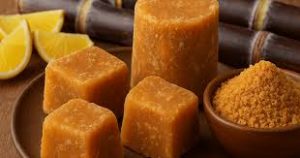
India accounts for over 70% of global jaggery production, firmly establishing itself as the world leader in natural sweeteners.
- Jaggery is commonly known as gur and is a traditional, unrefined, natural sweetener.
- It is produced by concentrating sugarcane juice without the use of chemicals.
- It retains essential minerals and micronutrients that are typically lost during the sugar-refining process.
- It retains minerals like calcium, magnesium, potassium, phosphorus, sodium, iron, zinc, copper, and manganese.
- It also contains trace amounts of vitamins, including folic acid and B-complex vitamins, as well as vitamins A, C, D, and E.
- India accounts for over 70 percent of global jaggery production. This makes it the world’s largest jaggery producer.
- Uttar Pradesh contributed 48.5 percent of total production, followed by Maharashtra (24.1 percent) and Karnataka (10.5 percent).
- Geographical Indication (GI) Tagged Jaggery Varieties in India:
- Kolhapur Jaggery (Maharashtra): It is valued for its golden colour and high sucrose content.
- Muzaffarnagar gur (Uttar Pradesh): It is export-oriented and made from high-quality cane.
- Marayoor and Central Travancore jiggery (Keralam): These are recognized for their purity, medicinal value, traditional processing and regional distinctiveness.



