
Mawmluh Cave:
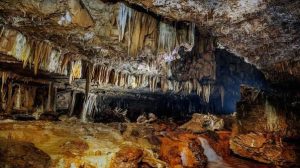
Climate change and mining are threatening Mawmluh Cave’s fragile cave systems, altering rainfall and groundwater patterns while destroying geological formations and underground ecosystems.
- Mawmluh Cave is located at Sohra in the East Khasi Hills district of Meghalaya.
- It is locally known as Krem Mawmluh.
- It was the first cave that was explored by a British official Lieutenant Yule in 1844.
- It is one of the longest and deepest caves in India and holds evidence of the events in the geological history of Earth.
- At 7.2 km in length, it is the fourth longest cave in the Indian subcontinent.
- The cave is part of the Meghalayan Age, the latest age in Earth’s official geological timeline, which began around 4,200 years ago and continues today.
- It is known for its stalagmite structures and other rock formations.
- It contains numerous stalactites, stalagmites, columns and drapes, collectively termed speleothems.
- In 2022, it was recognised among the First 100 Geological Heritage Sites by the International Union of Geological Sciences (IUGS).