
Musk Deer:
The Assam Police recovered six musk deer pods from two Arunachal Pradesh-based men during an operation near Guwahati.
- Musk deer (Moschidae) are small deer-like animals that belong to the family Moschidae.
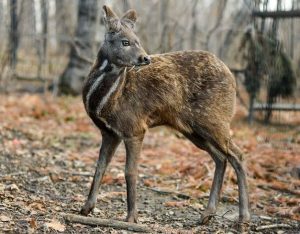
- Its coat is dark brown, mottled with paler, greyer hair underneath. It has whitish markings on its chin and ears.
- They typically inhabit forests and brushlands at intermediate elevations and rocky slopes at altitudes between 2,600 and 3,000 meters.
- They live in highland areas in central and northeastern Asia, particularly in western China, Myanmar and the Himalayas.
- They are shy, usually feeding at night, and tend to live alone, occasionally in pairs but never in herds.
- Musk deer lacks antlers.
- The animal has well-developed side toes that give it a sure-footedness and allow to scamper around rocks in the snow and even climb trees.
- Their diet includes both browse and graze, and they also consume some mosses and lichens
- A musk deer pod is a specialised scent gland found in the abdomen of a male musk deer.
- It produces a strong-smelling, reddish-brown secretion used in traditional perfumes and medicines.
- A musk gland in males produces a strong scent used for communication/territorial marking.
- Conservation Status:
- IUCN: Endangered
- CITES: Appendix I
- The Wildlife (Protection) Act of 1972: Schedule I



