
Nordic Countries:
In the fourth leg of his visit, the Prime Minister will reach Norway for the 3rd India-Nordic Summit and bilateral engagements.
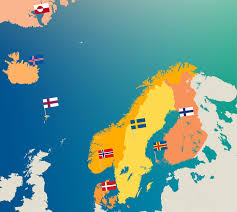
- The Nordic countries, also known as the Nordic region, are a group of countries in northern Europe consisting of Denmark, Finland, Iceland, Norway, and Sweden.
- The designation includes the Faroe Islands and Greenland, which are autonomous island regions of Denmark, and the Åland Islands, an autonomous island region of Finland.
- The term is sometimes used interchangeably with Scandinavia, a peninsular region of northern Europe that serves as the geographic core of the Nordic countries.
- Scandinavia is typically defined more restrictively, however, and refers primarily to Norway, Sweden, and Denmark.
- Sweden is the largest and most populous of the Nordic countries. Iceland is the least populous. Denmark is the smallest.
- The countries have many similarities in that they rank highly worldwide in such areas as education, civil liberties, quality of life, and economic competitiveness.
- Most inhabitants of the Nordic region speak North Germanic languages (also called Nordic or Scandinavian languages): Danish, Norwegian, and Swedish, as well as Faroese and Icelandic.
- Native non-Germanic languages include Greenlandic, Finnish, and Sami languages.
- Political System:
- Denmark, Sweden, and Norway are constitutional monarchies and parliamentary democracies.
- Finland and Iceland are democratic republics.
- Iceland’s parliament, the Althing, is the oldest parliament in the world.
- Cooperation:
- There is close cooperation between the countries through the Nordic Council and the Nordic Council of Ministers.
- Denmark, Sweden, and Finland are members of the European Union (EU).
- Norway and Iceland are European Economic Area (EEA) members.
- EEA includes EU countries and also Iceland, Liechtenstein, and Norway.