
Tokamaks for Nuclear Fusion:
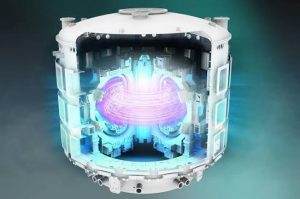
Bengaluru-based startup Pranos Fusion has unveiled PRAGYA, described as India’s first privately developed compact tokamak, marking a significant step in private-sector participation in the country’s nuclear fusion research.
- A tokamak (a Russian acronym for “toroidal chamber with magnetic coils”) is an experimental machine designed to harness fusion energy.
- Because no physical material on Earth can contain plasma heated to 150 million °C without instantly melting, a tokamak uses a ring-shaped (doughnut) vacuum vessel and powerful magnetic fields to suspend and confine the plasma in mid-air.
- It is the most researched fusion reactor design globally, serving as the basis for the International Thermonuclear Experimental Reactor (ITER) in France, of which India is a key member.
- The tokamak creates a highly stable “magnetic cage” to keep the plasma away from the walls by combining two magnetic fields:
- Toroidal Field: Generated by large external superconducting coils surrounding the chamber.
- Poloidal Field: Generated by inducing a massive electric current directly through the plasma itself.
- When fusion occurs, high-energy, uncharged neutrons escape the magnetic cage and strike the reactor’s inner wall.
- The inner wall is lined with a Lithium blanket. The kinetic energy of the neutrons heats the blanket (which boils water to spin electricity-generating turbines) and reacts with the lithium to breed fresh Tritium, ensuring the reactor sustains its own fuel supply.