
TRISHNA Satellite:
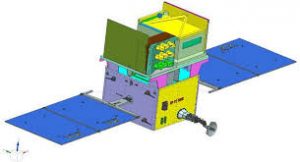
The Indo-French TRISHNA (Thermal Infra-Red Imaging Satellite for High-resolution Natural Resource Assessment) mission has entered an advanced stage of development, with ISRO expecting its launch within the next 12–16 months.
- TRISHNA is a joint Earth-observation mission of the Indian Space Research Organisation (ISRO) and France’s National Centre for Space Studies (CNES), aimed at high-resolution monitoring of Earth’s surface temperature, water resources and ecosystem dynamics.
- It will provide high spatial and temporal resolution data on surface temperature, emissivity, biophysical variables and radiation to support surface energy-budget assessment and sustainable natural resource management.
- The satellite will help monitor agricultural water use, irrigation efficiency, crop water stress, evapotranspiration, drought conditions, urban heat islands and ecosystem health, supporting climate studies and water-resource planning.
- Payloads: The satellite will carry two primary payloads:
- Thermal Infra-Red (TIR): Developed by CNES, France, to measure Earth’s surface thermal emissions.
- Visible-Near Infra-Red and Short-Wave Infra-Red (VNIR-SWIR): Developed by ISRO, to observe surface characteristics and vegetation conditions.
- Launch Vehicle: TRISHNA is planned to be launched using India’s Polar Satellite Launch Vehicle (PSLV).
- India–France Cooperation: TRISHNA is the third joint satellite mission following Megha-Tropiques and SARAL. ISRO is responsible for the satellite bus and VNIR-SWIR payload, while CNES provides the TIR payload. Scientific data will be processed jointly by India and France.