
Western Hoolock Gibbon:
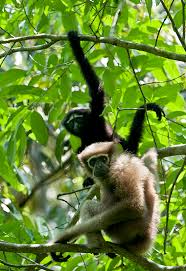
In a first, a male Western Hoolock Gibbon housed in the Hollongapar Gibbon Sanctuary in Assam’s Jorhat district crossed the canopy bridges installed over a railway line passing through the sanctuary.
- Western Hoolock Gibbon is the smallest and fastest of all apes.
- It is found in a range of forest types, from moist deciduous to evergreen, sub-tropical to lowland.
- It is found in all the states of the north-east, restricted between the south of the Brahmaputra river and east of the Dibang river. Outside India, it is found in Bangladesh and Myanmar.
- Characteristics of Western Hoolock Gibbon:
- They are diurnal and arboreal, brachiating through the trees with their long arms.
- They are monogamous (same partner throughout life).
- They live in small families and communicate with other gibbons by vocalisation.
- Life span: 25 years.
- Threats: Habitat destruction illegal logging presented the greatest threat.
- Conservation Status
- IUCN: Endangered
- Wildlife (Protection) Act of India, 1972: Schedule I



