
What is Psoriasis?
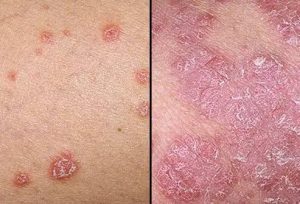
Patients with psoriasis have an increased risk for cataracts and cataract surgery, with the risks for these outcomes varying by treatment modality, according to a recent study.
- Psoriasis is a chronic autoimmune condition that causes the rapid buildup of skin cells.
- This buildup of cells causes scaling on your skin’s surface.
- It causes a rash with itchy, scaly patches, most commonly on the knees, elbows, trunk, and scalp.
- It can be painful, interfere with sleep, and make it hard to concentrate.
- The cause of psoriasis is not fully understood. It is believed to be caused by genetics, the immune system, and the environment.
- Psoriasis occurs because the overactive immune system speeds up skin cell growth.
- Normal skin cells completely grow and shed (fall off) in a month.
- With psoriasis, skin cells do this in only three or four days. Instead of shedding, the skin cells pile up on the surface of the skin.
- Treatment: It has no cure. Treatments aim to:
- reduce inflammation and scales;
- slow the growth of skin cells;
- remove plaques;
- Common psoriasis treatments include:
- Steroid creams.
- Moisturizers for dry skin.
- Medication to slow skin cell production (anthralin).
- Medicated lotions or shampoos.
- Vitamin D3 ointment.
- Vitamin A or retinoid creams.