
Zwan-Wolf Effect:
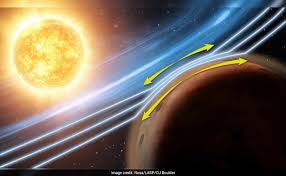
NASA’s MAVEN spacecraft recently recorded something Mars has never shown before, which is the Zwan-Wolf effect.
- Zwan-Wolf Effect is a process where charged particles are squeezed along magnetic structures, known as flux tubes.
- The Zwan-Wolf effect was discovered in 1976 and has so far only been observed in planetary magnetospheres and not their atmospheres.
- The solar wind is a stream of charged particles flowing outwards from the sun.
- As the solar wind nears the magnetic field of a planet, it becomes compressed near the magnetic boundaries.
- This creates a difference in pressure, or pressure gradient, that squeezes the charged particles along the magnetic field, away from the stream.
- As a result, closer to the stream is an area with a lower density of charged particles. This is called the Zwan-Wolf effect.
- On Earth, this mechanism deflects much of the solar wind and protects us from the Sun’s constant bombardment.
New Findings Important:
- Unlike Earth, Mars is not protected by a global magnetic field, affecting how it interacts with the solar wind and space weather.
- The Zwan-Wolf effect was observed in the ionosphere — deep within the Martian atmosphere below 200 km — which contains significant numbers of electrically charged particles.
- The data showed that these charged particles were being squeezed and distributed around Mars’ atmosphere.
- It suggests that Mars, despite lacking a global magnetic field, experiences similar interactions with the solar wind, offering valuable insights into the planet’s atmospheric dynamics.
MAVEN Spacecraft:
- Mars Atmosphere and Volatile EvolutioN (MAVEN) is the first spacecraft mission dedicated to surveying the upper atmosphere of Mars.
- It is part of NASA’s Mars Exploration Program.
- It aims to understand the role that loss of atmospheric gas to space played in changing the Martian climate over time.
- It was launched in 2013 and arrived at Mars in 2014.
- It carries three packages of instruments:
- One package studies the solar wind and its impact on Mars’s ionosphere. (Since Mars has no magnetic field, its atmosphere would be slowly removed by interaction with the solar wind.)
- The second package is an ultraviolet spectrometer that studies the upper atmosphere.
- The third package is a mass spectrometer that studies the composition of the upper atmosphere.
- MAVEN found that Mars lost about 2/3 of its early atmosphere to space.



