
Today’s Current Affairs: 29th Aug 2026 for UPSC IAS exams, State PSC exams, SSC CGL, State SSC, RRB, Railways, Banking Exam & IBPS, etc
Fourth Meeting of the India–Argentina Joint Trade Committee:

The Fourth Meeting of the India–Argentina Joint Trade Committee (JTC) was held at Palacio San Martín, Buenos Aires.
- Argentina is a large country occupying the southern part of South America.
- It shares its borders with 5 countries: Chile (south and west), Bolivia and Paraguay (north), and Brazil, Uruguay (east)
- It is also bounded by the South Atlantic Ocean to the east and the Drake Passage to the south.
- Capital City: Buenos Aires
Epidermolysis Bullosa:

A medical college in Karnataka has received a ₹ 5.5-crore research grant from the Indian Council of Medical Research (ICMR) to develop affordable diagnostic and precision treatment approaches for epidermolysis bullosa (EB).
- Epidermolysis Bullosa is a rare genetic disorder that causes extreme skin fragility.
- It comprises a group of inherited disorders in which minor friction or trauma can cause blistering and wounds.
- Patients can develop chronic wounds, scarring, nutritional complications and an increased risk of skin cancer.
- There are four types of epidermolysis bullosa (EB), all caused by different genetic mutations:
- EB simplex (EBS)
- Junctional EB (JEB)
- Dystrophic EB (DEB)
- Kindler’s syndrome
- EB simplex is the mildest and most common form of EB, while Junctional EB and Dystrophic EB are relatively less common and affect the patient more severely. Kindler’s syndrome is a mix of the other types of EB.
- It is caused by an inherited gene. One may inherit the disease gene from one parent who has the disease (autosomal dominant inheritance) or from both parents (autosomal recessive inheritance).
- There’s currently no cure for EB, so treatment aims to relieve symptoms and prevent complications developing.
12 Years of Pradhan Mantri Jan Dhan Yojana:
The Pradhan Mantri Jan Dhan Yojana (PM-JDY), the Government of India’s flagship National Mission for Financial Inclusion, has completed 12 years of implementation (2014–2026), marking a systemic shift in expanding formal banking, credit, digital payments, and social security across India.
- PMJDY has transformed financial inclusion in India, reaching 59.09 crore accounts by August 2026, while expanding access to savings, credit, insurance, pensions and DBT through the JAM framework.
- The next phase must focus on financial deepening, addressing dormant accounts, digital and biometric exclusion, limited overdraft access and cash-heavy usage through stronger last-mile technology, financial literacy, Bank Mitra networks and behavioural nudges.
- Pradhan Mantri Jan Dhan Yojana (PMJDY) launched in August 2014, PMJDY aims to ensure access to financial services, namely, basic savings & deposit accounts, remittance, credit, insurance, pension in an affordable manner.
- Under the scheme, a basic savings bank deposit (BSBD) account can be opened in any bank branch or Business Correspondent (Bank Mitra) outlet, by persons not having any other account.
- PMJDY operates under the Department of Financial Services within the Ministry of Finance.
- In 2018, the scheme transformed its strategic target from “every household” to “every unbanked adult”, expanding coverage to individuals within families.
- Beneficiaries can open a BSBD account without depositing any initial amount and are not penalized for maintaining a zero balance.
- Deposits kept in PMJDY accounts earn standard savings account interest rates, incentivizing the habit of saving.
- Enables individuals without formal documents to open a basic bank account. It is valid for 12 months and can be extended by another 12 months upon providing proof of having applied for an Officially Valid Document (OVD).
- Account holders receive a domestic RuPay debit card, enabling them to withdraw cash from ATMs and make digital payments (PoS/e-commerce).
- The RuPay card comes with a free accident insurance cover of Rs 2 lakh (for accounts opened after August 28, 2018). Accounts opened before this date have a Rs 1 lakh cover.
- The National Payments Corporation of India (NPCI) pays the premium.
- To address emergency financial needs, an overdraft facility of up to Rs 10,000 is available to one account holder per household (preferably a woman) after six months of satisfactory account operation.
- PMJDY accounts are eligible for Direct Benefit Transfer (DBT), Pradhan Mantri Jeevan Jyoti Bima Yojana (PMJJBY), Pradhan Mantri Suraksha Bima Yojana (PMSBY), Atal Pension Yojana (APY), and Micro Units Development & Refinance Agency Bank (MUDRA) scheme.
United Nations Convention to Combat Desertification: COP17
The 17th session of the Conference of the Parties (COP17) to the United Nations Convention to Combat Desertification (UNCCD) concluded in Ulaanbaatar, Mongolia, bringing together governments, scientists, civil society and pastoralist communities to address the interconnected challenges of desertification, land degradation and drought.
- Egypt will host the 18th session of the UNCCD COP (COP18) in Sharm El-Sheikh in 2028.
- UNCCD COP17 focused on tackling desertification, land degradation and drought, with emphasis on rangelands, pastoral communities, drought resilience, nature-based solutions and innovative finance.
- India highlighted community-led and science-based land restoration, predictable climate finance and conservation of Open Natural Ecosystems (ONEs), while advancing its Land Degradation Neutrality efforts.
Key Highlights of UNCCD COP17
- Theme and Focus: The UNCCD COP17 was hosted under the theme “Restoring Land. Restoring Hope.” It emphasized that land restoration is not just an environmental agenda but a core priority for food security, livelihood generation, and preventing forced human displacement.
- COP17 coincided with the United Nations International Year of Rangelands and Pastoralists (IYRP 2026), which was championed by the host country, Mongolia.
- The conference spotlighted the needs of pastoral communities who depend directly on these ecosystems.
- The convention noted the severe state of global land resources, highlighting that land degradation currently affects up to 40% of the world’s land surface, severely impacting water availability and economic stability.
- Being one of the most affected countries (nearly 77% of its land is degraded), Mongolia showcased its commitment through its national “Billion Trees” campaign ( initiated in 2021) aiming to plant one billion trees by 2030.
- COP17 focused on scaling Ecosystem-based Adaptation (EbA) and financing nature-based solutions to integrate ecosystem-related mechanisms into national planning and infrastructure development.
- Drought Resilience Index (DRI) Launched as the world’s first comprehensive technical tool, it uses AI-powered analytics and vulnerability mapping to assess countries’ capacity to anticipate, prepare for and adapt to droughts, enabling a shift from reactive relief to proactive preparedness and guiding data-driven investments.
- Drought Resilience Investment Facility (DRIF) Launched by the UNCCD and Luxembourg as the world’s first global catalytic financing platform, it uses public funds to de-risk investments and mobilise private and institutional finance for drought resilience, water security, climate-resilient agriculture and land restoration.
- The conference announced USD 1.3 billion in new and pipeline financing to scale up land restoration and strengthen drought resilience for vulnerable countries.
- Countries failed to agree on a legally binding global drought treaty, despite worsening droughts and a USD 278 billion annual resilience finance gap, deferring the issue to the next round of negotiations.
- A global drought framework would require countries to develop national drought plans and establish shared early-warning, monitoring and data-sharing systems covering rainfall, soil moisture, vulnerability and risk.
- It would create mechanisms to mobilise finance for drought resilience and land restoration.
- COP17 decided to make drought a standalone agenda item from COP18 onwards, ensuring its regular consideration rather than ad-hoc treatment.
Sarnath’s Path to the World Heritage List:
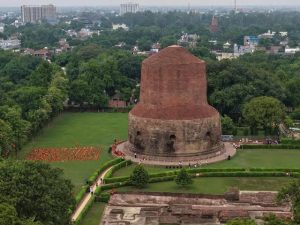
The Ancient Buddhist Site of Sarnath has been inscribed on the UNESCO World Heritage List during the 48th Session of the World Heritage Committee held in Busan, South Korea.With this recognition, India’s UNESCO World Heritage properties have increased to 45, making India the 6th largest country globally in terms of World Heritage properties and 2nd in the Asia-Pacific region.
- Sarnath, located in Varanasi, Uttar Pradesh, is one of the four major Buddhist pilgrimage sites. It is associated with Gautama Buddha’s first sermon after attaining enlightenment.
- The UNESCO World Heritage inscription includes two components — Chaukhandi Stupa and the Archaeological Remains of Sarnath. The archaeological complex contains important structures such as the Dhamek Stupa, Dharmarajika Stupa, Mulagandhakuti Vihara, and Ashokan Pillar.
- Known as Rishipatana, Ishipatana, and Mrigadava in Buddhist texts, Sarnath is the place where Buddha delivered the Dharmachakra Pravartana (Turning of the Wheel of the Law) sermon in the 6th century BCE, leading to the establishment of the Buddhist Sangha and teachings of the Noble Eightfold Path.
- The site reflects nearly 16 centuries of continuous development, with monuments ranging from the Pre-Mauryan period (4th–3rd century BCE) to the 12th century CE.
- It developed through the patronage of rulers, monasteries, and devotees before declining and later being rediscovered in the 18th century.
- Sarnath was included in India’s Tentative List of UNESCO World Heritage Sites in 1998. The nomination proposal was submitted to UNESCO in January 2025, followed by technical evaluation and review by UNESCO advisory bodies.
- UNESCO Criteria for Inscription: Sarnath was inscribed under Criteria (iii) and (vi) of the UNESCO World Heritage List:
- Criterion (iii): Recognises its enduring spiritual importance as one of the four principal Buddhist pilgrimage sites.
- Criterion (vi): Recognises its direct association with significant events in Buddha’s life, including his first sermon and meeting with his first five disciples.
- Sarnath remains a major global pilgrimage destination for Buddhists from countries such as Japan, Thailand, Sri Lanka, Myanmar, Vietnam, South Korea, Cambodia, and Mongolia, strengthening India’s cultural diplomacy.
- With Sarnath’s inclusion, three of the four major Buddhist pilgrimage sites associated with Buddha are now on the UNESCO World Heritage List:
- Lumbini (Nepal) – Birthplace of Buddha
- Mahabodhi Temple, Bodh Gaya (Bihar) – Place of Enlightenment
- Sarnath (Uttar Pradesh) – Place of First Sermon



