
Today’s Current Affairs: 16th February 2026 for UPSC IAS exams, State PSC exams, SSC CGL, State SSC, RRB, Railways, Banking Exam & IBPS, etc
Table of Contents
Spot-bellied Eagle-Owl:
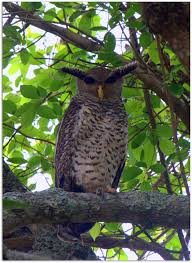
A rare and mysterious night bird, the Spot-bellied Eagle-Owl, known as the ‘Ghost of the Forest’, was recently caught on camera in Uttarakhand’s Corbett Reserve.
- The spot-bellied eagle-owl, also known as the forest eagle-owl, is a large bird of prey with a formidable appearance.
- Scientific Name: Ketupa nipalensis
- It is commonly found in India, Sri Lanka, Nepal, Bhutan, Bangladesh, and parts of Southeast Asia.
- It can be found in a variety of habitats, including tropical and subtropical forests, woodlands, and savannas.
- It is one of the longest owls in the world.
- The most distinguishing feature is its striking colouration. The upper parts of its body are a rich chocolate brown, speckled with white spots.
- It is primarily nocturnal.
- It is a solitary bird that is territorial and maintains a home range.
- It is famous for its strange, human-like calls.
- Conservation Status: IUCN Red List: Least Concern.
Exposome:
Scientists are launching an ambitious global effort to map the “human exposome” — the lifelong mix of environmental and chemical exposures that drive most diseases.
- It can be defined as the measure of all the exposures of an individual in a lifetime, from conception onward and how those exposures relate to health.
- The International Human Exposome Network (IHEN) defines the exposome as the “integrated compilation of all physical, chemical, biological, and psychosocial factors, and their interactions.”
- It reveals the accumulated lifetime exposures that determine our health, wellness, and susceptibility to disease.
- This is shaped by internal exposures such as individual metabolism or the microbiome, as well as external factors such as air quality.
- It also involves social or behavioral decisions that influence nutrition and exercise.
- Exposomics is the study of the exposome and relies on the application of internal and external exposure assessment methods
- Internal exposure assessment relies on fields of study such as genomics, metabonomics, lipidomics, transcriptomics, and proteomics.
- Commonalities of these fields include:
- use of biomarkers to determine exposure, effect of exposure, disease progression, and susceptibility factors
- use of technologies that result in large amounts of data and
- use of data mining techniques to find statistical associations between exposures, effect of exposures, and other factors such as genetics with disease.
- External exposure assessment relies on measuring environmental stressors.
- Common approaches include using direct reading instruments, laboratory-based analysis, and survey instruments.
Leiogalathea samudragiri:
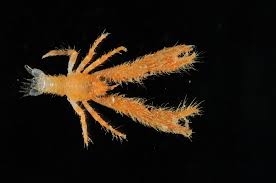
Researchers recently discovered a new species of squat lobster named Leiogalathea samudragiri off Lakshadweep’s coast.
- It is a new species of squat lobster.
- It was found in the Lakshadweep archipelago.
- Squat Lobsters are marine crustaceans that resemble small lobsters but are not true lobsters.
- They are more closely related to hermit crabs and porcelain crabs.
- They can be found in nearly every marine environment across most latitudes around the world.
- The lobsters earned their name by tucking their tails under their thorax, giving their bodies a shorter, more “squat” appearance.
- As with many other crustaceans, squat lobsters can use their tail as a paddle to escape backwards very quickly.
African Union hosted its annual summit in Ethiopia:

The African Union hosted its annual summit in Ethiopia.
- It is a continental body consisting of the 55 member states that make up the countries of the African Continent.
- It was officially launched in 2002 and replaced its predecessor, the Organization of African Unity (OAU), which was founded in 1963.
- Primary Objective is to promote unity, cooperation, and development among African nations while advancing the continent’s interests on the global stage.
- Headquarters: Addis Ababa, Ethiopia
- Governance of African Union:
- Assembly: It is the highest decision-making body, consisting of the heads of state and government of member countries.
- Executive Council: Made up of foreign affairs ministers, handles policy matters and makes recommendations to the Assembly.
- AU Commission: Headquartered in Addis Ababa, is the administrative arm responsible for implementing the decisions of the Assembly and the Executive Council.
- The Peace and Security Council: Responsible for maintaining peace and security on the continent.
- The AU structure promotes the participation of African citizens and civil society through the Pan-African Parliament and the Economic, Social & Cultural Council (ECOSOCC).
Piton de la Fournaise Volcano:

The Piton de la Fournaise volcano on Reunion Island erupted for the second time this year.
- Piton de la Fournaise Volcano occupies the east-southeastern end of French Island La Réunion in the western Indian Ocean.
- It is a massive basaltic shield volcano.
- It is one of the most active volcanoes in the world.
- It is in a phase of frequent but short-lived eruptions that start with lava fountains and produce large lava flows.
- It has been a member of the prestigious club of natural treasures listed as World Heritage sites by UNESCO.
- Shield Volcano are the largest volcanoes on Earth.
- They do not form soaring mountains with conical peaks like composite volcanoes. Instead, they are broad volcanoes with gentle slopes.
- They are almost exclusively basalt, a type of lava that is very fluid when erupted.
- Because basalt has a low viscosity, it can flow on the surface better. So, when these types of volcanoes erupt, lava flows outwards at large distances.
- They are built by repeated eruptions that occurred intermittently over vast periods of time.
- The Hawaiian shield volcanoes are the most famous examples.
Bio-based Chemicals:

India has prioritised bio-based chemicals and enzymes as a priority area under the Department of Biotechnology’s BioE3 policy.
- Bio-based chemicals are industrial chemicals produced using biological feedstocks like sugarcane, corn, starch or biomass residues.
- These are often produced through fermentation or enzymatic processes.
- Examples: Organic acids (such as lactic acid), bio-alcohols, solvents, surfactants, and intermediates used in plastics, cosmetics, and pharmaceuticals.
- Unlike conventional chemicals, for which the largely available supplies are obtained through sources of fossil fuel, bio-based alternatives reflect a sustainable solution.
- The bio-based industry reduces reliance on fossil fuels by applying renewable feedstocks.
- Biobased methods generate much lower amounts of hazardous waste than the conventional petroleum-based methodologies.
- The production of biochemicals generally requires less energy than their corresponding petroleum-based equivalents.
Waste Minimization and Circular Economy: With bio-based chemicals mostly coming from organic waste resources, development of the circular economy will be based on recycling, efficiency in the use of resources. - Higher production cost compared to petrochemical alternative, which creates entry level barrier.
- Availability of reliable feedstocks and supporting infrastructure required to produce different categories of bio-based chemicals at scale.
- Uncertainty about adapting bio-based chemicals as substitute over fossil fuel based chemicals.
Futala Lake:
Futala Lake, an iconic water body in the city, continues to grapple with untreated sewage inflow and mounting filth along its banks.Futala Lake, also known as Telankhedi Lake, is a man-made lake located in the western part of Nagpur, Maharashtra.It was created during the Bhonsle dynasty rule in the 18th century for the purpose of providing water to the nearby villages and farmlands.This lake is known for its colorful fountains.
Country’s First Underwater Road-cum-Rail Tunnel under Brahmaputra River:
The Cabinet Committee on Economic Affairs (CCEA) has approved India’s first underwater road-cum-rail tunnel under the Brahmaputra River in Assam at a cost of ₹18,662 crore.A 33.7 km four-lane access-controlled Greenfield connectivity project, including a 15.79 km twin-tube underwater tunnel beneath the Brahmaputra River in Assam.It will connect Gohpur (NH-15) and Numaligarh (NH-715), reducing distance from 240 km to 34 km.The Brahmaputra River is one of the largest rivers of Central and South Asia and ranks among the world’s top rivers in terms of average discharge.
Central Bank Digital Currency (CBDC)-based Public Distribution System (PDS):
The Union Home Minister launched India’s first Central Bank Digital Currency (CBDC)-based Public Distribution System (PDS) in Gandhinagar, Gujarat.The CBDC-based PDS is a digitally enabled ration distribution system that integrates Central Bank Digital Currency into the Public Distribution System to ensure secure and transparent food grain delivery.Organisations Involved: Ministry of Consumer Affairs, Food and Public Distribution – Nodal ministry overseeing PDS reforms and implementation.Reserve Bank of India (RBI) – Issuer of the Central Bank Digital Currency (Digital Rupee). Aim is to eliminate corruption and leakages in ration distribution,to operationalise the vision of “Minimum Government, Maximum Governance” in welfare delivery,to ensure secure, efficient, and transparent access to subsidised food grains.



