
Giant’s Causeway:
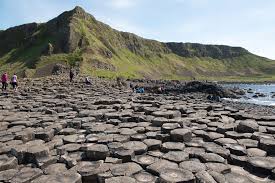
Geochronologists, investigating how the Giant’s Causeway was created, recently discovered it was formed over 5.5m years, 8m years less than previously estimated.
- It is located on the coastal edge of the Antrim Plateau in Northern Ireland.
- The region consists of 6 kilometers (4 miles) of stepping-stone-like black basalt columns.
- Each stone is a curiously distinct polygon or hexagon, with seemingly unnatural straight edges.
- The pillars range in height, and shoot up out of the sea, increasing in height until they reach the cliff top.
- This stepping stone or stair-like appearance of the area is where the Giant’s Causeway name is thought to have originated, as the columns look much like steps for a giant.
- It was declared a UNESCO World Heritage Site in 1986.
- The rock and column formations were first formed some 50 to 60 million years ago, during the Paleogene Period.
- The columns originally formed due to extensive volcanic activity in the area.
- Molten basalt rose up through a layer of chalk beds, creating what is known as a volcanic plateau.
- The lava then began to cool and contract, which caused fractures and edges within the rock.
- As the lava flow continued to cool, it receded, leaving behind tall column shapes.
- Because the lava cooled very quickly, it receded a great deal, leaving behind particularly prominent and large columns.



