
SpudCell: Lab-made Synthetic Cell
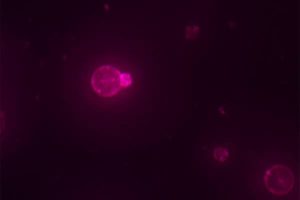
Researchers in the US have achieved a major milestone in synthetic biology by developing SpudCell, a lab-made synthetic cell built entirely from non-living chemical components that can grow, replicate its DNA, divide, and undergo evolutionary selection.
- Unlike traditional genetic engineering that modifies existing living organisms, this artificial cell was built entirely from scratch using lifeless chemicals, starting with a basic artificial fat bubble (liposome) acting as the cell membrane.
- The synthetic cell houses a specialized, cell-free chemical mixture (PURE system) that successfully translates a minimal, custom-made genetic code (90,000 base-pair DNA genome) into working proteins.
- The cell’s DNA instructs it to create a molecular “hook” (alpha-hemolysin protein) on its surface, allowing it to capture and fuse with smaller nutrient bubbles to absorb the lipids and materials it needs to expand.
- As the cell grows in size, it utilizes a specific copying enzyme to accurately duplicate its entire genetic blueprint.
- Instead of relying on a complex internal structural network (cytoskeleton) like natural cells, scientists engineered the cell to divide into two daughter cells using simple physical pressure and mechanical stress created by proteins crowding its outer surface.
- SpudCell shows life-like behaviour, but it is not a fully living or autonomous organism. It needs external supply of food and ribosomes and cannot sustain itself like a natural cell.
- The experiment successfully proved that artificial systems can undergo natural selection; when researchers introduced a genetic mutation that allowed some cells to feed faster, these efficient variants reproduced quicker and eventually outcompeted the original population.
Significance: This is a landmark achievement in Synthetic Biology. It proves that basic life processes can be chemically engineered from non-living matter.
This technology holds immense future applications for precision medicine (like programmable drug delivery systems), sustainable industrial biomanufacturing, and creating artificial organisms for environmental cleanup.



