
Agreement on Sardar Sarovar Project Financial Disputes:
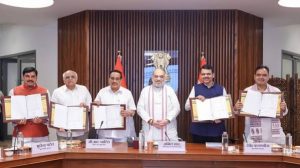
In a landmark development for cooperative federalism, the states of Maharashtra, Gujarat, Rajasthan, and Madhya Pradesh have signed a one-time settlement agreement to resolve decades-old financial disputes concerning the cost-sharing and pending dues of the Sardar Sarovar Project (SSP).
- The agreement resolves complex financial conflicts including cost-sharing of the Sardar Sarovar and Indira Sagar projects, Resettlement and Rehabilitation (R&R) expenditures for displaced communities, and the massive interest burden on construction-phase borrowings.
- In a move to facilitate closure, Gujarat agreed to increase its share of project costs to 75% (up from 50%), effectively reducing the financial burden on Madhya Pradesh.
- Sardar Sarovar Project (SSP) is a terminal gravity dam built on the Narmada River near Navagam, Gujarat.
- Located near the Statue of Unity, the Sardar Sarovar Dam is the largest major dam planned on the Narmada and one of the world’s largest concrete gravity dams by volume of concrete used.
- The idea of harnessing the Narmada River was envisioned by Sardar Vallabhbhai Patel in 1946, and the project gained momentum when Prime Minister Jawaharlal Nehru laid the foundation stone in 1961.
- The SSP is one of the largest water resource projects in India, covering four major states Maharashtra, Madhya Pradesh, Gujarat, and Rajasthan.
- It provides critical irrigation, drinking water, and hydropower. The project has transformed arid and drought-prone regions, particularly in Rajasthan and Gujarat, significantly enhancing agricultural productivity and skyrocketing land values.
- Narmada Water Disputes Tribunal (NWDT) constituted in 1969 under the Inter-State River Water Disputes Act, 1956, delivered its final award in 1979, determining the water and power-sharing arrangements among the four beneficiary States.
- While these allocations were largely settled, disputes over land compensation, rehabilitation costs, and shared infrastructure expenses persisted for decades.
- Narmada River is the largest river of Central India and Gujarat, originates from the Amarkantak Plateau in Madhya Pradesh and flows into the Arabian Sea through the Gulf of Khambhat (Cambay) in Gujarat.
- Spanning 1,312 km across Madhya Pradesh, Maharashtra, and Gujarat, it drains a vast basin of about 98,800 sq. km, making it one of India’s most important west-flowing rivers.



