
Dung Beetle:
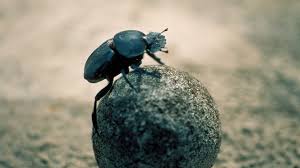
Scientists have discovered that dung beetles roll in remarkably straight lines—even in complete darkness by using the band of light created by our galaxy, the Milky Way.
- The Dung Beetle is scientifically known as the Scarabaeidae family within the Animal Kingdom’s order Coleoptera.
- They are robust, compact insects known for their hard, protective exoskeletons and strong, clawed legs adapted for digging and rolling dung.
- They vary in color, with some species displaying dull, black or brown hues, while others exhibit metallic shades of blue, green, or copper.
- Dung beetles are found worldwide, on every continent except Antarctica.
- They live in habitats that range from desert to forest.
- They feed on the feces of large herbivores during both their larval and adult stages.
- Dung beetles span three main lifestyles: rollers (ball-makers), tunnelers (bury beneath), and dwellers (live in the pat).
- Several dung beetles navigate using celestial cues; some use the Milky Way as an orientation reference during straight-line rolling.
- Many scarabs have fan-like (lamellate) antennae that open to sample odors-useful for locating fresh dung fast.
- They play major ecological roles in nutrient cycling, soil aeration, seed dispersal, and parasite/flies suppression.



